
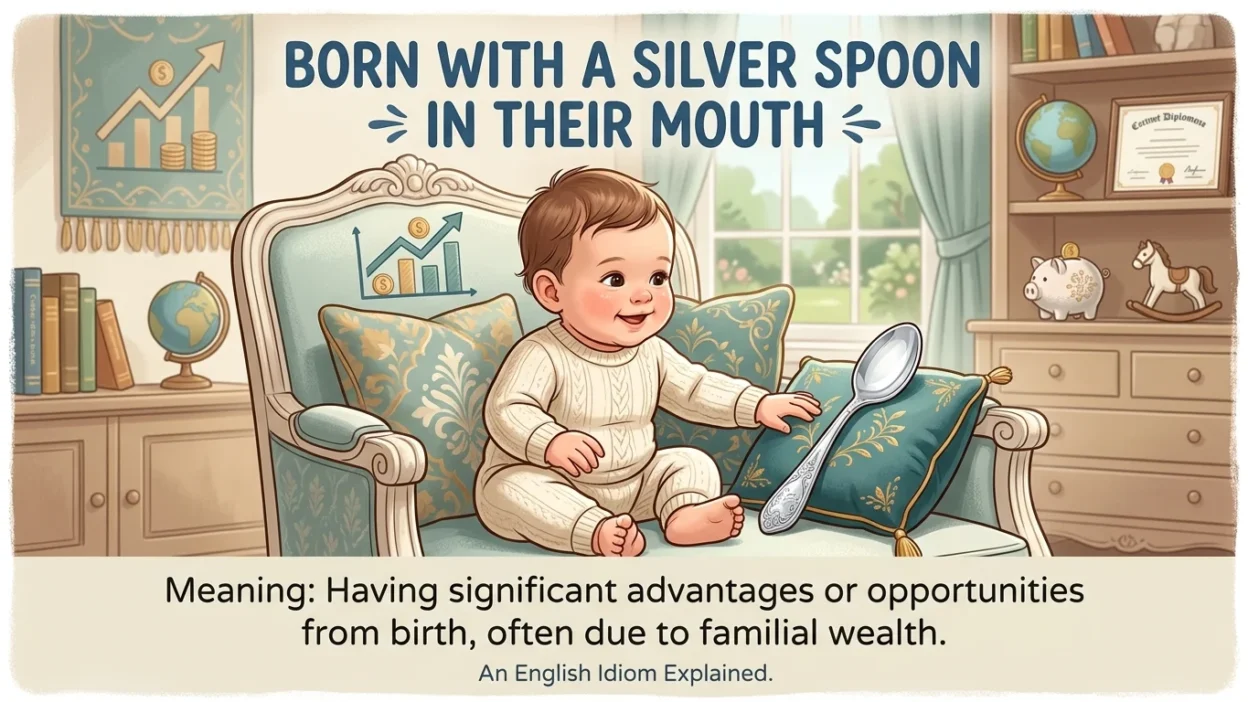
“Born with a silver spoon in their mouth” is a common English idiom used to describe someone who was born into a wealthy, privileged, or financially comfortable family.
The expression suggests that a person has had advantages, opportunities, and financial security from birth, rather than having to struggle to obtain them.
Quick Answer
“Born with a silver spoon in their mouth” means born into a wealthy or privileged family.
She was born with a silver spoon in her mouth.
This means she was born into a family with money, wealth, or social advantages.
The phrase is often used when discussing privilege, wealth, family background, or opportunities.
What Does “Born With a Silver Spoon in Their Mouth” Mean?
The idiom describes someone who is born into favorable circumstances, especially financial wealth.
A person who is born with a silver spoon in their mouth may have:
- Wealthy parents
- Financial security
- Access to better education
- Family connections
- Comfortable living conditions
- Greater opportunities
- Inherited wealth or property
For example:
He never had to worry about money because he was born with a silver spoon in his mouth.
The sentence suggests that his family was wealthy enough to provide him with financial security.
What Does “Silver Spoon” Mean?
A silver spoon is a literal spoon made of silver, but in this idiom it represents wealth and privilege.
Historically, silver objects were expensive and were often associated with wealthy families.
Therefore, someone who was supposedly born with a silver spoon already had access to valuable things from birth.
The expression is not meant literally.
Origin of “Born With a Silver Spoon in Their Mouth”
The exact origin of the expression is difficult to pinpoint, but the idea of a silver spoon representing wealth and social status has a long history.
Silver spoons were valuable possessions, especially in earlier periods when silver objects were expensive. Wealthy families could afford silver tableware, while poorer families generally could not.
The expression developed from the idea that a child born into wealth would metaphorically have a silver spoon waiting for them from birth.
The phrase eventually became a way to describe someone who inherits advantages simply because of the family into which they were born.
Is “Born With a Silver Spoon in Their Mouth” an Idiom?
Yes.
“Born with a silver spoon in their mouth” is an idiomatic expression.
It does not literally mean that a baby was born holding a silver spoon.
Instead, it communicates the idea of:
Being born into wealth and privilege.
Examples of “Born With a Silver Spoon in Their Mouth”
Example 1
He was born with a silver spoon in his mouth, so he never had to worry about paying for college.
This means his wealthy family could afford his education.
Example 2
She wasn’t born with a silver spoon in her mouth. She built her business from nothing.
This emphasizes that she did not inherit wealth or privilege.
Example 3
Many people assume that successful entrepreneurs were born with a silver spoon in their mouths.
The sentence suggests that people sometimes assume successful individuals had wealthy backgrounds.
Example 4
He grew up in a mansion and was definitely born with a silver spoon in his mouth.
The speaker is emphasizing his privileged upbringing.
Born With a Silver Spoon vs Earned It
The idiom is often used to contrast inherited advantages with personal achievement.
Compare:
She was born with a silver spoon in her mouth.
This suggests she started life with wealth or privilege.
She worked her way up from nothing.
This suggests she achieved success without significant inherited advantages.
These expressions can be used together:
Unlike his business partner, who was born with a silver spoon in his mouth, he built everything from scratch.
Is the Expression Positive or Negative?
It can be neutral, positive, or negative, depending on the context and tone.
Neutral
He was born with a silver spoon in his mouth.
This simply describes his wealthy background.
Positive
She was born with a silver spoon in her mouth and used her opportunities to help others.
Here, the phrase does not necessarily criticize her.
Negative
He was born with a silver spoon in his mouth and has no idea what ordinary people go through.
Here, the expression suggests entitlement or lack of understanding.
So the phrase often carries an implied criticism of privilege, especially when someone is perceived as having received advantages without earning them.
“Born With a Silver Spoon in His Mouth”
This is one common form of the idiom.
He was born with a silver spoon in his mouth.
The speaker is talking about a male person.
“Born With a Silver Spoon in Her Mouth”
For a female person:
She was born with a silver spoon in her mouth.
“Born With a Silver Spoon in Their Mouth”
Their can be used when the gender is unknown, irrelevant, or when using singular they.
Anyone who was born with a silver spoon in their mouth may have had different opportunities.
This is grammatically natural modern English.
Silver Spoon Meaning in a Sentence
He had a silver spoon upbringing.
This is understandable, but “born with a silver spoon in his mouth” is the established idiom.
More natural:
He was born with a silver spoon in his mouth.
Common Variations
You may encounter shortened forms such as:
Born with a silver spoon
or:
Have a silver spoon
For example:
She was born with a silver spoon.
However, the full traditional expression is:
born with a silver spoon in one’s mouth
“Silver Spoon” vs “Golden Spoon”
The established English idiom is:
born with a silver spoon in one’s mouth
You may sometimes hear “born with a golden spoon in one’s mouth,” but this is not the traditional form of the idiom.
Silver spoon is the standard expression.
Is “Born With a Silver Spoon in Their Mouth” Formal?
It is an idiomatic and somewhat informal expression.
It can appear in articles, essays, conversations, and other forms of writing, but it may be too figurative for highly formal or technical writing.
In formal contexts, alternatives include:
- Born into wealth
- Born into a wealthy family
- Born into privilege
- Born into financial security
- Raised in an affluent family
For example:
He was born into a wealthy family.
This is more direct and neutral than:
He was born with a silver spoon in his mouth.
Silver Spoon vs Born Into Privilege
These expressions are closely related.
Born into privilege is broader. It can include:
- Wealth
- Social status
- Education
- Family connections
- Political influence
- Other advantages
Born with a silver spoon in one’s mouth traditionally focuses more strongly on wealth and financial privilege.
Similar Expressions
Born Into Wealth
She was born into wealth.
This is straightforward and neutral.
Born Into Privilege
He was born into privilege.
This can refer to financial or social advantages.
Come From Money
She comes from money.
This informal expression means her family is wealthy.
Well-Off
He grew up in a well-off family.
This means his family was financially comfortable.
Affluent
She was raised in an affluent household.
This is more formal.
Opposite of “Born With a Silver Spoon”
There is no single exact opposite idiom, but several expressions communicate the opposite idea.
Born Into Poverty
He was born into poverty.
Come From Nothing
She came from nothing and built a successful company.
Start From Scratch
He started from scratch.
Work Your Way Up
She worked her way up from a low-paying job.
These expressions emphasize starting with few financial advantages.
Silver Spoon vs Rags to Riches
Born with a silver spoon in one’s mouth and rags to riches represent almost opposite life circumstances.
Born with a silver spoon:
Starts life with wealth or privilege.
Rags to riches:
Starts with very little and becomes wealthy or successful.
For example:
He was born with a silver spoon in his mouth.
versus:
She went from rags to riches through hard work.
Common Mistakes
Mistake 1: “Born with a silver spoon on their mouth”
❌ He was born with a silver spoon on his mouth.
✅ He was born with a silver spoon in his mouth.
The established expression uses in.
Mistake 2: Taking the expression literally
The phrase is figurative.
It does not mean that a person was literally born with a spoon in their mouth.
Mistake 3: Assuming it always means the person is spoiled
Being born into wealth does not automatically mean someone is spoiled or entitled.
The expression describes privileged circumstances, while the negative interpretation depends on context.
Mistake 4: Saying “born with a golden spoon”
Although golden spoon may appear as a creative variation, silver spoon is the standard form of the traditional idiom.
Quick Comparison Table
| Expression | Meaning | Tone |
|---|---|---|
| Born with a silver spoon in their mouth | Born into wealth or privilege | Idiomatic |
| Born into wealth | Born into a wealthy family | Neutral |
| Born into privilege | Born with social or financial advantages | Neutral/formal |
| Come from money | Come from a wealthy family | Informal |
| Born into poverty | Born into financial hardship | Neutral |
| From rags to riches | Becoming wealthy after starting poor | Idiomatic |
Easy Way to Remember
Imagine a baby being born with an expensive silver spoon already available.
The spoon represents the wealth and advantages provided by the family.
So:
Born with a silver spoon in their mouth = born into wealth or privilege.
The key idea is starting life with advantages.
Final Verdict
“Born with a silver spoon in their mouth” means born into a wealthy, privileged, or financially comfortable family.
The expression comes from the historical association between silver objects and wealth. It is not meant literally; the silver spoon represents the advantages someone receives because of their family background.
For example:
She was born with a silver spoon in her mouth, but she worked hard to build her own career.
The phrase can be neutral, but it may also carry a negative suggestion of privilege or entitlement, depending on the context.
The simplest meaning to remember is:
Born with a silver spoon in their mouth = born into wealth and privilege.
FAQs
What does “born with a silver spoon in their mouth” mean?
It means being born into a wealthy, privileged, or financially comfortable family.
Is “born with a silver spoon in their mouth” an idiom?
Yes. It is a common English idiom describing someone who starts life with significant financial or social advantages.
Is “born with a silver spoon in their mouth” negative?
Not necessarily. It can be neutral, but it can have a negative or sarcastic tone when used to criticize someone’s privilege or perceived entitlement.
What does the silver spoon symbolize?
The silver spoon symbolizes wealth, comfort, and privilege. Silver objects were historically associated with wealthy households.
What is the opposite of “born with a silver spoon”?
Expressions such as “born into poverty,” “come from nothing,” “start from scratch,” and “work your way up” can communicate the opposite idea.
Can you say “born with a silver spoon in their mouth” about a woman?
Yes.
She was born with a silver spoon in her mouth.
You can also use singular they when appropriate:
They were born with a silver spoon in their mouth.
Is “born with a golden spoon” correct?
It may be used as a variation, but “born with a silver spoon in one’s mouth” is the traditional and standard English idiom.
Conclusion
“Born with a silver spoon in their mouth” is a popular English idiom meaning born into wealth, privilege, or financial security. The silver spoon represents the valuable advantages that a person receives from their family from the beginning of life.
The expression can simply describe someone’s background, but it can also imply that the person has enjoyed opportunities that others did not have. Its exact tone depends on the context.
If you want a simple, direct alternative, you can say “born into a wealthy family” or “born into privilege.”

Joseph Richard is the administrator and a dedicated author at DrameyHut, overseeing the platform’s operations and content quality. Alongside his administrative role, he writes insightful articles on dream meanings, helping readers understand their subconscious mind. His work supports the mission of providing clear, meaningful, and engaging dream interpretations.