Many English learners and professionals wonder if extensible or extendible is the correct word. Since both come from the verb extend and have very similar meanings, it’s easy to assume they are interchangeable. While both are correct, their usage differs depending on the context.
Understanding the difference between extensible vs extendible will help you choose the most natural word in technical, academic, and everyday English.
Quick Answer
Both extensible and extendible are correct English adjectives. However, extensible is the preferred term in computing, engineering, and technical writing, while extendible is more common when referring to something that can be physically or generally extended.
Why People Confuse It
The confusion happens because both words come from the verb extend and both mean capable of being extended.
However, over time, extensible became the standard term in technical fields, while extendible remained more common in general English for physical extension.
Extensible
Extensible is an adjective.
Meaning
It means:
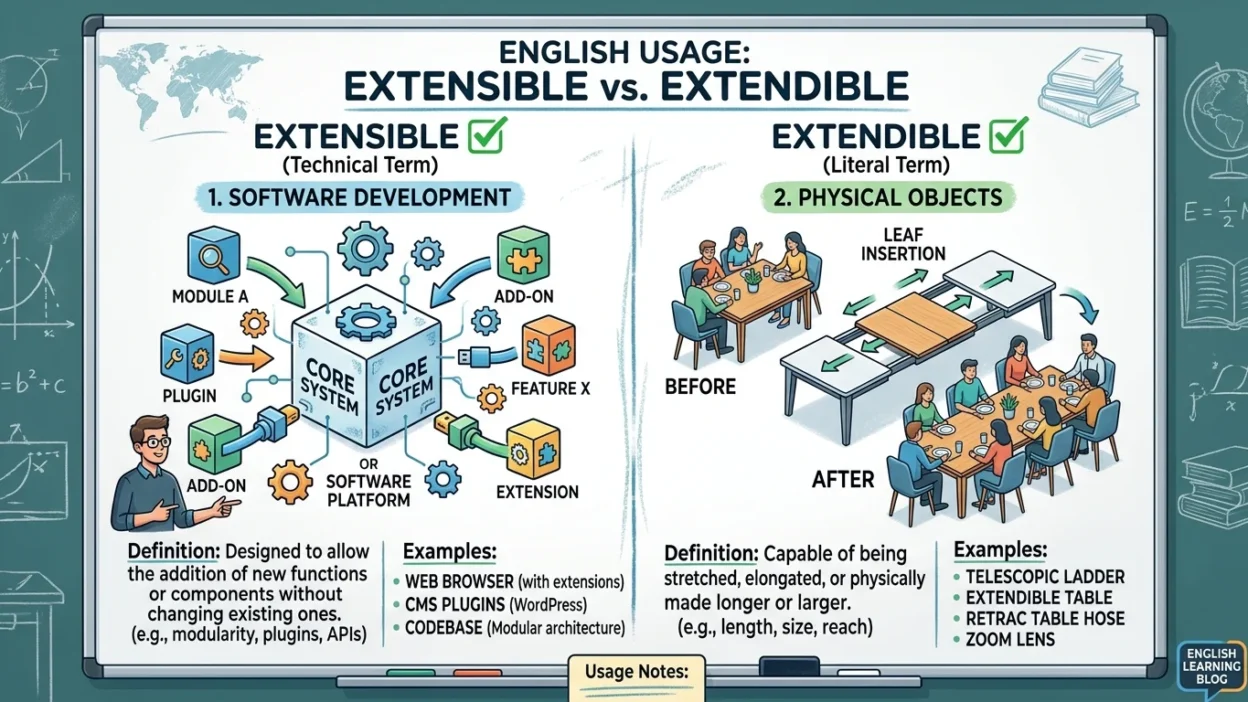
- Capable of being expanded or extended.
- Designed to allow additional features or functions.
It is especially common in technology and software.
Examples
- The software has an extensible architecture.
- XML is an extensible markup language.
- The framework is highly extensible.
- Developers built an extensible plugin system.
- The application is easily extensible.
Extendible
Extendible is also an adjective.
Meaning
It means:
- Able to be extended in length, size, or duration.
- Capable of being made longer or larger.
It is often used for physical objects or general situations.
Examples
- The table has an extendible leaf.
- We bought an extendible ladder.
- The contract is extendible for another year.
- The extendible pole reached the roof.
- The deadline is extendible with approval.
Comparison Table
| Feature | Extensible | Extendible |
|---|---|---|
| Correct English | ✅ Yes | ✅ Yes |
| Common in computing | ✅ Yes | Rarely |
| Common in engineering | ✅ Yes | Sometimes |
| Common for physical objects | Sometimes | ✅ Yes |
| Means capable of being extended | ✅ Yes | ✅ Yes |
When to Use Each
Use extensible when:
- Writing about software.
- Discussing programming or technology.
- Referring to systems that allow additional features.
- Writing technical documentation.
Use extendible when:
- Referring to furniture or tools.
- Describing something that can become longer.
- Talking about contracts, deadlines, or physical objects.
Examples
- The platform is fully extensible.
- The software supports extensible modules.
- Developers created an extensible API.
- The system uses an extensible design.
- The database is easily extensible.
- The dining table is extendible.
- We purchased an extendible ladder.
- The extendible antenna improved reception.
- The agreement is extendible by six months.
- The extendible handle makes storage easier.
- The framework remains extensible for future updates.
- The extendible shelf saves space.
Common Mistakes
Many learners make these errors.
- Using extendible in software documentation where extensible is the standard term.
- Assuming only one spelling is correct.
- Mixing both words in the same technical document.
Correct:
- The application is extensible.
- The ladder is extendible.
Less natural:
- The ladder is extensible.
- The software is extendible.
Memory Trick
Remember this simple rule:
Extensible = Extra features.
Extendible = Extend in size or length.
If you’re talking about software or technology, choose extensible.
If you’re talking about physical objects, choose extendible.
American vs British English
Both extensible and extendible are accepted in American and British English.
However, extensible is the preferred term in technical fields worldwide, while extendible is more common in general and physical contexts.
Similar Words
You may also confuse these word pairs:
- Expandable vs Extendable
- Flexible vs Elastic
- Expandable vs Extensible
- Configurable vs Customizable
- Adjustable vs Extendible
- Adaptable vs Extensible
- Portable vs Mobile
- Scalable vs Extensible
- Compatible vs Interoperable
- Modular vs Extensible
Final Verdict
Both extensible and extendible are correct English words, but they are preferred in different contexts. Extensible is the standard choice for software, programming, and technical systems, while extendible is more natural for physical objects, contracts, and anything that can be lengthened or prolonged.
Choosing the right word for the context will make your writing more accurate and professional.
Remember This
Extensible = Software, systems, and technology. ✅
Extendible = Physical objects, length, or duration. ✅
Use the word that best matches your context.
FAQs
Which is correct, extensible or extendible?
Both are correct. Extensible is preferred in technical writing, while extendible is more common for physical objects and general use.
What does extensible mean?
It means capable of being expanded or designed to accept additional features, especially in software and technology.
What does extendible mean?
It means capable of being extended in length, size, or duration.
Is XML extensible or extendible?
XML is described as extensible, as in Extensible Markup Language.
Can I use extensible for a table?
While it is understandable, extendible is the more natural choice for furniture such as tables and ladders.
Do British and American English prefer different spellings?
No. Both use extensible for technical contexts and extendible for more general or physical contexts.
Are extensible and extendible interchangeable?
Sometimes, but using the preferred term for the context makes your writing clearer and more professional.
Conclusion
The difference between extensible and extendible lies mainly in their typical usage. Extensible is the standard adjective for software, programming, and systems that can be expanded with new features, while extendible is generally used for physical objects or anything that can be made longer or last longer.
By matching the word to the context, you can communicate more precisely and write with greater confidence.

Nancy Lisa is a passionate writer and contributor at DrameyHut, focused on uncovering the deeper meanings behind dreams. She creates engaging and insightful content that helps readers interpret their dreams and understand their subconscious thoughts. Her work inspires self-reflection, clarity, and a stronger connection to inner emotions.