The words too and to are among the most commonly confused words in English. Since they sound exactly alike, many people accidentally use the wrong one when writing emails, text messages, essays, or social media posts.
Although the pronunciation is the same, their meanings and grammatical functions are completely different.
Understanding the difference between too and to is essential for writing clearly and correctly. Fortunately, the rule is simple once you learn it. This guide explains the meaning of each word, when to use it, common mistakes to avoid, and plenty of real world examples to help you remember the difference.
Quick Answer
To is a preposition and an infinitive marker. It shows direction, purpose, destination, or introduces a verb. Too is an adverb that means also or more than enough. If you mean also or excessively, use too. In all other cases, use to.
Why People Confuse It
People often mix up to and too because:
- They are pronounced exactly the same.
- Both words appear in everyday English.
- Typing quickly can lead to mistakes.
- Spell check may not catch the error because both are valid words.
- Many English learners focus on pronunciation rather than spelling.
A simple memory trick can make choosing the correct word much easier.
First Word: To
To is mainly used as a preposition or as part of an infinitive verb.
It can show:
- Direction
- Destination
- Purpose
- Time
- Relationship
- Movement
Example Sentences
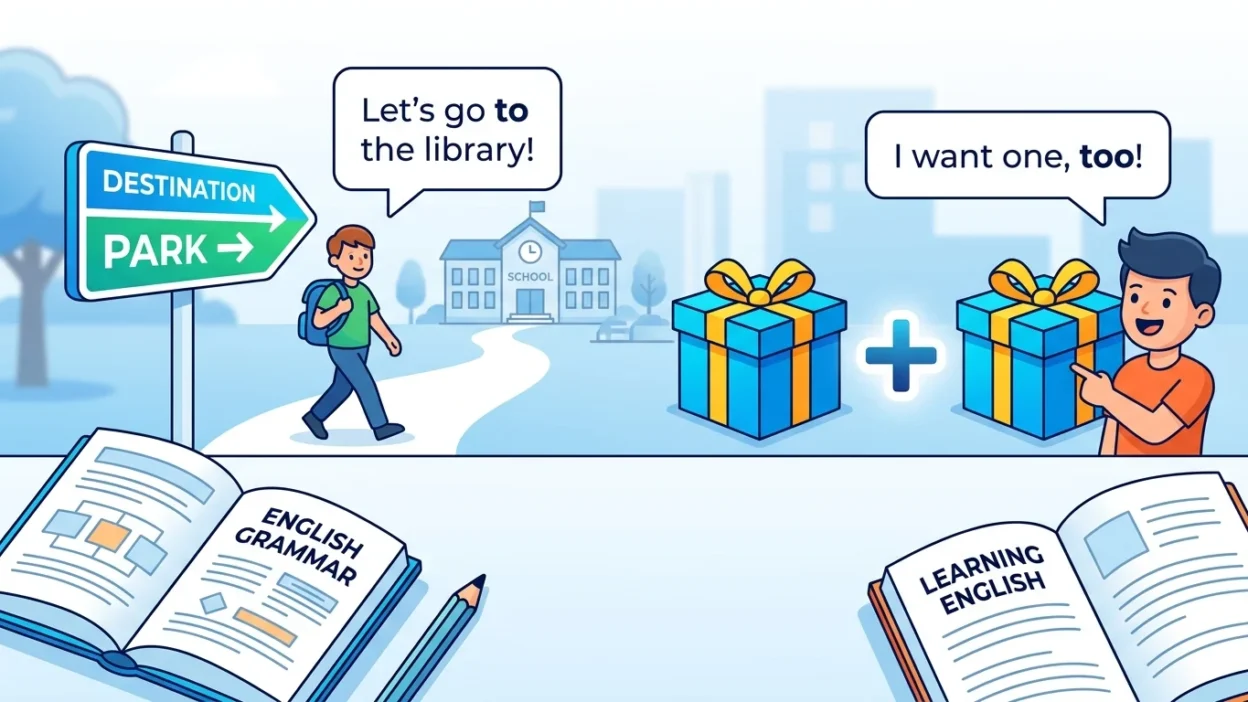
- We walked to the park.
- She gave the keys to her brother.
- I want to learn Spanish.
- They traveled to Italy last summer.
- It’s twenty minutes to five.
In each sentence, to connects ideas or introduces an action.
Second Word: Too
Too is an adverb with two main meanings.
Meaning One: Also
Examples:
- I want to come too.
- She loves chocolate too.
- They were invited too.
- Can I join too?
- He watched the movie too.
Meaning Two: More Than Enough
Examples:
- The soup is too hot.
- You’re speaking too loudly.
- The bag is too heavy.
- It’s too cold outside.
- The movie was too long.
In these examples, too means excessively or beyond what is needed.
Too vs To Comparison Table
| Feature | To | Too |
|---|---|---|
| Part of Speech | Preposition or infinitive marker | Adverb |
| Meaning | Direction, destination, purpose | Also or more than enough |
| Common Use | To school, to eat, to work | Me too, too much, too fast |
| Example | She went to the library. | She came too. |
When to Use Each
Use to when you are talking about:
- Going somewhere
- Giving something
- Showing direction
- Connecting ideas
- Introducing a verb
Use too when you mean:
- Also
- As well
- More than enough
- Excessively
A helpful question is:
Can I replace the word with also?
If the answer is yes, use too.
Examples
Here are more than ten examples of correct usage.
- I want to visit my grandparents.
- She drove to the airport.
- We need to finish our homework.
- Please send the package to Sarah.
- He likes to read before bed.
- I’d love to come too.
- The coffee is too hot to drink.
- You’re driving too fast.
- My sister is coming too.
- The room is too noisy.
- We walked to the station.
- That movie was too funny.
Common Mistakes
Incorrect:
- I want too study English.
Correct:
- I want to study English.
Incorrect:
- She is to tired.
Correct:
- She is too tired.
Incorrect:
- Can I come to?
Correct:
- Can I come too?
Always check whether you mean also or direction before choosing the word.
Memory Trick
A simple trick can help you remember the difference.
Too has an extra O.
Think of the extra O as representing something extra.
- Too means also or more than enough.
- To is used for direction, purpose, or before a verb.
American vs British English
There is no difference between American English and British English.
Both varieties use to and too with the same meanings and grammar rules.
Similar Words
If you’re learning commonly confused English words, you may also find these helpful.
- Your vs You’re
- Their vs There vs They’re
- Its vs It’s
- Affect vs Effect
- Accept vs Except
- Then vs Than
- Message vs Messege
- Reinforce vs Reenforce
- Lose vs Loose
- Principal vs Principle
Final Verdict
Although too and to sound the same, they have different meanings and uses.
Choose to when showing direction, purpose, or introducing a verb.
Choose too when you mean also or more than enough.
Learning this simple distinction will improve your grammar and help you avoid one of the most common English writing mistakes.
Frequently Asked Questions
What is the difference between to and too?
To shows direction or introduces a verb, while too means also or more than enough.
Is it me too or me to?
The correct expression is Me too because it means I also agree.
Is it too much or to much?
The correct phrase is too much because too means more than enough.
How can I remember the difference?
Remember that too has an extra O, which represents something extra.
Are to and too pronounced the same?
Yes. They are homophones, meaning they sound alike but have different meanings and spellings.
Is there a difference between American and British English?
No. Both varieties follow the same grammar rules for to and too.
Is it too late or to late?
The correct phrase is too late because too means excessively or more than desired.
Remember This
To shows direction or introduces a verb.
Too means also or more than enough.
If you can replace the word with also, always choose too.
Conclusion
The difference between too and to is one of the first grammar rules every English learner should master.
While they sound identical, to is used for direction, purpose, and infinitive verbs, whereas too means also or more than enough. Choosing the correct word makes your writing clearer and more professional.
Whenever you’re unsure, remember the extra O in too stands for something extra. With regular practice, you’ll quickly develop the habit of using to and too correctly in every situation.

Nancy Lisa is a passionate writer and contributor at DrameyHut, focused on uncovering the deeper meanings behind dreams. She creates engaging and insightful content that helps readers interpret their dreams and understand their subconscious thoughts. Her work inspires self-reflection, clarity, and a stronger connection to inner emotions.