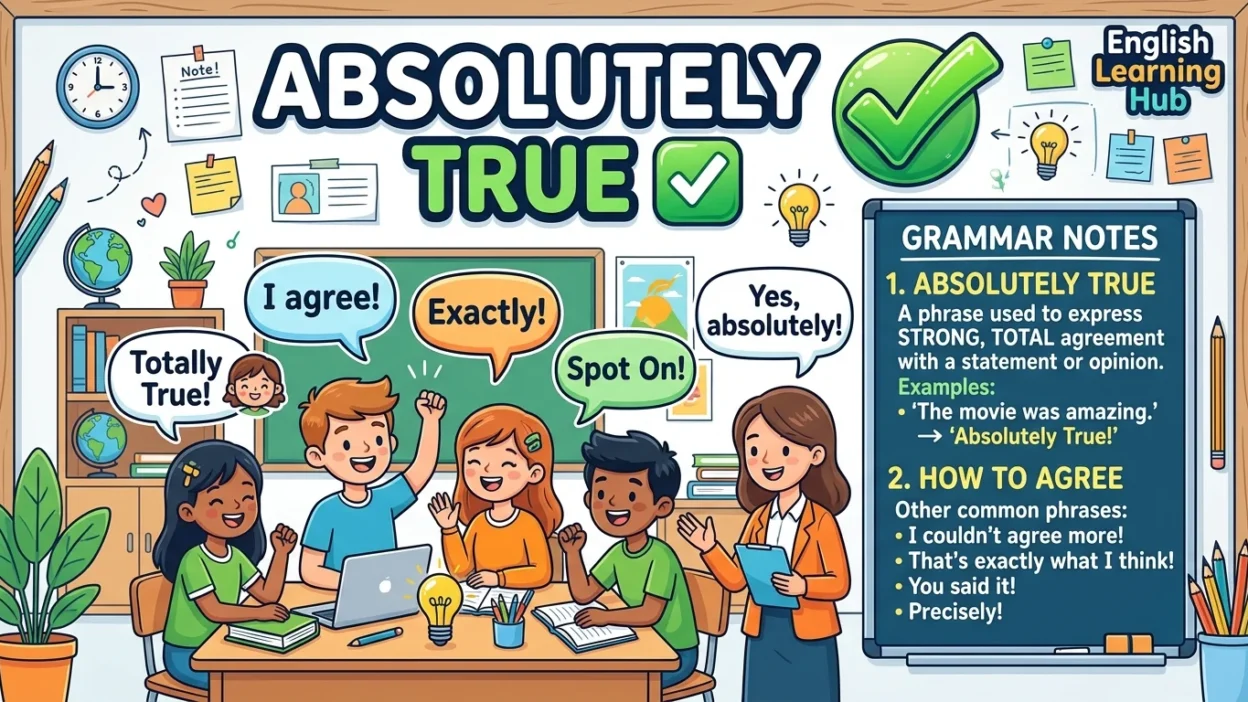
Many English learners wonder whether absolutely true is a correct expression. Since true already means something is correct or factual, some people question if adding absolutely is necessary. However, absolutely true is a common and grammatically correct phrase used to add emphasis.
Understanding the usage of absolutely true will help you express certainty more naturally in both spoken and written English.
Quick Answer
Absolutely true is grammatically correct and commonly used to emphasize that something is completely, unquestionably, or entirely true. It is suitable for both everyday conversations and formal writing.
Why People Confuse It
The confusion happens because true already expresses correctness.
Some people think adding absolutely is unnecessary, but in English, adverbs like absolutely, completely, and entirely are often used to strengthen adjectives for emphasis.
Absolutely True
Absolutely true is an adjective phrase.
Meaning
It means:
- Completely true.
- Entirely accurate.
- Beyond doubt.
- 100% correct.
Examples
- That’s absolutely true.
- Everything she said was absolutely true.
- His statement is absolutely true.
- It is absolutely true that exercise improves health.
- The report was absolutely true and supported by evidence.
Comparison Table
| Expression | Meaning | Natural English |
|---|---|---|
| Absolutely true | Completely true | ✅ Yes |
| Completely true | Entirely true | ✅ Yes |
| Entirely true | Fully accurate | ✅ Yes |
| Perfectly true | Wholly true | ✅ Yes |
| Very true | Quite true | ✅ Yes |
When to Use “Absolutely True”
Use absolutely true when:
- Emphasizing a fact.
- Agreeing strongly with someone.
- Confirming the accuracy of a statement.
- Writing or speaking with confidence.
It works well in both informal and formal contexts.
Examples
- That’s absolutely true.
- Her explanation was absolutely true.
- Everything in the article is absolutely true.
- It is absolutely true that practice improves skills.
- Your observation is absolutely true.
- The witness gave an absolutely true account.
- His comments proved to be absolutely true.
- The information is absolutely true and verified.
- What you said is absolutely true.
- The statement remains absolutely true today.
- It is absolutely true that honesty builds trust.
- The conclusion is absolutely true based on the evidence.
Common Mistakes
Many learners make these errors.
- Thinking absolutely true is incorrect.
- Using absolute true instead of absolutely true.
- Overusing absolutely in every sentence.
Correct:
- That is absolutely true.
Incorrect:
- That is absolute true.
Memory Trick
Remember this simple rule:
Absolutely = Completely.
If you can replace absolutely with completely, the phrase is usually correct.
Absolutely true = Completely true.
American vs British English
There is no difference between American and British English.
Both varieties commonly use absolutely true in conversation and writing.
Similar Words
You may also use these expressions:
- Completely true
- Entirely true
- Perfectly true
- Quite true
- Undoubtedly true
- Certainly true
- Factually correct
- Accurate
- Beyond doubt
- Without question
Final Verdict
Absolutely true is a correct and natural English expression. It is commonly used to emphasize that something is completely accurate or beyond doubt. Whether you’re agreeing with someone or confirming a fact, the phrase sounds natural in both everyday and professional English.
Just remember not to overuse absolutely. When used appropriately, it adds clarity and emphasis to your message.
Remember This
Absolutely true = Correct and natural. ✅
It means completely true or beyond doubt.
FAQs
Is “absolutely true” grammatically correct?
Yes. Absolutely true is a grammatically correct and widely used expression.
What does “absolutely true” mean?
It means something is completely, entirely, or unquestionably true.
Can I use “absolutely true” in formal writing?
Yes. It is appropriate in both formal and informal English when emphasis is needed.
Is “absolutely true” redundant?
Some style experts consider it emphatic because true already implies correctness, but it is a natural and accepted expression in English.
What is another way to say “absolutely true”?
You can say completely true, entirely true, perfectly true, undoubtedly true, or factually correct.
Do British and American English use “absolutely true” differently?
No. Both varieties use the phrase in the same way.
Can I say “That’s absolutely true”?
Yes. It is one of the most common and natural ways to strongly agree with a true statement.
Conclusion
The phrase absolutely true is both grammatically correct and widely accepted in modern English. It is used to emphasize that a statement is completely accurate or beyond doubt, making it a useful expression in conversations, presentations, and writing.
If you want to express strong agreement or confirm the accuracy of something, absolutely true is a natural and effective choice.

Joseph Richard is the administrator and a dedicated author at DrameyHut, overseeing the platform’s operations and content quality. Alongside his administrative role, he writes insightful articles on dream meanings, helping readers understand their subconscious mind. His work supports the mission of providing clear, meaningful, and engaging dream interpretations.