Many English learners confuse when I can and when can I because they contain the same words in a different order. However, these phrases serve different grammatical purposes. One is used in statements, while the other is used in questions.
Understanding the difference between when I can vs when can I will help you form correct English sentences and avoid common grammar mistakes.
Quick Answer
When I can is used in statements and subordinate clauses, while when can I is used to ask a direct question. The word order changes because English questions require inversion of the subject and auxiliary verb.
Why People Confuse It
The confusion happens because both phrases contain the same words:
- When
- I
- Can
The only difference is the word order, but that change completely alters the grammar and meaning.
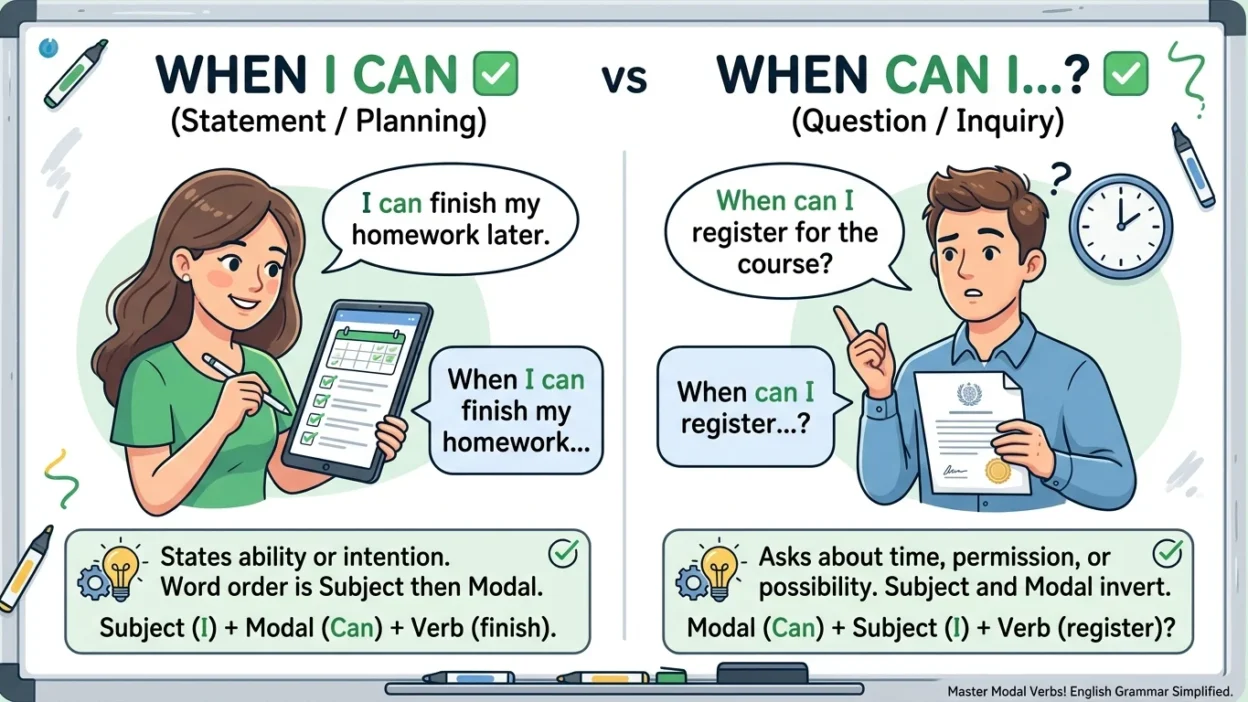
When I Can
When I can is a clause used within a sentence.
Meaning
It means:
- Whenever I am able to.
- At the time I am able to do something.
Examples
- I’ll call you when I can.
- I’ll visit when I can.
- I’ll reply when I can.
- I help my neighbors when I can.
- I’ll finish the work when I can.
When Can I
When can I begins a direct question.
Meaning
It asks:
- At what time am I allowed or able to do something?
Examples
- When can I leave?
- When can I start?
- When can I call you?
- When can I see the results?
- When can I apply?
Comparison Table
| Feature | When I Can | When Can I |
|---|---|---|
| Statement | ✅ Yes | ❌ No |
| Direct question | ❌ No | ✅ Yes |
| Subject before verb | ✅ Yes | ❌ No |
| Auxiliary before subject | ❌ No | ✅ Yes |
| Standard English | ✅ Yes | ✅ Yes |
When to Use Each
Use when I can when:
- Making a statement.
- Talking about something you will do when you have the opportunity.
- Writing subordinate clauses.
Use when can I when:
- Asking about the right time.
- Requesting permission.
- Asking when something is possible.
Examples
- I’ll answer when I can.
- I exercise when I can.
- I’ll visit my parents when I can.
- She helps others when she can.
- We’ll finish the project when we can.
- When can I leave work today?
- When can I collect my package?
- When can I meet the manager?
- When can I submit my application?
- When can I expect a reply?
- I’ll explain everything when I can.
- When can I use the new software?
Common Mistakes
Many learners make these errors.
- Using when can I inside a statement.
- Forgetting to change the word order in questions.
- Mixing statement and question structures.
Correct:
- I’ll call you when I can.
- When can I call you?
Incorrect:
- I’ll call you when can I.
- When I can call you?
Memory Trick
Remember this simple rule:
Questions flip the order.
If you’re asking a question:
When can I…? ✅
If you’re making a statement:
…when I can. ✅
American vs British English
There is no difference between American and British English.
Both varieties follow the same grammar rules for these phrases.
Similar Words
You may also confuse these sentence patterns:
- What I Need vs What Do I Need
- Where I Am vs Where Am I
- How I Can vs How Can I
- Why I Did vs Why Did I
- What I Should Do vs What Should I Do
- If I Can vs Can I
- Whether I Can vs Can I
- When We Can vs When Can We
- Who I Am vs Who Am I
- How I Feel vs How Do I Feel
Final Verdict
The difference between when I can and when can I comes down to sentence structure. When I can belongs in statements and subordinate clauses, while when can I is used only for direct questions.
Remember that English questions require the auxiliary verb can before the subject I, while statements keep the normal subject-verb order.
Remember This
When I can = Statement. ✅
When can I = Question. ✅
Think:
I’ll help when I can.
When can I help?
FAQs
Which is correct, when I can or when can I?
Both are correct, but they are used differently. When I can is used in statements, while when can I is used in questions.
Why can’t I say “I’ll call you when can I”?
Because indirect and subordinate clauses use normal word order. The correct sentence is I’ll call you when I can.
What does “when I can” mean?
It means whenever I am able to or at the earliest opportunity.
What does “when can I” mean?
It asks about the time or opportunity to do something.
Is the grammar different in British and American English?
No. Both follow the same word order rules.
Can “when I can” start a sentence?
Yes. For example, When I can, I like to volunteer at local events.
Why does the word order change in questions?
English grammar places the auxiliary verb before the subject in direct questions, which is why we say When can I…?
Conclusion
Although when I can and when can I contain the same words, they have different grammatical functions. When I can is used in statements to describe something you will do when you are able, while when can I is used to ask a direct question about timing or permission.
Learning this simple word order rule will make your English more accurate and help you communicate with confidence.

Christopher Thomas is a passionate writer and dream researcher dedicated to exploring the meanings behind dreams. As an author at DrameyHut, he creates insightful and easy-to-understand interpretations that help readers connect with their subconscious mind. His work focuses on guiding individuals toward self-discovery, clarity, and a deeper understanding of their inner thoughts.