
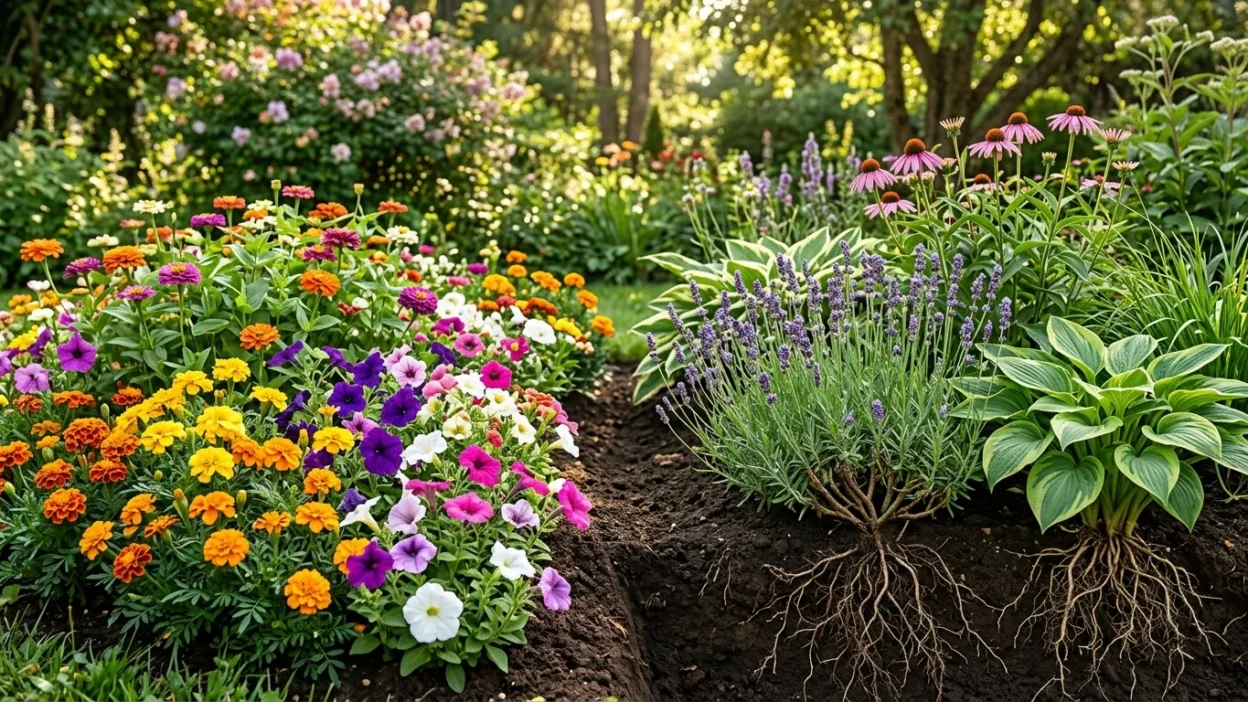
The words annual and perennial are often confused because both can describe something that happens repeatedly over time. However, they do not mean exactly the same thing. Annual generally means something that occurs once every year or lasts for one year, while perennial describes something that continues for several years or returns repeatedly over a long period.
The difference becomes especially important when talking about plants. An annual plant completes its entire life cycle within one growing season, while a perennial plant lives for multiple years and usually grows again each season. Outside gardening, annual can describe events, reports, fees, or activities that happen every year. Perennial can describe something that continues for a long time or repeatedly occurs, such as a perennial problem or perennial favorite.
Quick Answer
Annual means something that happens every year or lasts for one year. Perennial means something that lasts for many years or repeatedly returns. In gardening, annual plants complete their life cycle in one season, while perennial plants survive for multiple years and grow again.
Why Do People Confuse Annual and Perennial?
People confuse these words because both are connected with time and repetition.
For example, an annual event happens every year, while a perennial issue is an issue that continues or keeps coming back over many years.
The words can also both describe plants:
- Annual plants live for one growing season.
- Perennial plants live for several years.
- Annual plants usually need to be replanted each year.
- Perennial plants generally grow again after surviving through the appropriate seasons.
The key difference is simple: annual focuses on one year or yearly occurrence, while perennial focuses on lasting or recurring over multiple years.
Annual
Annual is an adjective that usually means happening once every year, occurring yearly, or lasting for one year.
The word comes from the Latin annus, meaning “year.”
Annual Meaning
When something is annual, it is connected specifically with a one year period.
For example:
- annual meeting
- annual report
- annual fee
- annual celebration
- annual salary
- annual vacation
An annual event happens once each year.
An annual subscription may cover a period of one year.
Annual in Gardening
In gardening, an annual is a plant that completes its entire life cycle within one growing season.
This usually means the plant:
- Germinates.
- Grows.
- Flowers.
- Produces seeds.
- Dies.
Examples of commonly grown annual flowers include marigolds, petunias, and zinnias.
Perennial
Perennial generally means lasting for many years, continuing for a long time, or repeatedly returning.
The word comes from Latin perennis, meaning lasting throughout the year or enduring.
Perennial Meaning
Outside gardening, perennial can describe something that continues to exist or repeatedly appears.
For example:
- a perennial problem
- a perennial debate
- a perennial favorite
- a perennial concern
- a perennial question
If something is called a perennial problem, it is a problem that keeps occurring or remains unresolved over a long period.
Perennial in Gardening
In gardening, a perennial is a plant that lives for multiple years.
Many perennial plants die back above the ground during a particular season but survive through their roots, bulbs, crowns, or other structures. They can then produce new growth in a later season.
Examples include:
- Lavender
- Peonies
- Daylilies
- Hostas
- Coneflowers
Annual vs Perennial: Comparison Table
| Feature | Annual | Perennial |
|---|---|---|
| Basic meaning | Related to one year or occurring yearly | Continuing for many years or recurring |
| Time period | One year or every year | Multiple years |
| Plant life cycle | Usually one growing season | Several years |
| Plant dies after reproduction | Usually yes | Usually no |
| Replanted each year | Often | Usually not |
| Example plant | Marigold | Lavender |
| Non gardening example | Annual report | Perennial problem |
| Main idea | Yearly | Long lasting or recurring |
When Should You Use Annual?
Use annual when you are talking about something that happens every year or something that covers a one year period.
Annual for Yearly Events
Use annual for events that happen once every year.
Example:
The company holds its annual meeting in December.
This means the meeting takes place every year.
Annual for Reports
The organization published its annual report.
The report covers the organization’s activities or financial information for a year.
Annual for Fees
The annual membership fee is $50.
This means the fee applies to a one year period.
Annual for Plants
Use annual when a plant completes its life cycle within one growing season.
These annual flowers need to be planted again next year.
When Should You Use Perennial?
Use perennial when something lasts for many years or repeatedly occurs.
Perennial for Problems
Traffic congestion is a perennial problem in the city.
This means traffic congestion continues to be a recurring problem.
Perennial for Questions
The cost of healthcare is a perennial topic of discussion.
The topic keeps returning to discussions over many years.
Perennial for Favorites
Chocolate cake is a perennial favorite at family celebrations.
This means people consistently enjoy it over time.
Perennial for Plants
Roses are perennial plants that can live for many years.
The plant can survive beyond one growing season.
Annual vs Perennial Examples
Here are more examples to make the difference clear.
- The school holds an annual sports day.
The event happens every year. - The company publishes an annual financial report.
The report is produced every year. - She pays an annual membership fee.
The fee covers a yearly period. - Marigolds are commonly grown as annual plants.
They generally complete their life cycle within one growing season. - The garden contains several perennial flowers.
These plants can survive for multiple years. - Unemployment remains a perennial concern.
The concern continues or repeatedly returns. - The festival has become an annual tradition.
It takes place every year. - The team faces the perennial challenge of finding new talent.
The challenge keeps occurring. - The university conducts an annual review of its programs.
The review takes place each year. - This perennial plant returns every spring.
The plant survives from year to year. - The annual subscription expires after twelve months.
It lasts for one year. - The issue has been a perennial source of disagreement.
The disagreement has continued for a long time.
Common Mistakes
Mistake 1: Thinking Annual Always Means Lasting One Year
Annual can mean occurring every year, not necessarily continuously lasting for an entire year.
For example:
We have an annual conference.
This means the conference occurs once a year.
Mistake 2: Using Perennial for Something That Simply Happens Every Year
Perennial emphasizes continued existence or repeated recurrence. If you simply mean something happens once each year, annual is usually the clearer choice.
Correct:
We have an annual meeting.
Less natural:
We have a perennial meeting.
Mistake 3: Assuming Every Plant That Returns Is Annual
An annual plant generally completes its life cycle in one growing season.
A perennial plant survives for multiple years.
Mistake 4: Confusing Perennial With Permanent
Perennial means lasting or recurring for a long period. It does not necessarily mean something lasts forever.
The city has a perennial traffic problem.
This does not mean the problem can never be solved.
Memory Trick
A simple way to remember the difference is:
Annual = year
Think of annual as something connected directly to a year.
Perennial = persists
Think of perennial as something that persists or keeps coming back.
So:
Annual = yearly
Perennial = long lasting or recurring
American vs British English
There is essentially no difference between American and British English in the meanings of annual and perennial.
Both varieties use:
- annual report
- annual meeting
- annual fee
- annual event
- perennial plant
- perennial problem
- perennial favorite
The pronunciation and usage are also broadly consistent across the two varieties.
In gardening, however, specific plants may be classified differently depending on climate. A plant that behaves as a perennial in a warm climate may be grown as an annual in a colder climate.
Similar Words
Yearly
Yearly means happening once every year.
We have a yearly celebration.
It is similar to one meaning of annual.
Recurring
Recurring means happening repeatedly.
The company has recurring expenses.
Recurring does not necessarily mean once a year.
Permanent
Permanent means intended to last indefinitely.
She accepted a permanent position.
Permanent is stronger than perennial because perennial does not necessarily mean forever.
Seasonal
Seasonal means related to a particular season or occurring during certain seasons.
The store hires seasonal workers.
A seasonal event does not necessarily happen once a year in the same sense as an annual event.
Enduring
Enduring means lasting for a long time.
Their friendship has been enduring.
This is similar to one meaning of perennial.
Final Verdict
Annual and perennial both relate to time, but they emphasize different ideas.
Use annual for something that happens every year or lasts for a one year period. Use perennial for something that continues for many years or repeatedly returns.
When discussing plants, the distinction is especially clear. Annual plants complete their life cycle within one growing season, while perennial plants survive for multiple years.
FAQs
Does annual mean every year?
Usually, yes. Annual commonly means something that happens once every year. It can also describe something that lasts for one year.
Does perennial mean every year?
Not exactly. Perennial means lasting for many years or repeatedly occurring. A perennial plant can return each year, but the word emphasizes its ability to survive over multiple years.
What is the difference between annual and perennial plants?
Annual plants generally complete their entire life cycle within one growing season. Perennial plants survive for multiple years and can produce new growth in later seasons.
Is annual the same as yearly?
In many contexts, yes. Both can describe something that happens once every year.
Is perennial the same as permanent?
No. Perennial means lasting a long time or recurring repeatedly. Permanent suggests something intended to last indefinitely.
Is a perennial plant better than an annual plant?
Neither term means better. Annual and perennial plants have different growth cycles, and which type is suitable depends on the garden, climate, maintenance preferences, and desired appearance.
Can a plant be annual in one place and perennial in another?
Yes. Climate can affect how a plant behaves. A plant that survives winter in a warm climate may not survive the winter in a colder climate and may therefore be grown as an annual.
What does perennial problem mean?
A perennial problem is a problem that continues for a long time or repeatedly occurs.
Remember This
Annual means yearly or lasting one year. Perennial means lasting for many years or repeatedly returning. For plants, annuals complete their life cycle in one growing season, while perennials survive for multiple years.
Conclusion
The difference between annual and perennial becomes easy to understand when you focus on the time involved. Annual is connected with one year, especially something that happens every year or lasts for a year. It is commonly used with words such as annual report, annual meeting, annual fee, and annual event.
Perennial focuses on something that continues for several years or keeps returning. It is commonly used for long lasting problems, recurring topics, enduring favorites, and plants that survive for multiple years. Remember the simple distinction: annual means yearly, while perennial means long lasting or recurring.

Nancy Lisa is a passionate writer and contributor at DrameyHut, focused on uncovering the deeper meanings behind dreams. She creates engaging and insightful content that helps readers interpret their dreams and understand their subconscious thoughts. Her work inspires self-reflection, clarity, and a stronger connection to inner emotions.