
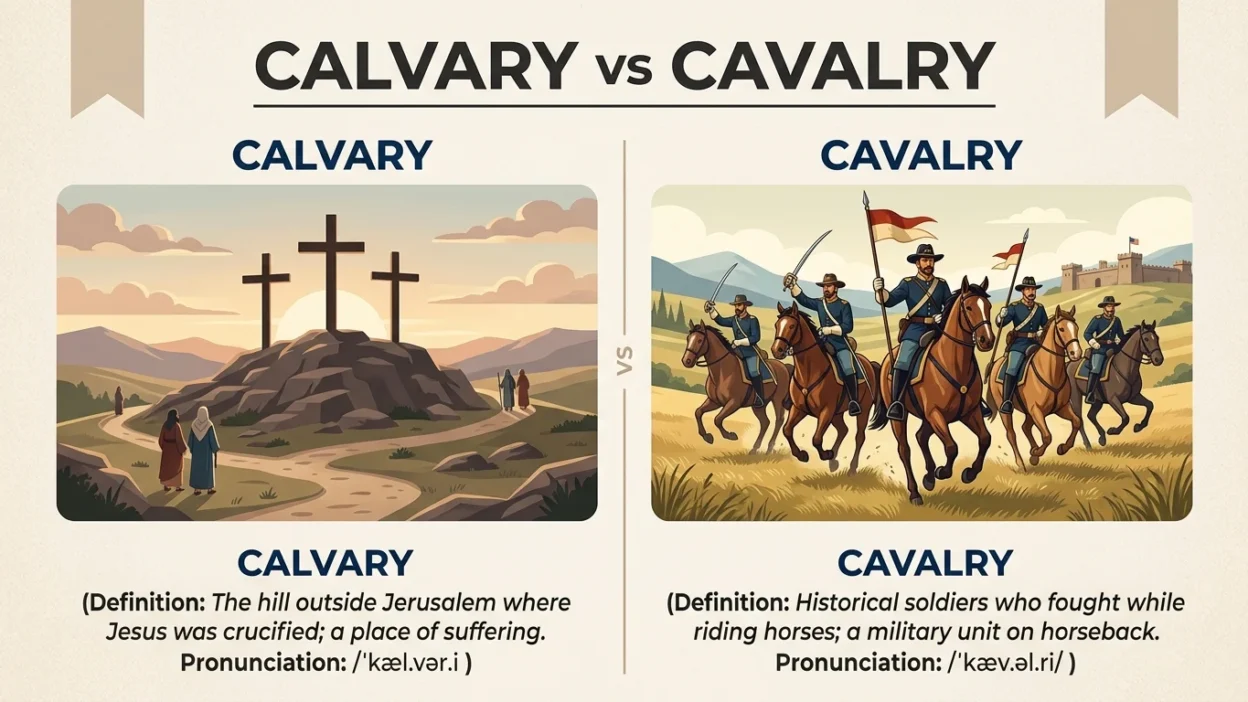
Calvary and cavalry are two commonly confused English words because they look and sound very similar. However, they have completely different meanings. One is connected with the Bible and Christianity, while the other refers to mounted soldiers and military forces.
Calvary is a proper noun that refers to the place outside Jerusalem where Jesus was crucified. It can also be used figuratively to describe a period of great suffering or hardship.
Cavalry, on the other hand, refers to soldiers or military units traditionally mounted on horses. In modern military contexts, cavalry can also refer to units using armored vehicles or other specialized equipment.
The difference is only one letter, but confusing these words can completely change the meaning of a sentence. Learning the simple connection between Calvary and crucifixion and cavalry and horses makes the distinction easy to remember.
Quick Answer
Calvary refers to the place associated with Jesus Christ’s crucifixion and can also mean a period of suffering. Cavalry refers to soldiers or military units traditionally mounted on horses. Remember: Calvary = crucifixion; cavalry = mounted soldiers.
Why Do People Confuse Calvary and Cavalry?
The words are easy to mix up because they contain almost the same letters:
Calvary
Cavalry
The main difference is the position of the a and v sounds in the middle of the words.
They are also pronounced differently.
Calvary is commonly pronounced approximately like KAL vuh ree.
Cavalry is commonly pronounced approximately like KAV uhl ree.
Because the words sound similar in fast speech, spelling mistakes are common.
What Does Calvary Mean?
Calvary is a proper noun referring to the place outside Jerusalem where Jesus was crucified.
The name comes from the Latin Calvaria, meaning “skull,” corresponding to the biblical name Golgotha, traditionally understood as “place of the skull.”
For example:
“The painting depicts Christ at Calvary.”
Calvary is often capitalized because it is used as a specific place name in Christian contexts.
Calvary as a Figurative Expression
“Calvary” can also be used figuratively to describe extreme suffering, hardship, or a painful experience.
For example:
“The long illness became a personal Calvary.”
Here, the writer is comparing the person’s suffering with the suffering associated with Christ’s crucifixion.
What Does Cavalry Mean?
Cavalry refers to soldiers or military units that traditionally fought while mounted on horseback.
Historically, cavalry was important because mounted soldiers could move quickly across the battlefield and attack from an advantageous position.
For example:
“The cavalry charged across the battlefield.”
Although horses are strongly associated with the word, modern cavalry units do not necessarily use horses. Some modern military organizations use the term cavalry for units operating armored vehicles or performing reconnaissance and other specialized military roles.
Calvary vs Cavalry
| Word | Meaning | Example |
|---|---|---|
| Calvary | The place associated with Jesus’s crucifixion | “The painting shows Jesus at Calvary.” |
| Calvary | A period of great suffering | “The experience became his personal Calvary.” |
| Cavalry | Mounted soldiers or military units | “The cavalry approached the battlefield.” |
| Cavalry | Modern military units descended from or named after mounted forces | “The cavalry unit conducted reconnaissance.” |
Calvary Examples
- “The church displayed a painting of Jesus at Calvary.”
- “Christ’s crucifixion at Calvary is central to the story.”
- “The pilgrims traveled to sites associated with Calvary.”
- “The sermon focused on the events leading to Calvary.”
- “The artist created a dramatic scene depicting Calvary.”
- “His years of suffering became a personal Calvary.”
- “She described the difficult experience as her own Calvary.”
- “The book explores themes of sacrifice and Calvary.”
- “The sculpture represents Christ on the way to Calvary.”
- “The story reaches its emotional climax at Calvary.”
Cavalry Examples
- “The cavalry rode across the open field.”
- “The army sent its cavalry toward the enemy position.”
- “The cavalry unit was trained for reconnaissance.”
- “The horses carried the cavalry into battle.”
- “The cavalry arrived quickly because of its mobility.”
- “The museum contains an exhibit about the history of cavalry.”
- “The commander ordered the cavalry to advance.”
- “The cavalry played an important role in many historical battles.”
- “The regiment has a long cavalry tradition.”
- “Modern cavalry units may use armored vehicles rather than horses.”
Calvary vs Cavalry Pronunciation
Pronunciation is another useful way to distinguish the words.
Calvary: commonly pronounced approximately KAL vuh ree
Cavalry: commonly pronounced approximately KAV uhl ree
The middle syllables are different, although the words can sound very similar in casual speech.
Common Mistakes
Mistake 1: Using cavalry when you mean Calvary
Incorrect:
“Jesus was crucified at the cavalry.”
Correct:
“Jesus was crucified at Calvary.”
The place associated with the crucifixion is Calvary.
Mistake 2: Using Calvary when you mean cavalry
Incorrect:
“The Calvary charged across the battlefield.”
Correct:
“The cavalry charged across the battlefield.”
Military soldiers or units are cavalry.
Mistake 3: Thinking cavalry always means horses today
Historically, cavalry was strongly associated with mounted soldiers.
However, modern military organizations may use the term for units that operate armored vehicles or perform reconnaissance.
Mistake 4: Forgetting that Calvary is usually capitalized
When referring to the biblical place, write:
Calvary
It is a proper name.
Memory Trick
Here is the easiest way to remember the difference:
Calvary = Christ
Cavalry = Combat
You can also remember:
Cavalry has an extra “a” like “a horse.”
So:
Calvary → crucifixion
Cavalry → soldiers
American vs British English
There is no major difference in meaning between American and British English for these words.
Both varieties use Calvary for the biblical place and cavalry for mounted or traditionally mounted military forces.
The spelling distinction remains the same in both varieties.
Similar Words
For Calvary
Related words include:
Golgotha: the biblical name associated with the place of Jesus’s crucifixion.
Crucifixion: the execution method used against Jesus.
Passion: the suffering and death of Jesus in Christian theology.
Golgotha: another name traditionally associated with Calvary.
For Cavalry
Related words include:
Mounted troops: soldiers traditionally fighting on horseback.
Horsemen: people who ride horses, especially in a military context.
Mounted unit: a military unit using mounted personnel.
Armored cavalry: modern military forces using armored vehicles.
Infantry: soldiers who traditionally fight on foot, contrasting with mounted forces.
Calvary vs Cavalry in a Sentence
Compare these two sentences:
“The soldiers joined the cavalry.”
This refers to a military unit.
“The painting depicts Jesus at Calvary.”
This refers to the biblical place associated with the crucifixion.
Changing just one letter completely changes the meaning.
Final Verdict
Calvary and cavalry are completely different words.
Calvary refers to the place associated with Jesus Christ’s crucifixion and can also describe intense suffering figuratively.
Cavalry refers to military soldiers or units traditionally mounted on horses. In modern military usage, the term can also refer to specialized units using vehicles and performing roles such as reconnaissance.
The easiest memory trick is:
Calvary = Christ.
Cavalry = combat soldiers.
FAQs
Is it Calvary or cavalry?
Both words are correct, but they have different meanings. Calvary is associated with Jesus’s crucifixion, while cavalry refers to military forces traditionally mounted on horses.
What is the difference between Calvary and cavalry?
Calvary is a biblical place name associated with the crucifixion of Jesus. Cavalry refers to mounted soldiers or military units.
Is Calvary the same as Golgotha?
Calvary and Golgotha are names traditionally associated with the place where Jesus was crucified. Calvary comes through Latin, while Golgotha comes from the biblical languages.
Does cavalry always mean soldiers on horses?
No. Historically, cavalry consisted of mounted soldiers, especially horsemen. Modern military units called cavalry may use armored vehicles and perform reconnaissance or other specialized roles.
How do you remember Calvary vs cavalry?
Remember Calvary = Christ and cavalry = combat. You can also associate the extra a in cavalry with a horse.
Is Calvary a proper noun?
Yes. When referring to the biblical place associated with Jesus’s crucifixion, Calvary is normally capitalized.
Can Calvary be used figuratively?
Yes. “A personal Calvary” can describe an extremely painful or difficult experience.
Are Calvary and cavalry pronounced the same?
No. They are similar but traditionally have different pronunciations. Calvary is commonly pronounced approximately “KAL vuh ree,” while cavalry is commonly pronounced approximately “KAV uhl ree.”
Conclusion
Calvary and cavalry may look almost identical, but they belong to completely different areas of meaning. Calvary is connected with the crucifixion of Jesus and can also represent great suffering. Cavalry refers to military forces traditionally mounted on horses and, in modern contexts, to certain specialized military units.
If you remember Calvary = Christ and cavalry = combat, you will rarely confuse the two again. One belongs primarily to religious history, while the other belongs to military history.
Remember This
Calvary = the place associated with Christ’s crucifixion.
Cavalry = mounted military soldiers or units.
Calvary has one “a.” Cavalry has two “a” letters.

Daniel Charles is a dedicated author and dream interpretation enthusiast at DrameyHut. He specializes in analyzing dream symbols and meanings, offering clear and insightful content for readers. His work aims to help individuals understand their subconscious thoughts, gain clarity, and explore the deeper messages hidden within their dreams.