
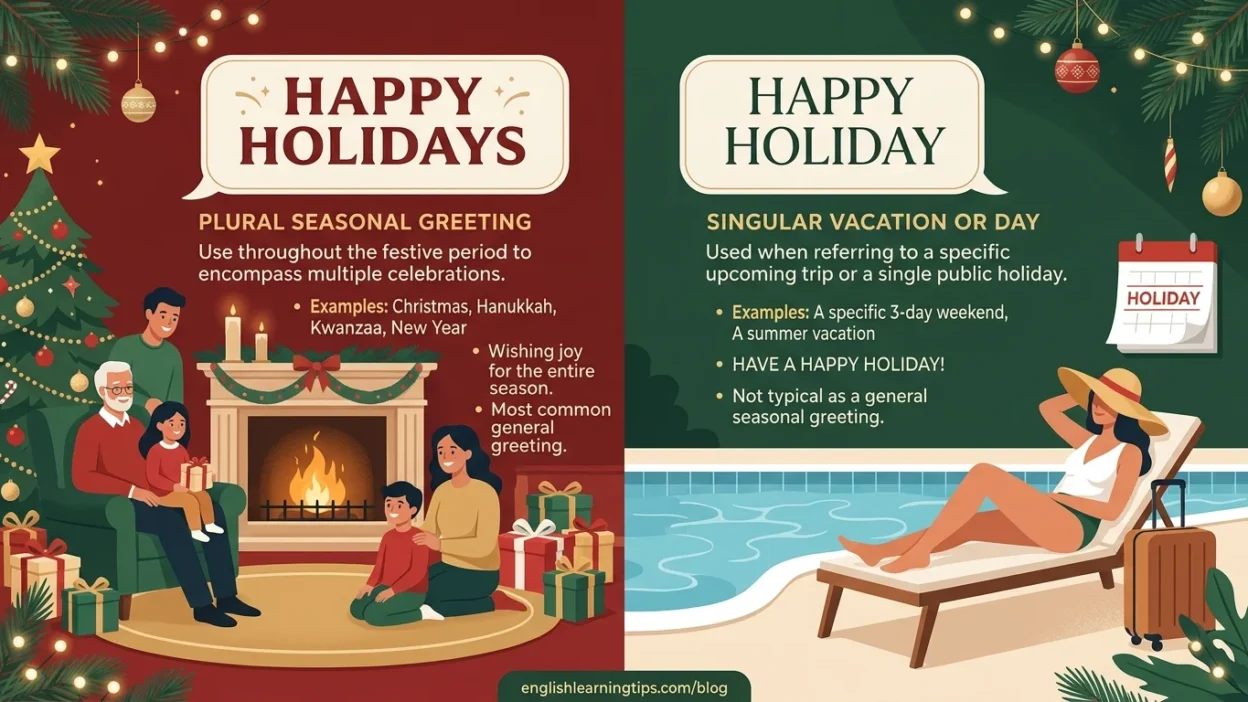
“Happy holidays” and “happy holiday” are both grammatically possible, but they are not normally used in the same way. The plural expression “Happy Holidays” is much more common when giving a seasonal greeting, especially around the end of the year. It can refer broadly to several holidays or to the entire holiday season.
“Happy holiday,” in the singular, is less common as a general seasonal greeting. It usually refers to one specific holiday or, in some varieties of English, a person’s vacation or break. This difference is small but important because choosing the singular or plural form can change what your message sounds like.
If you are writing a card, email, social media post, or casual message during the holiday season, “Happy Holidays!” is generally the natural choice. “Happy holiday!” can be correct when you are talking about one particular holiday or wishing someone well during a specific break.
Quick Answer
“Happy Holidays” is the standard seasonal greeting when referring broadly to the holiday season or multiple holidays. “Happy Holiday” is singular and usually refers to one particular holiday or a specific vacation or break. For a general end of year greeting, use “Happy Holidays!”
Why Do People Confuse “Happy Holidays” and “Happy Holiday”?
The confusion comes from the fact that holiday can refer to either one holiday or a broader holiday period.
For example:
“I hope you have a happy holiday.”
Here, the speaker may be referring to one specific holiday or break.
But:
“Happy Holidays!”
uses the plural to cover the broader holiday season.
The plural form is especially common when someone wants to greet people without naming a particular holiday.
What Does “Happy Holidays” Mean?
“Happy Holidays” is a common greeting used during a period when several holidays may be celebrated.
It can include holidays such as Christmas, Hanukkah, Kwanzaa, New Year’s, and other celebrations depending on the context.
The expression can also simply refer to the general holiday season without specifying which holiday someone celebrates.
For example:
“Wishing you and your family happy holidays!”
This is a broad seasonal greeting.
What Does “Happy Holiday” Mean?
“Happy Holiday” is grammatically correct, but it is less common as a general seasonal greeting in American English.
The singular form normally refers to one holiday or one specific holiday period.
For example:
“Have a happy holiday with your family.”
Here, the speaker may have a particular holiday in mind.
In British English, holiday can also mean a vacation.
For example:
“Have a happy holiday in Spain!”
In this context, “holiday” means a vacation or trip rather than a religious or seasonal celebration.
Happy Holidays vs Happy Holiday
| Expression | Meaning | Typical Use |
|---|---|---|
| Happy Holidays | A greeting covering the holiday season or multiple holidays | Very common seasonal greeting |
| Happy Holiday | A greeting referring to one particular holiday or break | Less common as a general seasonal greeting |
| Happy Christmas | A greeting specifically for Christmas | Common in British English |
| Merry Christmas | A greeting specifically for Christmas | Very common in American English |
| Have a happy holiday | Wishing someone an enjoyable holiday or vacation | Natural depending on context |
When Should You Use “Happy Holidays”?
Use “Happy Holidays!” when you want to give a broad seasonal greeting.
It is especially useful when:
- You do not know which holiday someone celebrates
- You are addressing a mixed group
- You are writing a general seasonal message
- You are referring to the entire holiday season
- You want a neutral holiday greeting
Examples:
“Happy Holidays to everyone!”
“Wishing you happy holidays and a wonderful New Year.”
“We wish all our customers happy holidays.”
When Should You Use “Happy Holiday”?
Use “Happy Holiday” when the context clearly refers to one specific holiday or break.
For example:
“I hope you have a happy holiday with your family.”
You might also hear the singular form when someone is talking about a vacation, particularly in British English.
“Have a happy holiday in Italy!”
Here, “holiday” means vacation.
Examples of “Happy Holidays”
- “Happy Holidays to you and your family!”
- “Wishing everyone happy holidays!”
- “Happy Holidays from our entire team.”
- “We hope you have a wonderful holiday season. Happy Holidays!”
- “Happy Holidays and best wishes for the New Year.”
- “The company wishes all its customers happy holidays.”
- “Happy Holidays! Enjoy this special time with your loved ones.”
- “Sending you warm wishes for happy holidays.”
- “Happy Holidays to all our readers!”
- “Have a safe and happy holiday season.”
Examples of “Happy Holiday”
- “Have a happy holiday with your family.”
- “I hope you have a happy holiday in France.”
- “Wishing you a happy holiday and a relaxing break.”
- “Have a happy holiday. I’ll see you next week.”
- “They wished us a happy holiday before we left.”
- “I hope you enjoy your holiday and have a happy one.”
- “Have a happy holiday in the countryside.”
- “She wished him a happy holiday before he went home.”
The exact meaning depends heavily on context.
Is “Happy Holidays” Grammatically Correct?
Yes.
“Happy Holidays” is grammatically correct and extremely common as a greeting.
It is essentially a shortened form of a longer wish such as:
“I hope you have happy holidays.”
The greeting drops the subject and verb, as is common with expressions such as:
“Happy Birthday!”
“Happy New Year!”
“Happy Anniversary!”
Is “Happy Holiday” Grammatically Correct?
Yes, but its meaning is narrower.
“Happy Holiday!” can be grammatically acceptable when referring to one particular holiday or break.
However, if you are trying to give a broad end of year seasonal greeting, “Happy Holidays!” is generally more natural.
American vs British English
There is an important difference in how holiday is commonly used.
American English
In American English, “holiday” usually refers to a specific public, religious, or cultural day.
“Happy Holidays!” is therefore a very common seasonal greeting.
For vacation, Americans generally use vacation:
“We are going on vacation.”
British English
In British English, “holiday” commonly means a vacation or period away from work.
For example:
“We’re going on holiday next month.”
British speakers also use “holidays” to refer to holiday periods and celebrations, so “Happy Holidays” can still be understood as a seasonal greeting.
Happy Holidays vs Merry Christmas
These expressions are not exactly interchangeable.
Happy Holidays is a broad seasonal greeting.
Merry Christmas specifically refers to Christmas.
For example:
“Happy Holidays!”
does not identify a particular celebration.
But:
“Merry Christmas!”
specifically wishes someone well for Christmas.
Neither expression is grammatically more correct. The appropriate choice depends on the message and context.
Common Mistakes
Mistake 1: Using “Happy Holiday” for a general seasonal greeting
If you are sending a general end of year greeting, Happy Holidays is usually the more natural choice.
Mistake 2: Thinking “holidays” must refer to several specific holidays
Not necessarily.
“Happy Holidays” can refer to the broader holiday season as a whole.
Mistake 3: Assuming “Happy Holiday” is grammatically wrong
It is not wrong.
It simply has a different use and is much less common as a general seasonal greeting.
Mistake 4: Forgetting the British meaning of “holiday”
In British English, “holiday” can mean vacation.
So:
“Have a happy holiday!”
can naturally mean:
“Have a great vacation!”
Memory Trick
Remember:
Happy Holidays = broad seasonal greeting.
Happy Holiday = one holiday or one break.
If you are greeting people generally during the end of the year, choose Happy Holidays.
Similar Expressions
Depending on the situation, you can also say:
Happy holiday season!
Season’s greetings!
Merry Christmas!
Happy New Year!
Have a wonderful holiday!
Enjoy the holidays!
Wishing you a wonderful holiday season!
Have a relaxing vacation!
Final Verdict
“Happy Holidays” is the usual choice for a general seasonal greeting.
It works well when you are referring broadly to the holiday season or when you do not want to name one specific celebration.
“Happy Holiday” is grammatically correct but less common as a general greeting. It normally refers to one particular holiday or, especially in British English, a vacation or break.
So, if you are writing a card, email, social media post, or general seasonal message, “Happy Holidays!” is usually the natural choice.
FAQs
Is it “Happy Holiday” or “Happy Holidays”?
For a general seasonal greeting, “Happy Holidays!” is the standard and more common expression.
Is “Happy Holiday” grammatically correct?
Yes. It can be correct when referring to one specific holiday or break, but it is less common as a broad seasonal greeting.
Why do people say “Happy Holidays” instead of “Happy Holiday”?
The plural form can refer to the broader holiday season or multiple holidays celebrated around the same period.
Can I say “Happy Holiday” to one person?
Yes, depending on context. For example, “Have a happy holiday” can refer to a person’s specific holiday or vacation.
Is “Happy Holidays” American or British?
“Happy Holidays” is particularly common as a seasonal greeting in American English, but British English speakers can understand and use the expression as well.
Does “holiday” mean vacation in American English?
Usually not. American English generally uses vacation for a period away from work or school, while “holiday” more often refers to a specific public or religious celebration.
Does “holiday” mean vacation in British English?
Yes. In British English, “holiday” commonly means vacation.
Is “Happy Holidays” more polite than “Merry Christmas”?
They serve different purposes. “Happy Holidays” is broader, while “Merry Christmas” specifically refers to Christmas. The appropriate choice depends on the context and the people you are addressing.
Conclusion
“Happy Holidays” and “Happy Holiday” are both grammatically possible, but they are used differently. Happy Holidays is the much more common expression when giving a broad seasonal greeting, especially around the end of the year.
“Happy Holiday” is singular and usually refers to one specific holiday or break. In British English, it can also naturally refer to a vacation. Understanding this difference will help you choose the expression that fits your situation naturally.
Remember This
Happy Holidays = general seasonal greeting.
Happy Holiday = one specific holiday or break.
For a general end of year message, “Happy Holidays!” is usually the best choice.

Nancy Lisa is a passionate writer and contributor at DrameyHut, focused on uncovering the deeper meanings behind dreams. She creates engaging and insightful content that helps readers interpret their dreams and understand their subconscious thoughts. Her work inspires self-reflection, clarity, and a stronger connection to inner emotions.