
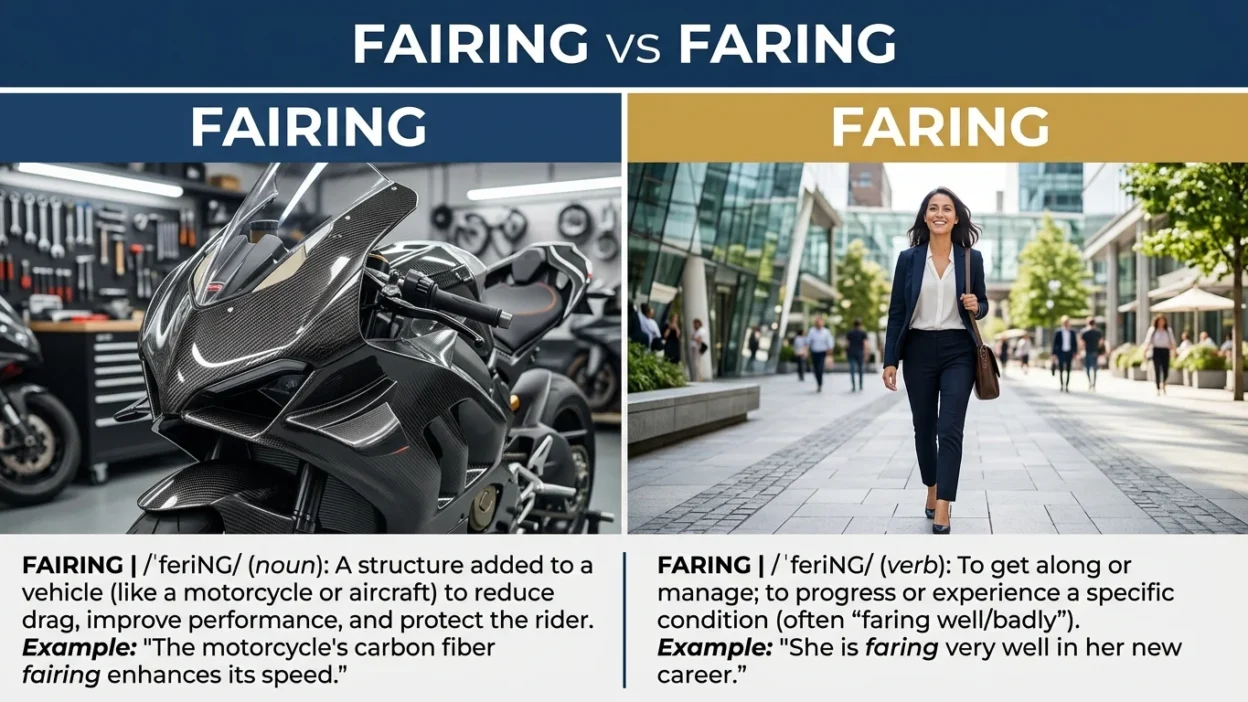
Fairing and faring are both correct English words, but they have completely different meanings. Fairing is usually a noun referring to a structure or covering designed to reduce air resistance or improve appearance. Faring is the present participle of fare, meaning to get along, perform, or experience a particular situation.
If you are asking how someone is doing, the correct word is faring: “How are you faring?” If you are talking about an aerodynamic covering on an aircraft, motorcycle, bicycle, or other vehicle, fairing is the correct spelling. The extra i in fairing is important because it connects the word to fair, while faring comes from fare.
Quick Answer
Fairing is a covering or structure that improves aerodynamics or appearance. Faring means getting along, doing, or experiencing something. Use faring in “How are you faring?” and fairing for an aerodynamic covering on a vehicle.
Why People Confuse It
The confusion happens because fairing and faring sound very similar and differ by only one letter.
However, they come from different words:
Fairing → fair
Faring → fare
Their meanings are therefore unrelated in most everyday contexts.
Compare:
How are you faring in your new job?
The motorcycle has a new fairing.
The first asks how someone is doing. The second refers to a physical part of a vehicle.
Fairing
Fairing is primarily a noun. It refers to a structure, covering, or enclosure designed to make something smoother, more aerodynamic, or sometimes more attractive.
It is especially common in engineering, aviation, automotive, and motorcycle contexts.
Examples of fairing
The motorcycle has a sleek fairing.
The aircraft’s fairing helps reduce aerodynamic drag.
The cyclist installed a protective fairing on the bike.
The word can also have other meanings in specialized contexts, but the aerodynamic sense is the one most people encounter today.
Faring
Faring is the present participle of fare.
The verb fare means to get along, progress, perform, or experience a particular situation.
For example:
How are you faring at your new job?
This means:
How are you doing at your new job?
Examples of faring
How is your business faring this year?
She is faring well in her new position.
How are the students faring in their exams?
The company is faring better than expected.
In each case, faring describes how someone or something is doing or progressing.
Comparison Table
| Word | Meaning | Part of Speech | Example |
|---|---|---|---|
| Fairing | A covering or structure, often aerodynamic | Noun | The motorcycle has a new fairing. |
| Faring | Getting along, progressing, or doing | Verb form | How are you faring? |
When to Use Each
Use “fairing” for a physical covering
Use fairing when referring to an aerodynamic structure or covering.
The mechanic replaced the damaged fairing.
Use “faring” for how someone is doing
Use faring when describing someone’s progress or situation.
How are you faring after the move?
Use “faring” with “well” or “badly”
A common construction is:
faring well
or
faring badly
For example:
The new restaurant is faring well.
The team is faring badly this season.
Examples of Fairing and Faring
- The mechanic repaired the motorcycle’s fairing.
- How are you faring in your new position?
- The aircraft has a lightweight aerodynamic fairing.
- The company is faring well despite the difficult market.
- The damaged fairing was replaced.
- How is your new business faring?
- The bike’s fairing reduces air resistance.
- The students are faring well in their classes.
- The engineer designed a new protective fairing.
- How are the patients faring after the procedure?
- The motorcycle’s front fairing was scratched.
- The smaller company is faring better than expected.
Common Mistakes
Mistake 1: “How are you fairing?”
Usually incorrect if you mean “How are you doing?”
Correct:
How are you faring?
Mistake 2: “The motorcycle has a new faring.”
If you mean the aerodynamic covering, use fairing.
Correct:
The motorcycle has a new fairing.
Mistake 3: Thinking “faring” comes from “fair”
It does not.
Faring comes from fare.
Fairing is associated with fair and has developed into a specialized noun for a covering or structure.
Memory Trick
Remember the source words:
Faring → fare → doing
Think:
How are you faring?
means:
How are you doing?
For fairing, think of a physical covering that makes a vehicle smoother or more aerodynamic.
Faring = doing
Fairing = covering
American vs British English
There is no major spelling difference between American and British English for these two words.
Both varieties use faring as the present participle of fare and fairing for the relevant noun.
For example:
How are you faring?
and
The motorcycle has a protective fairing.
are standard in both American and British English.
Similar Words
Fare vs fair
Fare can mean to get along or experience something:
How did you fare?
Fair can mean reasonable, acceptable, attractive, or just.
That seems fair.
Faring vs doing
Faring and doing can sometimes have similar meanings.
How are you faring?
How are you doing?
However, faring is somewhat more formal and is often used when discussing someone’s progress or circumstances.
Fairing vs covering
A fairing can function as a type of covering, particularly one designed for aerodynamic purposes.
However, not every covering is a fairing.
Final Verdict
Fairing and faring are both correct words, but they belong in very different contexts.
Use faring when you mean doing, progressing, or getting along:
How are you faring?
Use fairing when you mean an aerodynamic or protective covering or structure:
The motorcycle needs a new fairing.
The easiest way to remember the difference is faring = fare = doing, while fairing = a physical covering or aerodynamic structure.
FAQs
Is it “How are you faring” or “How are you fairing”?
The correct expression is “How are you faring?” when you mean “How are you doing?”
Is faring a real word?
Yes. Faring is the present participle of fare, meaning getting along, progressing, or experiencing a particular situation.
What is a fairing?
A fairing is a structure or covering, often used on vehicles or aircraft, that can reduce aerodynamic drag or protect components.
What does “faring well” mean?
Faring well means doing well or progressing successfully.
The business is faring well.
Are fairing and faring pronounced the same?
They are commonly pronounced very similarly, which is one reason they are easy to confuse. Their meanings and spellings are different.
Is “faring” formal English?
Yes. Faring is standard English and can sound somewhat more formal than the everyday word doing, especially in expressions such as “faring well.”
What is the difference between fairing and faring?
Fairing is generally a physical covering or aerodynamic structure, while faring means doing, progressing, or getting along.
Conclusion
The difference between fairing and faring becomes simple once you identify their source words. Faring comes from fare and describes how someone or something is doing. Fairing is generally a noun for a physical covering or structure, especially one used to improve aerodynamics.
When you want to ask about someone’s progress, write “How are you faring?” When you are talking about a motorcycle, aircraft, bicycle, or similar structure, fairing may be the word you need.
Remember This
Faring = fare = doing or progressing
Fairing = physical covering or aerodynamic structure

Nancy Lisa is a passionate writer and contributor at DrameyHut, focused on uncovering the deeper meanings behind dreams. She creates engaging and insightful content that helps readers interpret their dreams and understand their subconscious thoughts. Her work inspires self-reflection, clarity, and a stronger connection to inner emotions.