
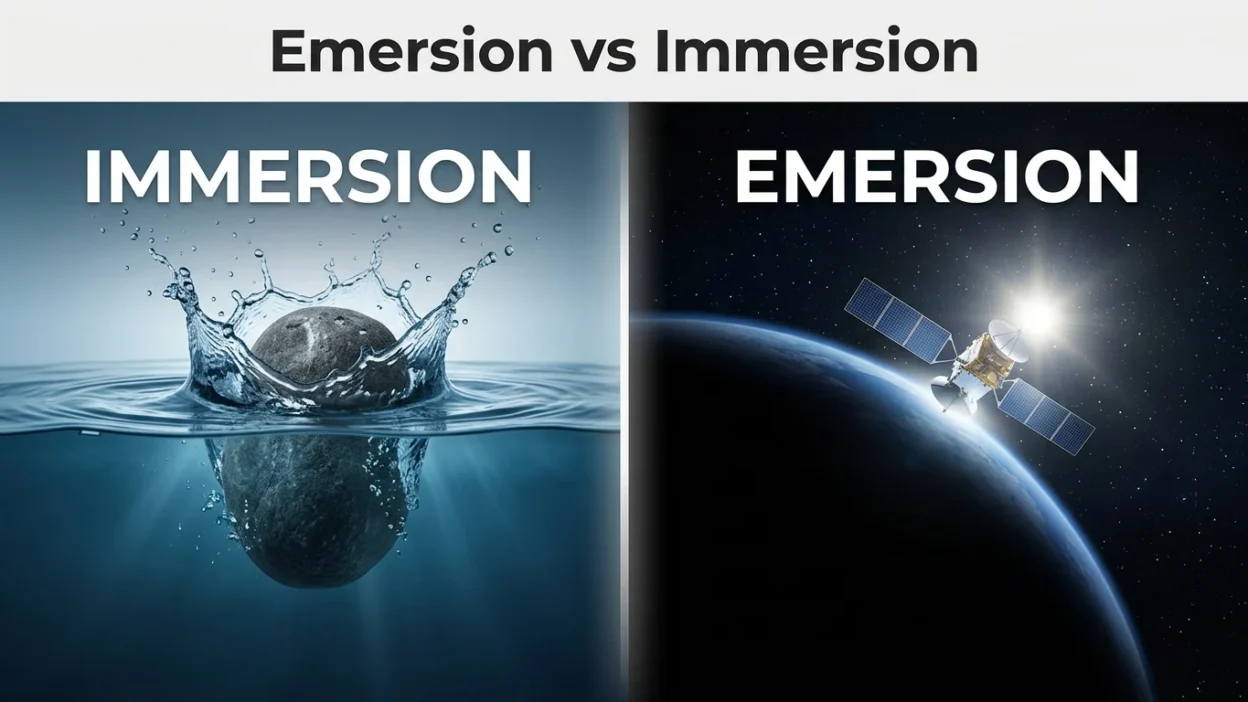
Emersion and immersion are both real English words, but they describe opposite ideas in many contexts. The confusion usually comes from their similar spelling and pronunciation. The key difference is the prefix: e in emersion and im in immersion.
Immersion is much more common. It generally means being completely surrounded by something, especially by liquid, or becoming deeply involved in an activity, language, culture, or experience. Emersion, by contrast, means the act of emerging or coming out from something, particularly from being hidden or covered. It is a specialized word that appears in scientific and astronomical contexts.
Knowing this distinction can help you choose the right word in academic writing, language learning, science, and everyday English. If you mean becoming deeply involved or submerged, immersion is almost certainly the word you need. If you mean emerging or becoming visible again, emersion is the correct term.
Quick Answer
Immersion means being submerged, surrounded, or deeply involved in something. Emersion means emerging or coming out from something, especially becoming visible after being hidden. Immersion is common; emersion is relatively rare and mainly used in specialized contexts.
Why People Confuse It
The words emersion and immersion look almost identical.
Both contain mersion, which comes from a Latin root associated with plunging or dipping.
The prefixes provide the important distinction:
Immersion suggests going into or being surrounded by something.
Emersion suggests coming out or becoming visible.
Compare:
Language immersion helped her become fluent.
The star’s emersion became visible after the eclipse.
The first sentence describes deep involvement. The second describes something becoming visible again.
Emersion
Emersion is a noun meaning the act or process of emerging or coming out, particularly after being hidden, covered, or obscured.
It is much less common than immersion.
The word is sometimes used in astronomy when a celestial object becomes visible again after being obscured by another object.
For example:
The astronomers recorded the emersion of the star.
Here, the star became visible again after being hidden.
Emersion in astronomy
In astronomical terminology, emersion can describe the moment when an object reappears after an occultation.
For example:
Observers recorded the moon’s emersion from behind the planet.
The important idea is reappearance or emergence.
Other uses of emersion
Emersion can also be used more generally for the act of emerging from a submerged or concealed state, although everyday English normally uses words such as emergence, appearance, or reappearance instead.
Immersion
Immersion is far more common and has several meanings.
It can mean:
- Being completely covered or submerged in liquid
- Becoming deeply involved in an activity
- Being surrounded by a language or culture
- Becoming completely absorbed in an experience
Physical immersion
The treatment involves immersion in warm water.
Here, something is physically placed into liquid.
Language immersion
Students benefit from total English immersion.
This means students spend extensive time surrounded by and using English.
Cultural immersion
The trip provided an opportunity for cultural immersion.
This means becoming deeply involved in another culture.
Immersion in an activity
He became completely immersed in the project.
Here, immersed means deeply involved or absorbed.
Comparison Table
| Word | Meaning | Frequency | Common Context | Example |
|---|---|---|---|---|
| Emersion | Emerging or becoming visible | Relatively rare | Astronomy, specialized writing | The astronomers observed the star’s emersion. |
| Immersion | Submerging, surrounding, or becoming deeply involved | Very common | Water, language, culture, education | Language immersion improved her fluency. |
The easiest distinction is:
Immersion = going in or being deeply involved
Emersion = coming out or becoming visible
When to Use Each
Use immersion for being surrounded by something
Use immersion when something is physically submerged.
The equipment requires immersion in water.
Use immersion for language learning
Language immersion is a standard term for learning a language by being surrounded by and regularly using it.
The school offers an English immersion program.
Use immersion for cultural experiences
Cultural immersion can help travelers understand local customs.
Use immersion for deep involvement
Her immersion in the research lasted several months.
Here, immersion is figurative rather than physical.
Use emersion for emerging or reappearing
Use emersion when you specifically need the noun for something emerging or becoming visible again.
The telescope captured the emersion of the star.
Because this word is uncommon, emergence or reappearance may sound more natural in ordinary writing.
Examples of Emersion and Immersion
- The diver experienced complete immersion in cold water.
- The language program uses total English immersion.
- The astronomer recorded the star’s emersion.
- Cultural immersion helped the students understand local traditions.
- The equipment must undergo water immersion testing.
- Her complete immersion in the novel made her lose track of time.
- The researchers observed the celestial body’s emersion.
- The course provides students with intensive language immersion.
- The athlete used cold water immersion after training.
- The telescope detected the object’s emersion from behind the moon.
- The program encourages students to learn through cultural immersion.
- The scientist carefully recorded the exact time of emersion.
Common Mistakes
Mistake 1: Using emersion for language learning
Incorrect:
The students participated in an English emersion program.
Correct:
The students participated in an English immersion program.
Language learning involves being surrounded by the language, so immersion is the standard word.
Mistake 2: Assuming emersion is a misspelling
Emersion is a legitimate word.
It is simply much less common than immersion.
Mistake 3: Using immersion when you mean emergence
If you mean that something appeared or came into existence, emergence is usually the better word.
The emergence of new technology changed the industry.
Not:
The immersion of new technology changed the industry.
Mistake 4: Thinking immersion always involves water
Immersion can be physical, but it can also be figurative.
She was immersed in her studies.
No water is involved. The sentence means she was deeply involved in studying.
Memory Trick
Think about the direction.
Immersion = in
The word immersion contains im, which you can associate with in.
Immersion = going in, being surrounded, or becoming deeply involved.
Emersion = emerge
Both emersion and emerge begin with em.
Emersion = coming out or becoming visible.
A simple memory sentence is:
Immersion takes you in; emersion brings you out.
American vs British English
There is no major difference between American and British English in the basic meanings of emersion and immersion.
Immersion is widely used in both varieties, particularly in expressions such as:
language immersion
cultural immersion
water immersion
Emersion is also recognized in both varieties, but it is uncommon and is more likely to appear in specialized scientific or astronomical writing.
In everyday English, speakers will often choose emergence, appearance, or reappearance instead of emersion, depending on the context.
Similar Words
Immersion vs submersion
Immersion means being placed or involved deeply in something.
Submersion specifically emphasizes being placed beneath a liquid or other substance.
Water immersion is part of the treatment.
The device was completely submerged.
Emersion vs emergence
These words are related in meaning but are not identical.
Emergence generally means coming into view, existence, prominence, or awareness.
Emersion specifically refers to emerging from a submerged, concealed, or obscured state and is particularly specialized in astronomy.
Immersed vs involved
Immersed can mean deeply involved.
She was immersed in her work.
Involved is broader and more neutral.
She was involved in the project.
Final Verdict
Emersion and immersion are both correct words, but they point in different directions.
Use immersion for submerging, being surrounded, or becoming deeply involved:
The students learned through language immersion.
Use emersion for emerging or becoming visible again, particularly in specialized scientific and astronomical contexts:
The astronomers recorded the star’s emersion.
For everyday English, immersion is by far the more common word. If you rarely encounter emersion, that is normal. It is a specialized term rather than a common alternative to immersion.
Frequently Asked Questions
Is emersion a real word?
Yes. Emersion is a legitimate English noun meaning the act of emerging or becoming visible after being hidden or submerged. It is relatively uncommon.
What is the difference between emersion and immersion?
Immersion means going into, being surrounded by, or becoming deeply involved in something. Emersion means emerging or becoming visible after being hidden or covered.
Is it “English immersion” or “English emersion”?
The correct phrase is English immersion. It describes learning English by being surrounded by and regularly using the language.
Is emersion the opposite of immersion?
In a broad sense, the words can describe opposite movements: immersion involves going into or being submerged, while emersion involves coming out or emerging. However, they are not exact opposites in every context.
What does immersion mean?
Immersion can mean physical submersion in a liquid or deep involvement in an activity, language, culture, or experience.
What does emersion mean in astronomy?
In astronomy, emersion refers to the reappearance of a celestial object after it has been hidden or obscured by another object.
Is emersion commonly used?
No. Emersion is relatively rare and tends to occur in specialized contexts. Immersion is much more common in everyday, academic, educational, and professional English.
Conclusion
The easiest way to distinguish emersion from immersion is to think about direction. Immersion involves going in, being submerged, or becoming deeply involved. Emersion involves coming out, emerging, or becoming visible again. The difference is small in spelling but important in meaning.
For most everyday situations, especially language learning, education, culture, and physical submersion, immersion is the word you need. Emersion is a specialized term that you are more likely to encounter in scientific or astronomical contexts.
Remember This
Immersion = in, submerged, or deeply involved
Emersion = emerge, come out, or become visible
Immersion takes you in; emersion brings you out.

Christopher Thomas is a passionate writer and dream researcher dedicated to exploring the meanings behind dreams. As an author at DrameyHut, he creates insightful and easy-to-understand interpretations that help readers connect with their subconscious mind. His work focuses on guiding individuals toward self-discovery, clarity, and a deeper understanding of their inner thoughts.