
The words paid and payed often confuse English learners because both appear to be past tense forms of the verb pay. However, they are not interchangeable.
While paid is the correct spelling in almost every situation, payed is a rare term used only in specific nautical and technical contexts.
If you’ve ever wondered if to write paid or payed, you’re not alone. This guide explains the difference, when to use each word, common mistakes to avoid, and provides plenty of examples to help you use the correct form with confidence.
Quick Answer
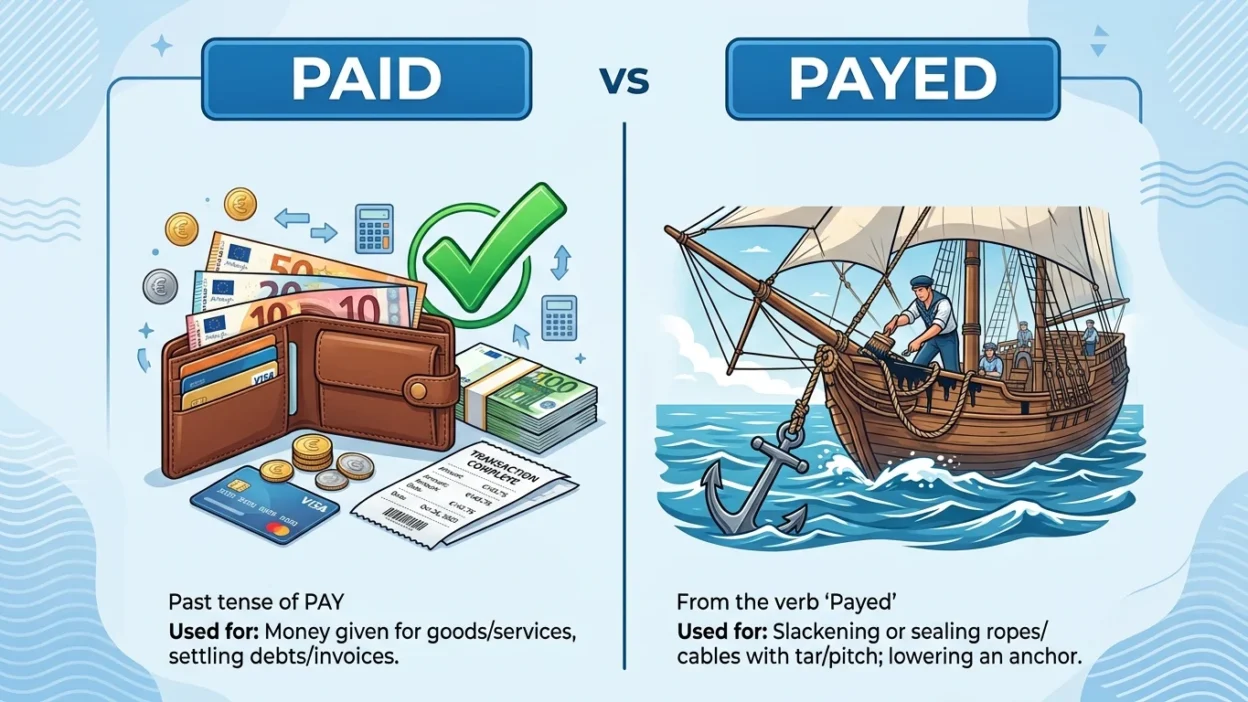
Paid is the correct past tense and past participle of pay in almost every context. Payed is a rare spelling used mainly in nautical language, such as payed out rope or payed the seams of a ship. For money, salaries, bills, or purchases, always use paid.
Why People Confuse It
People often mix up paid and payed because:
- Most English verbs form the past tense by adding ed.
- The verb pay seems like it should become payed.
- Payed is a real word, but it has a very specialized meaning.
- Spell check may not explain the difference.
The easiest rule is that paid is almost always the correct choice.
First Word: Paid
Paid is the standard past tense and past participle of the verb pay.
It is used when talking about:
- Money
- Bills
- Wages
- Purchases
- Debts
- Rewards
- Attention
- Respect
Example Sentences
- I paid the electricity bill yesterday.
- She paid for dinner.
- They paid their employees on Friday.
- He paid close attention during the meeting.
- We paid the full amount in advance.
These are the most common uses of paid in everyday English.
Second Word: Payed
Payed is a correct but uncommon word.
It is mainly used in nautical and maritime language.
It can mean:
- Letting out rope or cable.
- Sealing the seams of a wooden ship with tar or pitch.
Example Sentences
- The sailors payed out the anchor rope.
- They payed the ship’s seams before launching it.
Outside these specialized meanings, payed should not be used.
Paid vs Payed Comparison Table
| Feature | Paid | Payed |
|---|---|---|
| Correct for Money | Yes | No |
| Past Tense of Pay | Yes | No |
| Common in Everyday English | Yes | No |
| Used in Nautical Contexts | No | Yes |
| Example | She paid the bill. | The crew payed out the rope. |
When to Use Each
Use paid when referring to:
- Paying money
- Buying something
- Receiving wages
- Paying taxes
- Paying attention
- Paying respect
- Paying a debt
Use payed only when referring to:
- Letting out rope or cable.
- Waterproofing a wooden ship by sealing its seams.
If you’re writing about money or everyday life, paid is almost certainly the correct word.
Examples
Here are more than ten examples of correct usage.
- I paid my rent on time.
- She paid for everyone’s lunch.
- He paid the repair bill.
- We paid our taxes early.
- They paid the workers every Friday.
- Thank you for the time you paid to this project.
- She paid close attention to the lesson.
- The sailors payed out the heavy cable.
- The crew payed the seams with tar.
- They paid the membership fee.
- He paid off his loan.
- We paid in cash.
Common Mistakes
Incorrect:
- I payed for the tickets.
Correct:
- I paid for the tickets.
Incorrect:
- She payed the electricity bill.
Correct:
- She paid the electricity bill.
Correct nautical example:
- The crew payed out the rope.
Memory Trick
Here’s an easy way to remember.
If the sentence involves money, bills, shopping, or salary, use paid.
Think of the phrase:
Money is paid.
Reserve payed for ships and ropes.
American vs British English
Both American English and British English follow the same rule.
- Paid is the standard past tense of pay.
- Payed is used only in specialized nautical contexts.
There is no regional difference.
Similar Words
If you’re learning commonly confused English words, these pairs are also useful.
- Has Run vs Has Ran
- Accept vs Except
- Affect vs Effect
- Passed vs Past
- Than vs Then
- Too vs To
- Principal vs Principle
- Compliment vs Complement
- Reinforce vs Reenforce
- Message vs Messege
Final Verdict
Although both paid and payed are real English words, they are used in different situations.
Use paid for money, purchases, wages, bills, debts, attention, and respect.
Use payed only in rare nautical contexts involving ropes or ship maintenance.
For almost all everyday writing, paid is the correct choice.
Frequently Asked Questions
Is paid or payed correct?
For everyday English, paid is correct. Payed is only correct in specialized nautical contexts.
Is payed a real word?
Yes. It is a real but uncommon word used in maritime language.
Can I say I payed the bill?
No. The correct sentence is I paid the bill.
Why is paid spelled differently?
The verb pay is irregular, so its past tense is paid, not payed.
Is payed used in American English?
Yes, but only in nautical contexts. Otherwise, Americans use paid.
What is the past tense of pay?
The correct past tense and past participle is paid.
Remember This
Paid is for money, bills, wages, and everyday situations.
Payed is for ships, ropes, and maritime terminology.
When in doubt, choose paid.
Conclusion
The difference between paid vs payedvs payed is simple once you know their meanings. Paid is the standard past tense and past participle of pay, making it the correct choice for almost every situation involving money, purchases, wages, or expressions like paid attention.
Payed, while a legitimate English word, is limited to specialized nautical uses and is rarely encountered outside maritime contexts.
If you’re writing for school, work, or everyday communication, paid is almost always the correct spelling. Remember this rule, and you’ll avoid one of the most common English spelling mistakes.

Daniel Charles is a dedicated author and dream interpretation enthusiast at DrameyHut. He specializes in analyzing dream symbols and meanings, offering clear and insightful content for readers. His work aims to help individuals understand their subconscious thoughts, gain clarity, and explore the deeper messages hidden within their dreams.