Verbs that start with P are some of the most useful action words in the English language. From everyday conversations to academic writing and professional communication, these verbs help describe actions, processes, and emotions clearly and effectively.
If you’re a student, writer, teacher, or English learner, expanding your vocabulary with verbs that start with P can improve your speaking and writing skills.
This guide includes a comprehensive list of common P verbs, their meanings, and example sentences.
Quick Answer
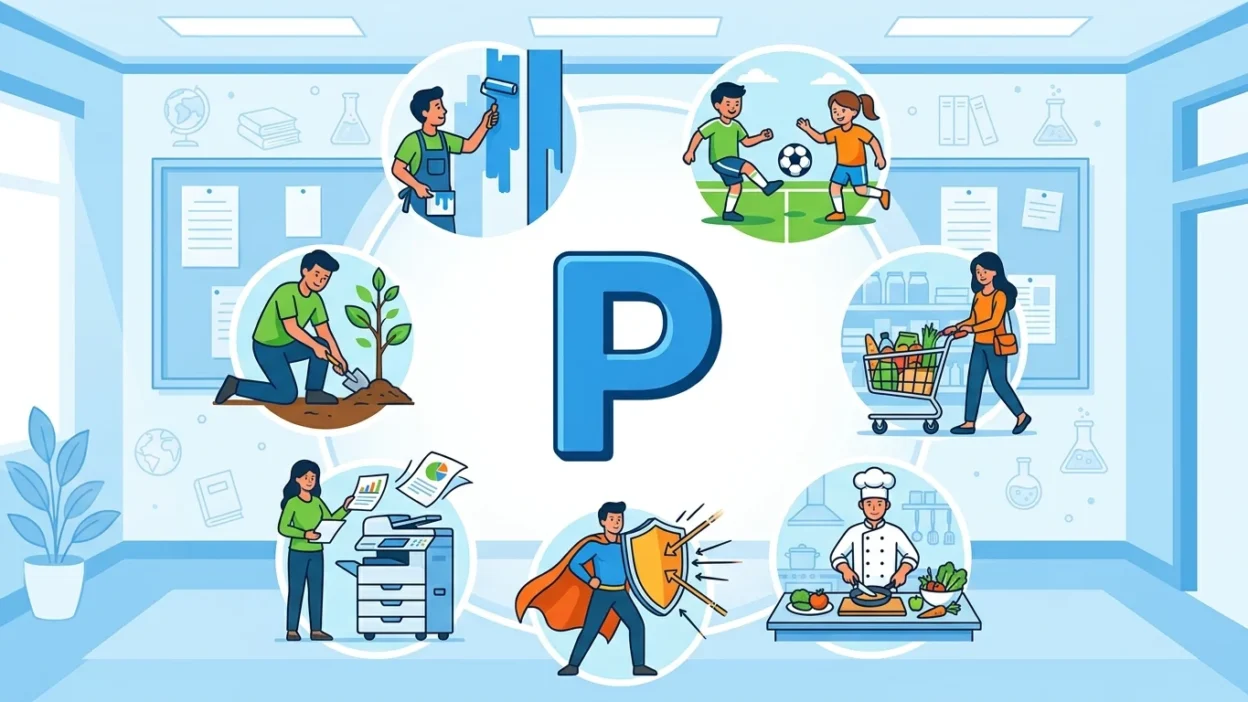
Some of the most common verbs that start with P include paint, park, participate, pass, pay, perform, permit, persuade, plan, play, point, postpone, practice, predict, prepare, prevent, print, produce, protect, prove, provide, publish, pull, push, and purchase.
Common Verbs That Start With P
| Verb | Meaning | Example Sentence |
|---|---|---|
| Paint | Apply color to a surface | She painted the wall blue. |
| Park | Leave a vehicle in a place | He parked the car outside. |
| Participate | Take part in an activity | Students participated in the competition. |
| Pass | Move beyond or succeed | She passed the exam. |
| Pay | Give money | I paid the bill yesterday. |
| Perform | Carry out an action | The band performed live. |
| Permit | Allow | Smoking is not permitted here. |
| Persuade | Convince someone | She persuaded him to stay. |
| Plan | Decide in advance | We planned our vacation. |
| Plant | Put seeds in the ground | They planted flowers. |
| Play | Take part in a game | The children played outside. |
| Point | Indicate a direction | He pointed at the map. |
| Polish | Make smooth or shiny | She polished her shoes. |
| Postpone | Delay until later | They postponed the meeting. |
| Practice | Repeat to improve | She practices the piano daily. |
| Praise | Express approval | The teacher praised the students. |
| Predict | Say what will happen | Experts predicted heavy rain. |
| Prefer | Like better | I prefer coffee to tea. |
| Prepare | Get ready | We prepared dinner together. |
| Present | Show or introduce | She presented the report. |
| Preserve | Protect from damage | They preserved the old building. |
| Press | Push firmly | Press the green button. |
| Pretend | Act as if something is true | The children pretended to be pirates. |
| Prevent | Stop from happening | Seat belts prevent injuries. |
| Produce text on paper | Please print the document. | |
| Produce | Create or manufacture | The factory produces cars. |
| Promise | Give your word | I promise to help. |
| Protect | Keep safe | Sunscreen protects your skin. |
| Prove | Show to be true | She proved her point. |
| Provide | Supply something | The hotel provides free breakfast. |
| Publish | Make available publicly | The author published a new book. |
| Pull | Move toward yourself | Pull the door open. |
| Pump | Move liquid or air | They pumped water from the well. |
| Punch | Hit with a fist | He punched the boxing bag. |
| Purchase | Buy something | We purchased new furniture. |
| Pursue | Follow or chase | She pursued her dreams. |
| Push | Move away using force | Push the cart slowly. |
More Verbs That Start With P
Here are additional useful verbs beginning with P.
- Pack
- Paddle
- Pair
- Panic
- Patrol
- Pause
- Peek
- Peel
- Perform
- Perish
- Persist
- Personalize
- Phone
- Photograph
- Pick
- Pin
- Pinch
- Pioneer
- Place
- Plead
- Plug
- Plunge
- Pose
- Possess
- Pour
- Pray
- Preach
- Precede
- Prefer
- Process
- Program
- Progress
- Pronounce
- Propose
- Protest
- Pry
- Purify
- Puzzle
Verbs That Start With P for Everyday Use
These are some of the most frequently used P verbs in daily conversations.
- Play
- Pay
- Pull
- Push
- Pass
- Plan
- Prepare
- Park
- Purchase
Positive Verbs That Start With P
If you’re looking for encouraging or uplifting action words, consider these positive P verbs.
- Praise
- Protect
- Promote
- Provide
- Prosper
- Perform
- Progress
- Preserve
- Promise
- Pursue
Example Sentences
- She planned a surprise party.
- We prepared breakfast together.
- Please print the report.
- They protected the environment.
- He performed beautifully on stage.
- I prefer reading before bed.
- The teacher praised the class.
- We purchased a new laptop.
- She predicted the outcome correctly.
- They participated in the charity event.
- Please push the door gently.
- He proved his innocence.
Tips for Learning P Verbs
- Learn a few new verbs each week.
- Write sentences using each verb.
- Read books to see verbs in context.
- Practice speaking aloud.
- Group similar verbs together for easier memorization.
Frequently Asked Questions
What are common verbs that start with P?
Common examples include play, pay, plan, prepare, perform, protect, provide, print, predict, and purchase.
What are positive verbs that start with P?
Positive P verbs include praise, protect, provide, prosper, perform, pursue, and progress.
What are action verbs that start with P?
Examples include push, pull, paint, park, perform, play, prepare, and plant.
Are there many English verbs that start with P?
Yes. English has hundreds of verbs beginning with P, ranging from simple everyday words to advanced academic vocabulary.
Which P verbs are useful for writing?
Useful writing verbs include present, propose, prove, publish, preserve, process, prepare, and provide.
Remember This
Many P verbs describe actions involving planning, preparing, performing, protecting, or providing. Learning these words will improve your vocabulary and make your English more expressive.
Conclusion
Verbs that start with P are essential for effective communication in both spoken and written English. If you’re using everyday verbs like play and pay or more advanced words like pursue and preserve, expanding your vocabulary will help you express yourself with greater confidence and precision.
Practice using these verbs in conversations and writing, and you’ll quickly strengthen your English language skills.

Joseph Richard is the administrator and a dedicated author at DrameyHut, overseeing the platform’s operations and content quality. Alongside his administrative role, he writes insightful articles on dream meanings, helping readers understand their subconscious mind. His work supports the mission of providing clear, meaningful, and engaging dream interpretations.