Many English learners confuse propose and purpose because the words look and sound somewhat similar. However, they have completely different meanings and grammatical roles. Mixing them up can change the meaning of your sentence and lead to misunderstandings.
Understanding the difference between propose vs purpose will help you communicate more clearly in conversations, academic writing, business emails, and everyday English. This guide explains the meanings, correct usage, examples, common mistakes, and an easy memory trick.
Quick Answer
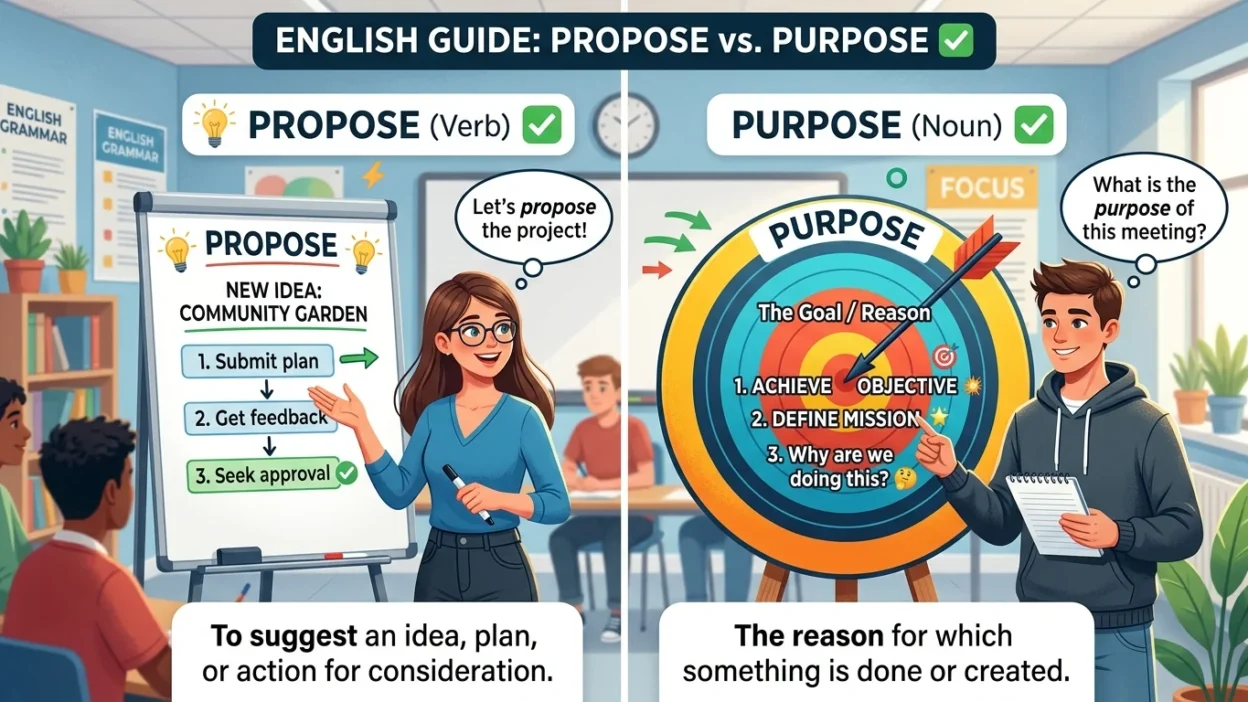
Propose is a verb that means to suggest an idea, plan, or marriage. Purpose is usually a noun that means the reason for doing something, although it can also be used as a verb in formal English meaning to intend.
Why People Confuse It
The confusion happens because propose and purpose have similar spellings and pronunciation.
However, they belong to different parts of speech and are used in different situations. Propose is mainly about making a suggestion, while purpose refers to an aim or reason.
Propose
Propose is a verb.
Meaning
It means:
- To suggest an idea or plan.
- To recommend something for consideration.
- To ask someone to marry you.
Examples
- I propose a new marketing strategy.
- She proposed changing the meeting time.
- The committee proposed several improvements.
- He proposed to his girlfriend last weekend.
- They proposed a solution to the problem.
Purpose
Purpose is mainly a noun.
Meaning
It refers to:
- The reason something exists.
- An aim or objective.
- A goal or intention.
As a formal verb, purpose means to intend.
Examples
- The purpose of this meeting is to discuss the budget.
- What is the purpose of this tool?
- His life has a clear purpose.
- The purpose of education is to develop knowledge.
- She purposed to finish the project by Friday. (formal and uncommon)
Comparison Table
| Feature | Propose | Purpose |
|---|---|---|
| Part of speech | Verb | Mainly noun |
| Means to suggest | ✅ Yes | ❌ No |
| Means reason or goal | ❌ No | ✅ Yes |
| Used for marriage proposals | ✅ Yes | ❌ No |
| Common in everyday English | ✅ Yes | ✅ Yes |
When to Use Each
Use propose when:
- Suggesting an idea.
- Offering a plan.
- Recommending a solution.
- Asking someone to marry you.
Use purpose when:
- Explaining the reason for something.
- Describing a goal or objective.
- Talking about intention or function.
Examples
- I propose that we start early.
- She proposed a better solution.
- They proposed new company policies.
- He proposed during their holiday.
- The manager proposed hiring more staff.
- The purpose of the lesson is to improve grammar.
- What is the purpose of this machine?
- Our purpose is to help customers.
- The meeting served an important purpose.
- She found a new purpose in life.
- The purpose of the experiment was clear.
- We propose making a few changes.
Common Mistakes
Many learners make these errors.
- Using purpose when they mean propose.
- Confusing the noun purpose with the verb propose.
- Writing I purpose a new plan instead of I propose a new plan.
Correct:
- I propose a new idea.
- The purpose of the project is to reduce costs.
Incorrect:
- I purpose a new idea.
- The propose of the project is clear.
Memory Trick
Remember this simple rule:
Propose = Present an idea.
Purpose = Reason or goal.
If you’re suggesting something, use propose.
If you’re explaining why something exists, use purpose.
American vs British English
There is no significant difference between American and British English.
Both varieties use propose and purpose with the same meanings and grammar.
Similar Words
You may also confuse these word pairs:
- Propose vs Suggest
- Purpose vs Goal
- Purpose vs Objective
- Plan vs Proposal
- Intent vs Purpose
- Goal vs Aim
- Offer vs Propose
- Recommend vs Propose
- Mission vs Purpose
- Reason vs Purpose
Final Verdict
The difference between propose and purpose is straightforward once you know their roles. Propose is a verb used when suggesting an idea, plan, or marriage. Purpose is mainly a noun that refers to a reason, aim, or objective.
Choosing the correct word will make your English more precise and help you avoid common vocabulary mistakes.
Remember This
Propose = To suggest something. ✅
Purpose = The reason or goal. ✅
Think:
I propose a solution.
The purpose is to solve the problem.
FAQs
What is the difference between propose and purpose?
Propose means to suggest an idea or plan, while purpose means the reason or objective behind something.
Is propose a verb?
Yes. Propose is a verb.
Is purpose a noun?
Yes. Purpose is mainly a noun, although it can also be used as a formal verb meaning to intend.
Can purpose be used as a verb?
Yes, but it is uncommon in modern English. Most people use it as a noun.
Which is correct, I propose or I purpose?
Use I propose when suggesting an idea. I purpose is rare and usually sounds overly formal or old-fashioned.
Do British and American English use these words differently?
No. Both varieties use propose and purpose in the same way.
What is another word for purpose?
Common alternatives include goal, aim, objective, reason, and intention.
Conclusion
Although propose and purpose look similar, they have different meanings and functions. Propose is the word to use when making a suggestion or asking someone to marry you, while purpose refers to the reason, goal, or objective behind an action or thing.
By remembering Propose = Suggest and Purpose = Reason, you’ll choose the correct word with confidence and make your spoken and written English more accurate.

Joseph Richard is the administrator and a dedicated author at DrameyHut, overseeing the platform’s operations and content quality. Alongside his administrative role, he writes insightful articles on dream meanings, helping readers understand their subconscious mind. His work supports the mission of providing clear, meaningful, and engaging dream interpretations.