Many English learners wonder whether they should say I didn’t do nothing or I didn’t do anything. The confusion often comes from hearing both expressions in movies, songs, and everyday conversations. While both are commonly heard, they are not considered equally correct in standard English.
Understanding the difference between I didn’t do nothing vs I didn’t do anything will help you speak and write more accurately. This guide explains the correct usage, grammar rules, examples, common mistakes, and when the informal version may be acceptable.
Quick Answer
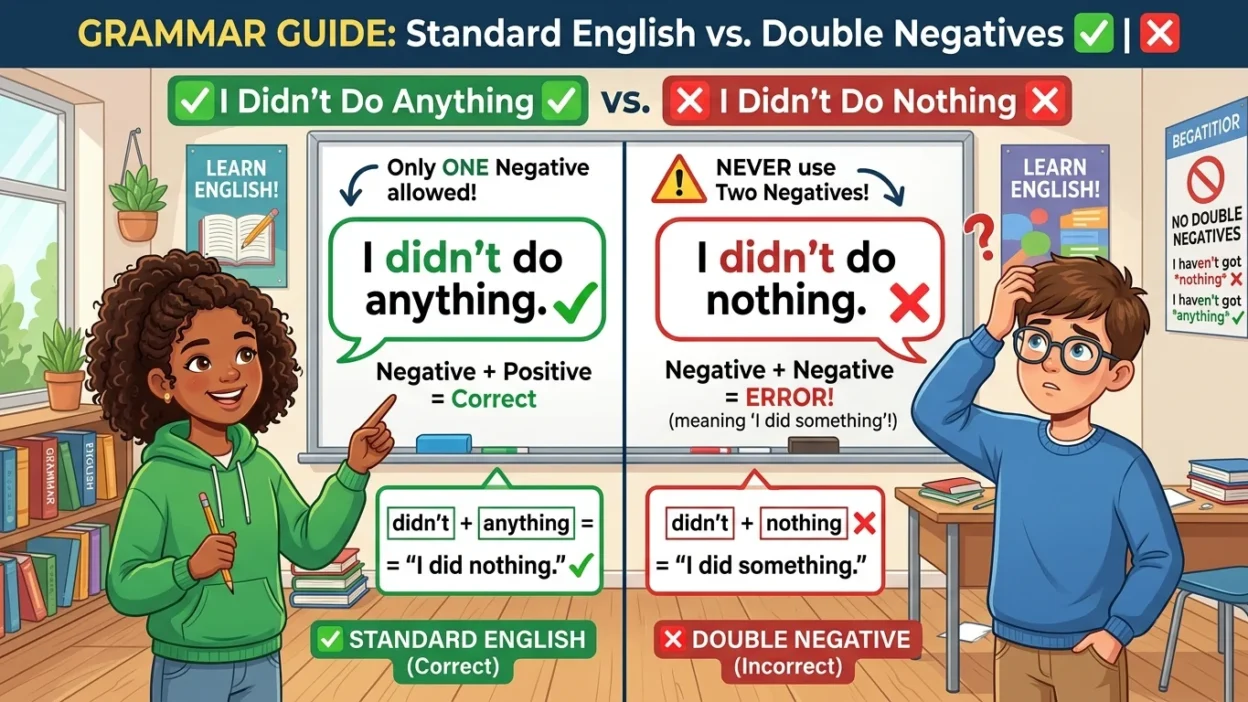
I didn’t do anything is the correct form in standard English. I didn’t do nothing is a double negative, which is considered grammatically incorrect in formal English. However, it is used in some regional dialects and informal speech for emphasis.
Why People Confuse It
The confusion happens because many native speakers use double negatives in casual conversation, music, and certain dialects.
In standard English, two negatives usually cancel each other out, making the sentence grammatically incorrect.
I Didn’t Do Anything
I didn’t do anything is the correct expression in standard English.
Meaning
It means you did not do any action.
Examples
- I didn’t do anything wrong.
- She didn’t do anything unusual.
- We didn’t do anything yesterday.
- They didn’t do anything to cause the problem.
- He didn’t do anything during the meeting.
I Didn’t Do Nothing
I didn’t do nothing is a non-standard expression.
Meaning
In many regional dialects, it means the same as I didn’t do anything. However, in standard grammar, it is considered a double negative.
Examples
- I didn’t do nothing! (informal or dialectal speech)
- He didn’t say nothing all day. (non-standard)
- We didn’t see nobody there. (non-standard)
In formal English, these should be:
- I didn’t do anything.
- He didn’t say anything all day.
- We didn’t see anybody there.
Comparison Table
| Feature | I Didn’t Do Anything | I Didn’t Do Nothing |
|---|---|---|
| Grammatically correct in standard English | ✅ Yes | ❌ No |
| Uses a double negative | ❌ No | ✅ Yes |
| Suitable for formal writing | ✅ Yes | ❌ No |
| Common in regional dialects | Sometimes | ✅ Yes |
| Recommended for learners | ✅ Yes | ❌ No |
When to Use Each
Use I didn’t do anything when:
- Writing essays.
- Sending emails.
- Speaking in professional settings.
- Taking English exams.
- Communicating in standard English.
Use I didn’t do nothing only when:
- Quoting someone’s speech.
- Writing dialogue for a character.
- Reflecting a specific regional dialect or informal style.
Examples
- I didn’t do anything wrong.
- She didn’t do anything to upset him.
- We didn’t do anything after dinner.
- They didn’t do anything illegal.
- He didn’t do anything suspicious.
- I didn’t do nothing. (non-standard)
- He didn’t say nothing. (non-standard)
- We didn’t see nobody. (non-standard)
- She didn’t tell nobody. (non-standard)
- They didn’t buy nothing. (non-standard)
- I didn’t do anything all weekend.
- We didn’t hear anything during the storm.
Common Mistakes
Many learners make these errors.
- Using nothing after didn’t in formal writing.
- Confusing standard English with regional speech.
- Assuming double negatives are always correct.
Correct:
- I didn’t do anything.
Incorrect in standard English:
- I didn’t do nothing.
Memory Trick
Remember this simple rule:
If your sentence already has didn’t, use anything, anybody, or anywhere.
Avoid another negative word like nothing, nobody, or nowhere in standard English.
American vs British English
Both American and British English follow the same grammar rule in standard usage.
However, I didn’t do nothing is heard in some regional dialects in both countries, especially in informal speech.
Similar Words
You may also confuse these pairs:
- Anything vs Nothing
- Anybody vs Nobody
- Anywhere vs Nowhere
- Ever vs Never
- Neither vs Either
- None vs Any
- Something vs Anything
- No one vs Anyone
- Hardly vs Barely
- Few vs A Few
Final Verdict
The correct choice for standard English is I didn’t do anything. It is grammatically correct, clear, and appropriate in both spoken and written English.
Although I didn’t do nothing is common in some dialects and informal speech, it is considered a double negative and should be avoided in formal communication and English learning.
Remember This
I didn’t do anything. ✅ Standard English
I didn’t do nothing. ❌ Non-standard English
If your sentence already contains didn’t, use anything, not nothing.
FAQs
Which is correct, I didn’t do nothing or I didn’t do anything?
I didn’t do anything is correct in standard English.
Why is I didn’t do nothing considered incorrect?
Because it uses a double negative, which is generally avoided in standard English grammar.
Is I didn’t do nothing ever acceptable?
Yes. It is common in some regional dialects, song lyrics, and informal speech, but not in formal writing.
What is a double negative?
A double negative occurs when two negative words appear in the same clause, such as didn’t and nothing.
Do native speakers say I didn’t do nothing?
Yes. Some native speakers use it in casual conversation or dialects, but it is not considered standard English.
Is the rule the same in British and American English?
Yes. Both varieties recommend I didn’t do anything in standard English.
What should English learners use?
English learners should use I didn’t do anything because it is correct in formal and everyday standard English.
Conclusion
The difference between I didn’t do nothing and I didn’t do anything comes down to standard grammar. I didn’t do anything is the correct and recommended form because it avoids a double negative and is accepted in both formal and informal standard English.
While you may hear I didn’t do nothing in songs, films, or regional dialects, it is best to reserve that form for quoted speech or stylistic purposes. For clear and accurate English, choose I didn’t do anything.

Daniel Charles is a dedicated author and dream interpretation enthusiast at DrameyHut. He specializes in analyzing dream symbols and meanings, offering clear and insightful content for readers. His work aims to help individuals understand their subconscious thoughts, gain clarity, and explore the deeper messages hidden within their dreams.