
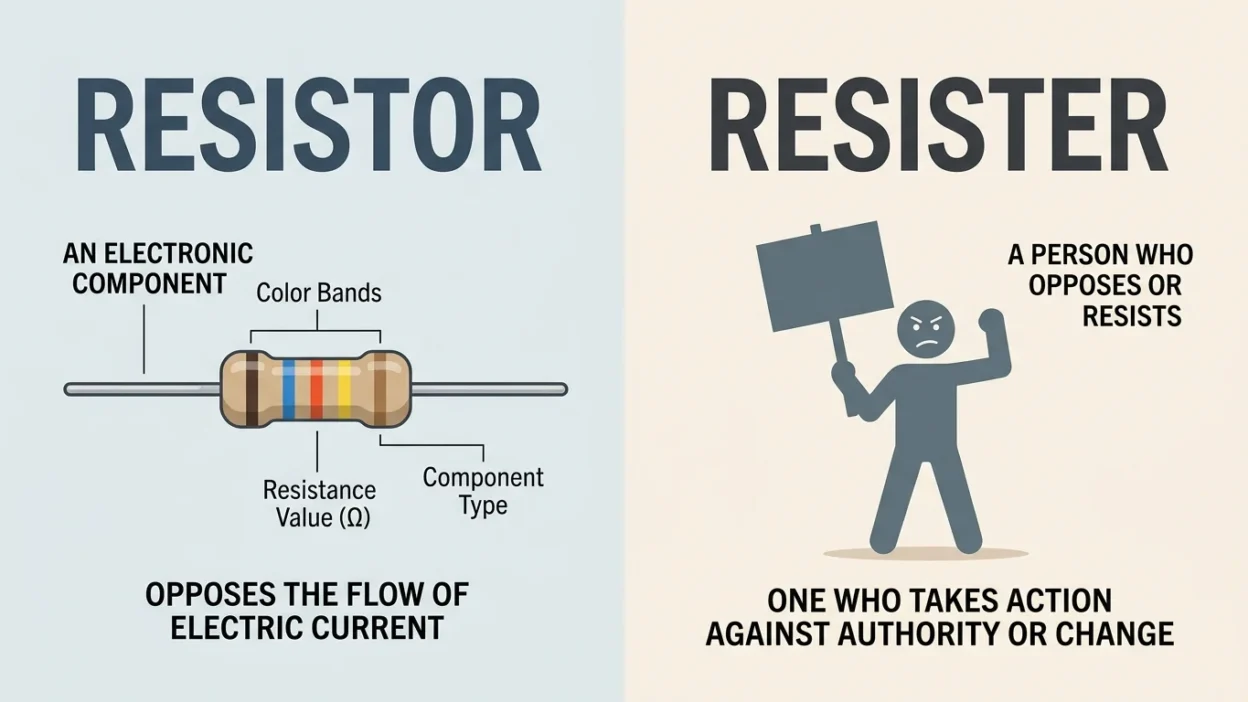
“Resistor” and “resister” look almost identical, so it is easy to confuse them. However, they have completely different meanings. One is a common technical term used in electronics, while the other refers to a person who resists something.
Resistor is the correct word when you are talking about an electronic component that limits or controls the flow of electric current. Resister is a noun formed from the verb “resist” and means a person or thing that resists something.
Understanding the difference is especially important in technical writing, electronics, engineering, and everyday English. A single letter can completely change the meaning of the word.
Quick Answer
Resistor is an electronic component that limits the flow of electrical current. Resister means a person or thing that resists something. If you are talking about circuits, voltage, current, or resistance, the correct word is resistor.
Why People Confuse Resistor and Resister
The confusion comes from their similar spelling and pronunciation.
Both words contain the same basic letters, and both are related to the idea of resistance. However, they developed into different words with different uses.
The easiest way to remember the difference is:
Resistor = electronics
Resister = someone who resists
Resistor: Meaning and Definition
A resistor is an electronic component designed to resist or limit the flow of electric current in a circuit.
Resistors are fundamental components in electrical and electronic systems. They are commonly used to control current, divide voltage, protect other components, and set operating conditions.
For example:
The technician replaced the damaged resistor.
Here, “resistor” refers to a physical electronic component.
A resistor has a specific resistance, usually measured in ohms.
Examples of Resistor
- The circuit needs a 100 ohm resistor.
- The resistor limits the amount of current flowing through the circuit.
- We replaced the burned resistor.
- This resistor has a higher resistance than the original one.
- The engineer selected a resistor for the new circuit.
- Check the resistor before turning on the device.
- The resistor became hot during the experiment.
- The circuit contains several resistors.
- A resistor can be used to reduce voltage.
- The technician tested the resistor with a multimeter.
Resister: Meaning and Definition
A resister is a person or thing that resists something.
It comes from the verb resist, which means to oppose, fight against, or refuse to accept something.
For example:
He was a strong resister of the proposed changes.
Here, “resister” describes someone who opposes or resists something.
The word is grammatically possible, but it is much less common than resistor. In many everyday situations, speakers would simply say someone who resists or opponent instead.
Examples of Resister
- He was known as a resister of the new policy.
- The resister refused to accept the proposed changes.
- Several resisters organized a peaceful protest.
- She became a vocal resister of the plan.
- The movement attracted many resisters.
- He described himself as a resister of unnecessary rules.
- The resister continued to oppose the decision.
- The group included several political resisters.
- She was a determined resister of the policy.
- The resister refused to cooperate with the new system.
Resistor vs Resister: Comparison Table
| Word | Meaning | Part of Speech | Common Context |
|---|---|---|---|
| Resistor | An electronic component that limits current | Noun | Electronics and engineering |
| Resister | A person or thing that resists | Noun | General or formal writing |
When to Use Resistor
Use resistor when discussing electronics or electrical circuits.
Common phrases include:
- electrical resistor
- circuit resistor
- resistor value
- resistor network
- resistor color code
- fixed resistor
- variable resistor
- carbon resistor
- resistor circuit
- resistor rating
For example:
The resistor has a resistance of 220 ohms.
We need to replace the resistor in this circuit.
When to Use Resister
Use resister when you specifically need a noun meaning a person or thing that resists.
However, the word is relatively uncommon. Depending on the context, alternatives such as opponent, protester, dissenter, or person who resists may sound more natural.
For example:
The protesters were resisters of the new policy.
In many contexts, this would be more naturally expressed as:
The protesters opposed the new policy.
Resistor and Resister in Sentences
Here are some clear examples that show the difference:
- The resistor controls the current in the circuit.
- The resister opposed the proposed law.
- The engineer installed a new resistor.
- The resister refused to accept the decision.
- This resistor is rated at 1,000 ohms.
- The group included several resisters.
- A damaged resistor can affect the circuit.
- He became a vocal resister of the policy.
- The technician measured the resistor with a multimeter.
- The resister continued to oppose the changes.
- The circuit contains three resistors.
- She was described as a determined resister.
Common Mistakes
Mistake 1: Using Resister for an Electronic Component
Incorrect:
The technician replaced the broken resister.
Correct:
The technician replaced the broken resistor.
When talking about an electronic component, always use resistor.
Mistake 2: Using Resistor for a Person Who Opposes Something
Incorrect:
He was a resistor of the new policy.
Better:
He was a resister of the new policy.
Even more natural in many contexts:
He opposed the new policy.
Mistake 3: Assuming Both Words Have the Same Meaning
Although both words are connected to the idea of resistance, they refer to different things.
A resistor is normally an electronic component.
A resister is someone or something that resists.
A Simple Memory Trick
Remember:
Resistor = circuit
Resister = resistance by a person
Think of the o in resistor as belonging to the technical word you see in electronics.
You can also remember:
Resistor controls current.
Resister opposes something.
American vs British English
There is no major American versus British spelling difference between resistor and resister.
Both forms are understood in American and British English.
The distinction is based on meaning, not regional spelling.
In both varieties of English:
resistor refers to the electronic component.
resister refers to someone or something that resists.
Resistor vs Resistance
These words are related but not interchangeable.
Resistance is the property or opposition to the flow of electric current.
Resistor is the component designed to provide resistance in a circuit.
For example:
The resistor has a resistance of 500 ohms.
Here, resistor refers to the component, while resistance refers to its electrical property.
Similar Words
Resistance
Resistance can mean opposition to something or, in physics, opposition to the flow of electric current.
The circuit has high resistance.
Resist
Resist is a verb meaning to oppose, withstand, or refuse to accept something.
She resisted the pressure to change her decision.
Resister
Resister is the noun for a person or thing that resists.
He was an active resister of the policy.
Resistor
Resistor is the electronic component that provides resistance.
The resistor protects the LED from excessive current.
Final Verdict
Resistor and resister are both legitimate words, but they are used in different contexts.
Use resistor for an electronic component that limits or controls electrical current.
Use resister for a person or thing that resists something, although this word is less common in everyday English.
The easiest rule is:
Resistor = electronic component.
Resister = one who resists.
Frequently Asked Questions
Is resistor the correct spelling for an electronic component?
Yes. Resistor is the standard spelling for the electronic component that resists or limits electrical current.
Is resister a real word?
Yes. Resister is a legitimate noun meaning a person or thing that resists something. However, it is less common than resistor.
What is the difference between resistor and resister?
A resistor is an electronic component. A resister is a person or thing that resists.
Is resister used in electronics?
Generally, no. The standard electronics term is resistor.
What is a resistor used for?
A resistor is used to limit current, divide voltage, protect components, and control electrical behavior within a circuit.
Is resistor spelled differently in British English?
No. Resistor is used in both American and British English.
What is the plural of resistor?
The plural is resistors.
The circuit contains four resistors.
What is the plural of resister?
The plural is resisters.
The movement attracted several resisters.
Conclusion
The difference between resistor and resister is simple once you connect each word with its meaning. A resistor is an electronic component used to control electrical current, while a resister is someone or something that resists.
Although the two words look and sound similar, they should not be used interchangeably. In electronics and electrical engineering, resistor is the word you need. When describing someone who opposes or resists something, resister may be appropriate, although a more specific word such as “opponent” or “protester” may often sound more natural.
Remember This
Resistor = electronics and circuits.
Resister = someone or something that resists.

Nancy Lisa is a passionate writer and contributor at DrameyHut, focused on uncovering the deeper meanings behind dreams. She creates engaging and insightful content that helps readers interpret their dreams and understand their subconscious thoughts. Her work inspires self-reflection, clarity, and a stronger connection to inner emotions.