Many writers and English learners come across the term staccato sentence and wonder what it means. Originally borrowed from music, staccato describes something that is short, separate, and sharply detached. In writing, it refers to a style that uses brief, punchy sentences to create emphasis or tension.
Understanding the staccato sentence meaning can help you recognize this writing technique and use it effectively in stories, speeches, and persuasive writing.
Quick Answer
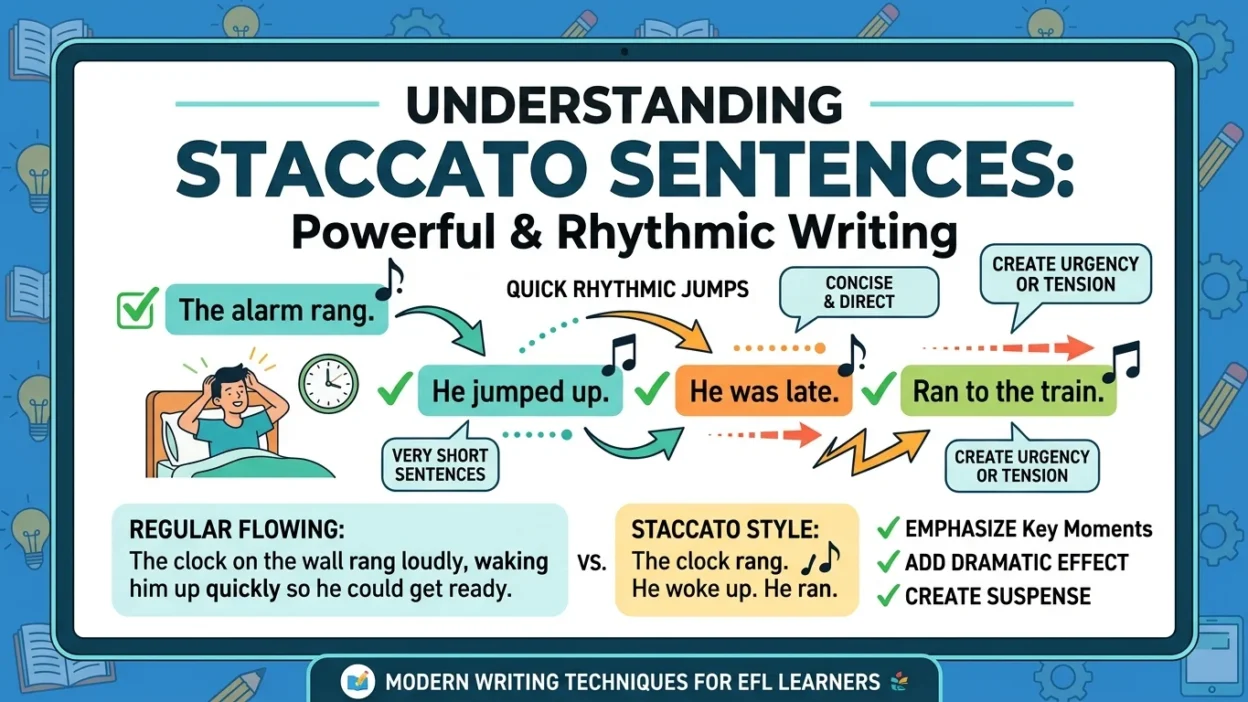
A staccato sentence is a very short, abrupt sentence that creates a quick, sharp rhythm. Writers use staccato sentences to build suspense, emphasize an idea, increase emotional impact, or make the writing more dramatic.
Why People Confuse It
The confusion happens because staccato is originally a musical term.
In music, it means notes are played short and detached. In writing, the same idea applies to short, separate sentences that create a strong rhythm.
Staccato Sentence
A staccato sentence is a sentence that is:
- Short.
- Direct.
- Abrupt.
- Separate from the surrounding sentences.
Writers often use several staccato sentences together to speed up the pace or highlight important moments.
Examples
- He stopped. He listened. Nothing.
- Run. Hide. Wait.
- She looked up. Silence. Then laughter.
- The lights went out. Panic followed.
- One chance. One decision. One outcome.
Characteristics of Staccato Sentences
A staccato writing style often includes:
- Very short sentences.
- Strong verbs.
- Minimal description.
- Fast pacing.
- Dramatic emphasis.
Comparison Table
| Feature | Staccato Sentence | Regular Sentence |
|---|---|---|
| Length | Short | Usually longer |
| Rhythm | Sharp and quick | Smooth and flowing |
| Purpose | Create emphasis or tension | Explain ideas in detail |
| Common in | Fiction, speeches, journalism | Everyday writing |
| Reading pace | Fast | Moderate |
When to Use Staccato Sentences
Use staccato sentences when you want to:
- Build suspense.
- Create excitement.
- Add dramatic impact.
- Highlight an important point.
- Speed up the pace of a story.
Avoid using them throughout an entire piece of writing, as too many short sentences can make your writing feel repetitive or choppy.
Examples
- The door opened. No one entered.
- She waited. Nothing happened.
- Stop. Think. Act.
- The clock struck midnight. Silence.
- He smiled. Then disappeared.
- One mistake. Everything changed.
- Rain fell. Winds howled. Trees bent.
- The phone rang. Again.
- No warning. No escape.
- Victory. At last.
- The room froze. Everyone stared.
- He knew. It was over.
Common Mistakes
Many learners make these errors.
- Thinking every short sentence is automatically staccato.
- Overusing staccato sentences until the writing becomes choppy.
- Using them in formal academic writing where longer, connected sentences are more appropriate.
Correct:
- She ran. She fell. She stood again.
Less effective:
- Every sentence in an essay is only two or three words long.
Memory Trick
Remember this simple rule:
Staccato = Short and Sharp.
Think of quick drumbeats or short musical notes.
If the sentences feel quick, detached, and dramatic, they are likely staccato.
American vs British English
There is no difference between American and British English.
The term staccato sentence has the same meaning in both varieties and is commonly used in writing and literary analysis.
Similar Terms
You may also come across these writing terms:
- Short sentence
- Fragment
- Simple sentence
- Periodic sentence
- Loose sentence
- Parallelism
- Repetition
- Rhythm in writing
- Sentence variety
- Concise writing
Final Verdict
A staccato sentence is a short, sharp sentence used to create rhythm, emphasis, or dramatic effect. Inspired by the musical meaning of staccato, this writing technique helps capture attention and increase emotional impact.
When used sparingly, staccato sentences make writing more engaging and memorable. However, balancing them with longer sentences creates the best reading experience.
Remember This
Staccato sentence = Short, abrupt, and impactful. ✅
Use it to create tension, emphasis, or fast pacing.
FAQs
What is a staccato sentence?
A staccato sentence is a very short, abrupt sentence used to create emphasis, suspense, or a quick rhythm in writing.
Why is it called a staccato sentence?
The term comes from music, where staccato means notes are played in a short, detached manner. The same idea applies to writing.
Are staccato sentences grammatically correct?
Yes. They are grammatically correct when used intentionally for stylistic effect.
Where are staccato sentences commonly used?
They are common in fiction, journalism, speeches, advertising, and creative writing.
Can I use staccato sentences in academic writing?
Use them sparingly. Academic writing usually favors more connected and detailed sentence structures.
What is the opposite of a staccato sentence?
A long, flowing sentence with connected ideas is often considered the opposite of a staccato sentence.
How do staccato sentences affect readers?
They increase pace, draw attention to key ideas, and create tension or emotional impact.
Conclusion
Staccato sentences are a powerful writing technique that uses short, detached statements to create rhythm and emphasis. They are especially effective in storytelling, persuasive writing, and speeches because they capture the reader’s attention and heighten emotion.
While they can make your writing more dynamic, they work best when balanced with longer sentences. Using both styles together creates a natural flow and keeps readers engaged.

Joseph Richard is the administrator and a dedicated author at DrameyHut, overseeing the platform’s operations and content quality. Alongside his administrative role, he writes insightful articles on dream meanings, helping readers understand their subconscious mind. His work supports the mission of providing clear, meaningful, and engaging dream interpretations.