Many English learners and computer users wonder if they should use unselect or deselect. Since both words seem to describe removing a selection, it’s easy to think they are interchangeable. However, one is far more common and widely accepted, especially in technology and software.
Understanding the difference between unselect vs deselect will help you use the correct term in everyday conversations, technical writing, and user interface instructions.
Quick Answer
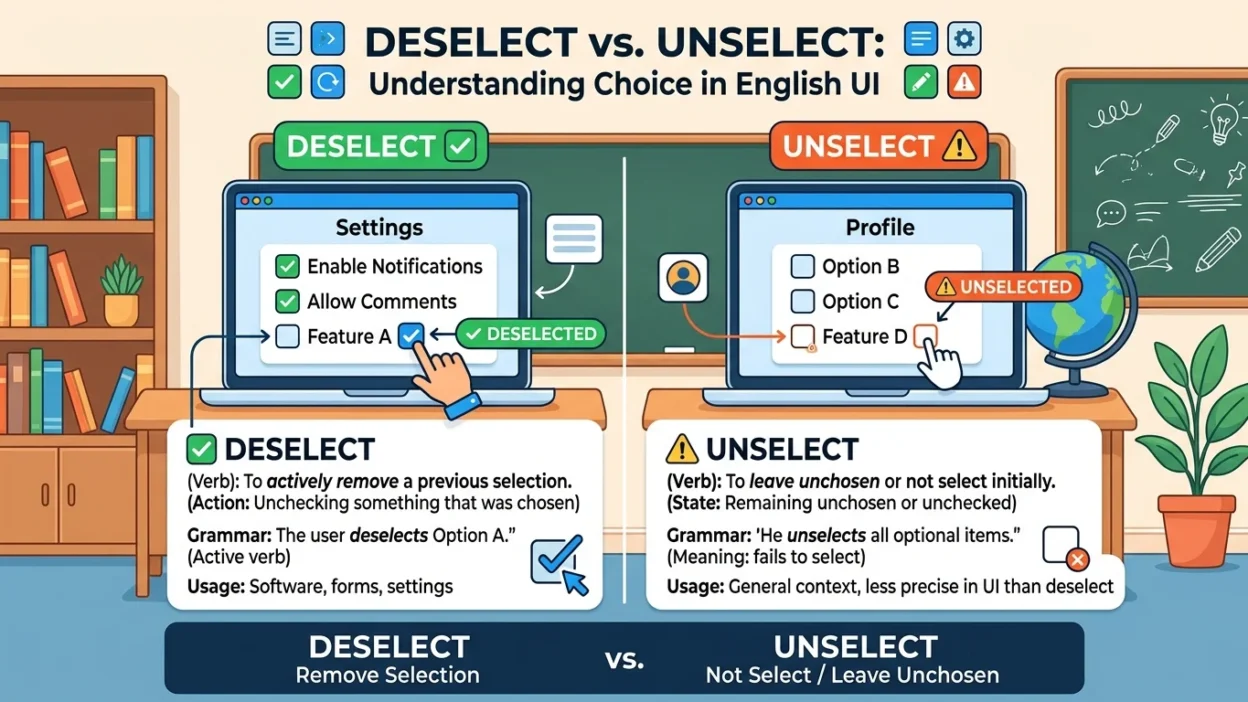
Both unselect and deselect can mean to remove a selection, but deselect is the standard and preferred term in modern English, especially in computing. Unselect is less common and is often considered nonstandard or informal.
Why People Confuse It
The confusion happens because the prefixes un- and de- both suggest reversing an action.
However, in software, apps, and operating systems, deselect has become the accepted term for removing a selected item.
Deselect
Deselect is a verb.
Meaning
It means:
- To remove a selection.
- To cancel the selected status of an item.
Examples
- Click anywhere outside the image to deselect it.
- Press Ctrl and click to deselect the file.
- You can deselect multiple items at once.
- The app lets you deselect unwanted photos.
- Tap again to deselect the option.
Unselect
Unselect is also used by some speakers and software, but it is much less common.
Meaning
It means:
- To remove a selection.
Although many people understand it, unselect is generally less preferred than deselect.
Examples
- You can unselect the checkbox if you change your mind.
- The option allows users to unselect all items.
Comparison Table
| Feature | Deselect | Unselect |
|---|---|---|
| Correct English | ✅ Yes | ✅ Yes, but less common |
| Preferred in computing | ✅ Yes | ❌ Usually no |
| Common in software interfaces | ✅ Yes | Rarely |
| Suitable for formal writing | ✅ Yes | Less preferred |
| Means remove a selection | ✅ Yes | ✅ Yes |
When to Use Each
Use deselect when:
- Writing software instructions.
- Creating user manuals.
- Referring to computer, mobile, or web interfaces.
- Writing formal or technical content.
Use unselect only if:
- You’re following wording already used in a specific application.
- You’re writing informally and your audience expects it.
Examples
- Click the icon to deselect the image.
- Press Esc to deselect the object.
- Users can deselect unwanted files.
- Deselect all checkboxes before continuing.
- Tap the selected item again to deselect it.
- You can unselect the option if needed.
- The app lets users unselect multiple photos.
- Unselect the checkbox to disable notifications.
- Deselect the row before deleting it.
- The software automatically deselects completed tasks.
- Click outside the box to deselect the text.
- You may unselect the filter to see all results.
Common Mistakes
Many learners make these errors.
- Using unselect in formal technical writing where deselect is the standard term.
- Assuming unselect is the only correct word.
- Mixing both terms within the same document.
Correct:
- Deselect the file before closing the program.
Less preferred:
- Unselect the file before closing the program.
Memory Trick
Remember this simple rule:
Deselect = Default computer term. ✅
Unselect = Less common alternative.
If you’re writing about computers, apps, or software, choose deselect.
American vs British English
There is no significant difference between American and British English.
Both varieties overwhelmingly prefer deselect in computing and technical writing.
Similar Words
You may also confuse these word pairs:
- Select vs Deselect
- Enable vs Disable
- Activate vs Deactivate
- Connect vs Disconnect
- Lock vs Unlock
- Check vs Uncheck
- Install vs Uninstall
- Upload vs Download
- Expand vs Collapse
- Open vs Close
Final Verdict
Both unselect and deselect can mean to remove a selection, but deselect is the standard, more widely accepted choice. It appears in most operating systems, software applications, and technical documentation.
For clear and professional English, especially in technology-related writing, deselect is the word you should use.
Remember This
Deselect = Standard and preferred. ✅
Unselect = Less common alternative. ⚠️
When in doubt, choose deselect.
FAQs
Which is correct, unselect or deselect?
Both are understandable, but deselect is the standard and preferred term, especially in computing.
Is unselect a real word?
Yes. Unselect exists, but it is much less common than deselect and is rarely used in formal technical writing.
Why do software programs use “deselect”?
Because deselect has become the accepted industry standard for removing a selection.
Can I use unselect in everyday English?
Yes. People will usually understand it, but deselect sounds more natural in most contexts.
Is deselect used in British and American English?
Yes. Both varieties use deselect as the preferred term.
What is the opposite of select?
The opposite is deselect, meaning to remove a selection.
Is uncheck the same as deselect?
Not always. Uncheck refers specifically to removing a check mark from a checkbox, while deselect refers more generally to removing the selected state from an item.
Conclusion
The difference between unselect and deselect is mostly a matter of usage rather than meaning. Both describe removing a selection, but deselect is the standard word used in modern English, particularly in software, technology, and professional documentation.
To make your writing sound more natural and align with common computer terminology, choose deselect whenever possible.

Christopher Thomas is a passionate writer and dream researcher dedicated to exploring the meanings behind dreams. As an author at DrameyHut, he creates insightful and easy-to-understand interpretations that help readers connect with their subconscious mind. His work focuses on guiding individuals toward self-discovery, clarity, and a deeper understanding of their inner thoughts.