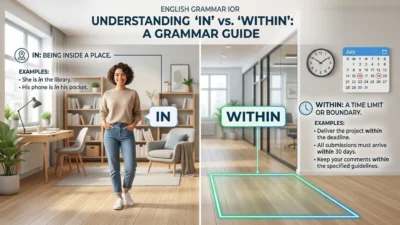
The words “in” and “within” are both commonly used to talk about time, place, limits, and boundaries. Because their meanings sometimes overlap, English learners often wonder whether they can be used interchangeably. For example, you might hear both “I will finish it in two hours” and “I will finish it within two hours.” Although both sentences are correct, they do not always communicate exactly the same idea.
The main difference is that in is a very broad and common preposition, while within emphasizes being inside a particular limit, boundary, period, or range. In time expressions, in two hours can mean something will happen after two hours, while within two hours means it will happen at some point before the two hour limit ends. Understanding this small distinction can make your English more precise and natural.
Quick Answer
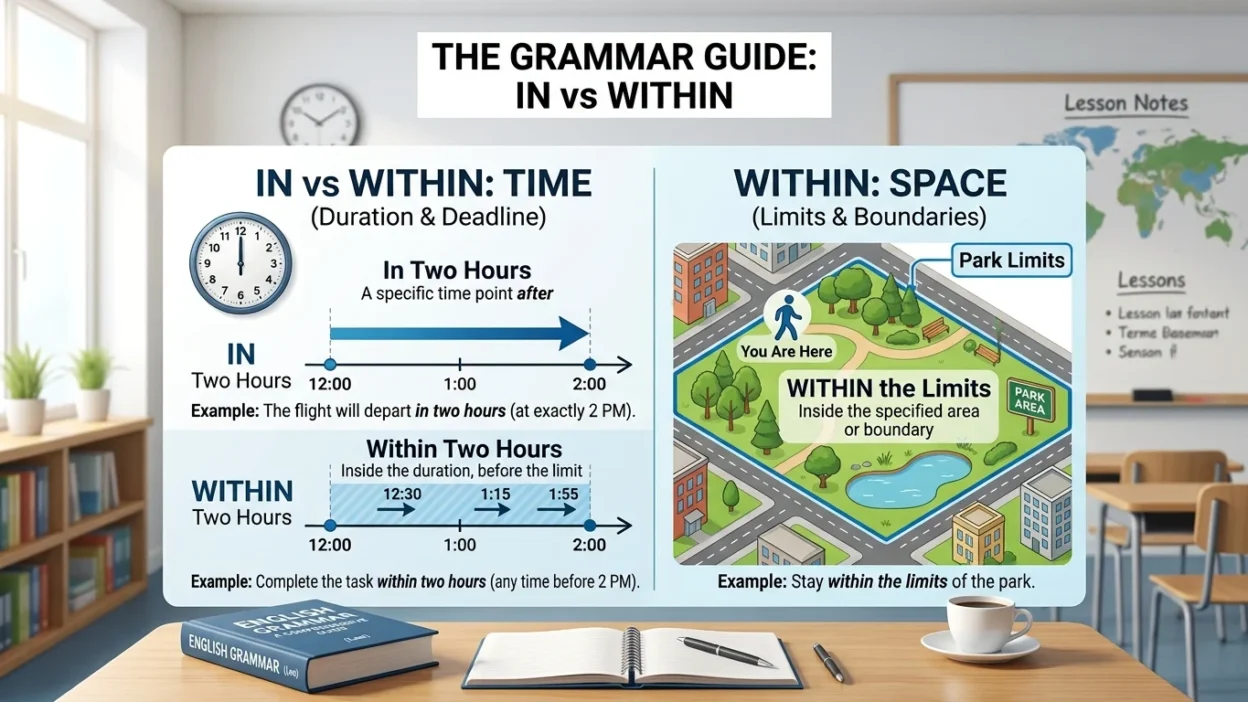
In is a general preposition used for time, place, situations, and conditions. Within emphasizes being inside a specific limit or boundary. For example, “I will finish it in two hours” usually means after two hours, while “I will finish it within two hours” means before two hours have passed.
Why People Confuse It
The confusion mainly occurs because in and within can both be used with periods of time.
Compare:
I will call you in an hour.
I will call you within an hour.
Both sentences involve a one hour period, but the meaning is different.
In an hour normally means the action will happen approximately one hour from now.
Within an hour means the action will happen at some point during the next hour, but no later than the end of that hour.
There is another important difference.
In can describe where something is located:
The keys are in the drawer.
But within often emphasizes an area, boundary, or limit:
The village is within the city limits.
So although the two words sometimes overlap, within usually carries a stronger sense of boundaries or limits.
First Word: In
In is one of the most frequently used prepositions in English. It has many meanings and functions.
In for time
We use in with periods of time.
I will see you in two days.
She will arrive in an hour.
The project will be completed in three months.
Here, in commonly indicates the amount of time before something happens.
In for location
We use in to show that something is inside a place or area.
The books are in the library.
She lives in London.
There is water in the bottle.
In for situations or conditions
In can also describe a situation or state.
He is in trouble.
She is in danger.
They are in love.
We are in a difficult situation.
In for months, years, and longer periods
I was born in 1995.
She graduated in June.
They moved here in 2020.
We usually travel in summer.
Second Word: Within
Within means inside, inside the limits of, or before a particular period has ended.
It is often used when a boundary or maximum limit is important.
Within for time
Please reply within three days.
This means you can reply today, tomorrow, or the day after tomorrow, but not after the three day limit.
The package should arrive within a week.
This means it should arrive at some point before one week has passed.
Within for physical boundaries
The restaurant is within walking distance.
The school is within the city limits.
The animals were kept within a fenced area.
Here, within emphasizes a boundary.
Within for limits or ranges
The word can also refer to limits that are not physical.
The project must stay within budget.
Keep the answer within 100 words.
The temperature remained within the normal range.
In these examples, within means inside a particular limit.
Comparison Table
| Expression | Main Meaning | Example | Explanation |
|---|---|---|---|
| In two hours | After two hours | I will call you in two hours. | Usually refers to a point approximately two hours from now. |
| Within two hours | Before two hours have passed | I will call you within two hours. | Any time before the two hour limit ends. |
| In the room | Inside a place | She is in the room. | Shows location. |
| Within the room | Inside the boundaries of the room | There were several cameras within the room. | Emphasizes the defined area. |
| In the city | Located in the city | He lives in the city. | General location. |
| Within the city limits | Inside a defined boundary | The airport is within the city limits. | Emphasizes the boundary. |
| In the budget | Included in the budget | The expense is in the budget. | Refers to inclusion. |
| Within budget | Not exceeding the budget | We completed the project within budget. | Emphasizes a limit. |
When to Use Each
Use “in” for a general location
When you simply want to say that something is inside a place, in is usually the natural choice.
The children are in the classroom.
She lives in New York.
There is milk in the refrigerator.
Use “within” when a boundary matters
If the idea of a limit or boundary is important, within is often better.
The house is within the city limits.
Please stay within the designated area.
Use “in” for a future point in time
Use in + period of time when talking about when something will happen after a particular amount of time.
The train will arrive in ten minutes.
I will finish the work in two hours.
Use “within” for a deadline or maximum period
Use within + period of time when something can happen at any point before the period ends.
Please submit the form within ten days.
You should receive a response within 48 hours.
Use “within” for restrictions
Within is particularly useful when talking about limits.
Stay within the speed limit.
Keep your spending within your budget.
The answer must be within the specified range.
Examples
Examples with “in”
- I will call you in an hour.
- She will arrive in twenty minutes.
- We moved here in 2018.
- The children are playing in the garden.
- There is a mistake in the report.
- He lives in Pakistan.
- The meeting will begin in ten minutes.
- She was born in December.
- There is something in the box.
- They completed the work in three days.
Examples with “within”
- Please respond within 24 hours.
- The package should arrive within a week.
- You must complete the application within 30 days.
- The hotel is within walking distance.
- The building is within the city limits.
- Please stay within the designated area.
- The project was completed within budget.
- The answer must be within 200 words.
- The temperature remained within the acceptable range.
- You should receive an email within a few minutes.
Common Mistakes
Mistake 1: Thinking “in two hours” and “within two hours” mean exactly the same thing
They can overlap in some contexts, but the emphasis is different.
I will finish the work in two hours.
This generally suggests completion after two hours.
I will finish the work within two hours.
This gives a maximum time limit. The work may be finished earlier.
Mistake 2: Using “within” for every location
Although within can mean inside, it can sound unnecessarily formal when simply describing location.
The children are in the house.
is much more natural than:
The children are within the house.
Use within when the boundary or limits are relevant.
Mistake 3: Confusing “within” with “during”
These words are related but not identical.
During focuses on when something happens inside a period or event.
I fell asleep during the movie.
Within emphasizes a limit.
I will finish the report within two days.
Mistake 4: Saying “within two hours” when you mean exactly two hours later
If you mean the event will happen after two hours, use in.
I will meet you in two hours.
If you mean any time before two hours have passed, use within.
I will meet you within two hours.
Mistake 5: Forgetting that “within” can refer to abstract limits
Within is not only about physical spaces.
within budget
within the law
within the rules
within the limits
within the deadline
These expressions are extremely common in formal and professional English.
Memory Trick
Use this simple rule:
In = after a period
Within = before the limit ends
For example:
I will call you in two hours.
Think:
Two hours from now.
I will call you within two hours.
Think:
Any time during the next two hours, but not later.
For physical or abstract boundaries, remember:
Within = inside a boundary
within the city limits
within the budget
within the rules
within the area
This makes the distinction much easier to remember.
American vs British English
In and within are standard in both American and British English.
There is no major difference in the basic meaning of these prepositions.
Both American and British speakers naturally say:
I will be there in ten minutes.
and:
Please respond within ten minutes.
The main difference is one of context and style rather than regional grammar.
Within can sometimes sound more formal, particularly in professional, legal, academic, and official writing.
For example:
Please respond within seven days.
sounds formal and appropriate for an official notice.
In casual conversation, people may simply say:
Please respond in the next few days.
Similar Words
Inside
Inside refers to being in the interior of something.
The keys are inside the drawer.
It is often interchangeable with in when describing physical location.
During
During means at some point in a period or event.
She called me during the meeting.
It focuses on the period in which something happens.
Before
Before means earlier than a particular time.
Please arrive before 8 p.m.
By
By indicates a deadline.
Please finish the work by Friday.
There is an important difference between by and within.
Finish it by Friday.
Friday is the deadline.
Finish it within three days.
Three days is the maximum period after a particular starting point.
Into
Into often indicates movement from outside to inside.
She walked into the room.
During the next
This can sometimes replace within in informal contexts.
I will call you during the next two hours.
However, within two hours is shorter and clearer when emphasizing a deadline.
FAQs
What is the difference between “in” and “within”?
In is a general preposition used for time, place, situations, and conditions. Within emphasizes being inside a boundary, limit, range, or period.
Is “in two hours” the same as “within two hours”?
No. In two hours usually means after two hours have passed. Within two hours means at any time before the two hour period ends.
Is “within” more formal than “in”?
Often, yes. Within can sound more formal, especially when used for deadlines, limits, rules, and official instructions.
Can “within” mean “inside”?
Yes. For example:
The building is within the city limits.
This means the building is inside the defined boundaries of the city.
Should I say “in 24 hours” or “within 24 hours”?
It depends on your meaning. In 24 hours generally points to a time 24 hours from now. Within 24 hours means at any point before 24 hours have passed.
Is “within walking distance” correct?
Yes. Within walking distance is a common expression meaning close enough to reach by walking.
What is the difference between “within” and “during”?
During focuses on the period when something happens. Within focuses on a limit or maximum amount of time.
What is the difference between “within” and “by”?
By gives a deadline, while within usually gives a maximum period measured from a starting point.
For example:
Finish the work by Friday.
Finish the work within three days.
Final Verdict
“In” and “within” can sometimes overlap, but they have different functions and emphasis. Use in for general time and location, especially when describing when something will happen or where something is located.
Use within when you want to emphasize a boundary, limit, range, or deadline. This is why expressions such as within 24 hours, within budget, within the city limits, within walking distance, and within the rules are so common.
The most important distinction is between “in two hours” and “within two hours.” The first usually points to a time after two hours, while the second gives a maximum period in which something can happen.
Remember This
Think of IN as a general position or point in time.
I will call you in two hours.
Think of WITHIN as a boundary or limit.
I will call you within two hours.
Remember:
In = a general time or place
Within = inside a limit or boundary
In two hours = after two hours
Within two hours = before two hours have passed
In the city = located there
Within the city limits = inside the defined boundary
Conclusion
The difference between in and within may seem small, but understanding it can make your English more accurate and natural. In is the more general and versatile preposition, while within is particularly useful when you want to emphasize limits, boundaries, ranges, or deadlines.
When talking about time, remember that in often points to a future point, while within gives a maximum period. When talking about location, in usually gives a simple description of where something is, while within highlights that something is inside a defined area or boundary.

Nancy Lisa is a passionate writer and contributor at DrameyHut, focused on uncovering the deeper meanings behind dreams. She creates engaging and insightful content that helps readers interpret their dreams and understand their subconscious thoughts. Her work inspires self-reflection, clarity, and a stronger connection to inner emotions.