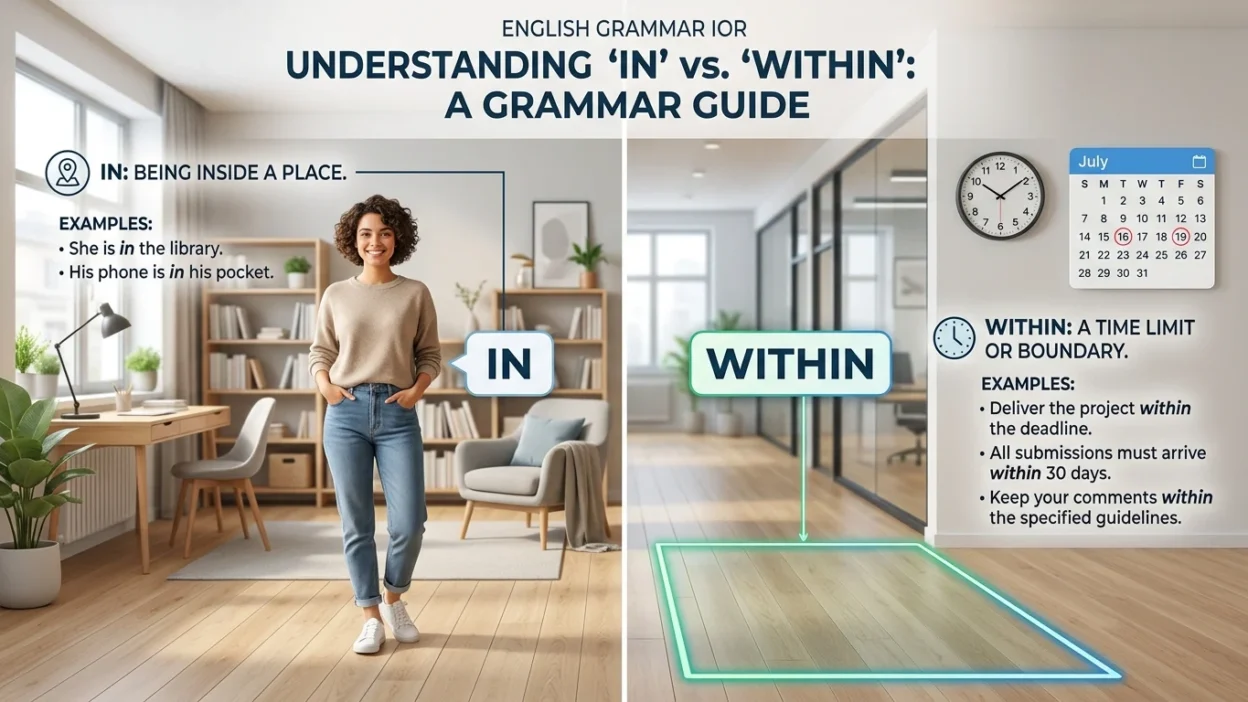
The words “in” and “within” are often used to talk about time, place, limits, and boundaries. Because their meanings sometimes overlap, English learners frequently wonder if they can be used interchangeably. In some sentences, both are possible, but they can create slightly different meanings or levels of emphasis.
The most important difference is that “in” is much more common and flexible, while “within” often emphasizes a boundary, limit, or deadline. For example, “I will finish it in two hours” can mean the task will be completed after two hours, whereas
“I will finish it within two hours” means the task will be completed at some point before two hours have passed. Understanding this distinction will help you use both words naturally in everyday and formal English.
Quick Answer
“In” and “within” can both describe time and location, but they are not always interchangeable. In is more general, while within emphasizes a limit or boundary. For example, “I will arrive in two hours” and “I will finish it within two hours” have different meanings.
Why People Confuse It
The confusion happens because in and within can sometimes appear before the same noun.
For example:
The package will arrive in three days.
and:
The package will arrive within three days.
Both sentences are grammatical, but they do not necessarily communicate exactly the same idea.
In three days often points to a time three days from now.
Within three days means at any point before the three day period ends.
The distinction is easier to understand when you think of within as emphasizing a boundary.
Imagine a three day time limit.
If someone says:
I will complete the work within three days.
They are promising that the work will be completed before the three day deadline expires.
The word in is more flexible and can describe location, time, condition, manner, and many other relationships.
First Word: In
In is one of the most common prepositions in English.
It can describe location, time, situations, periods, conditions, and more.
In for location
Use in when something is inside an area, space, container, or place.
The keys are in the drawer.
She lives in London.
There is water in the bottle.
He is sitting in the room.
Here, in indicates that something is inside a particular place or area.
In for time
In can refer to a period of time.
I will call you in an hour.
She will arrive in two days.
The project will be completed in six months.
In these examples, in commonly indicates how much time will pass before something happens.
In for periods
We also use in with months, years, seasons, and parts of the day.
I was born in 1995.
We are traveling in July.
She studies in the morning.
Flowers bloom in spring.
In for situations
In can also describe a condition or situation.
He is in trouble.
We are in danger.
She is in a difficult situation.
The company is in financial difficulty.
Because in has so many uses, context is extremely important.
Second Word: Within
Within generally means inside a particular boundary, limit, range, or period.
It can describe both physical and abstract boundaries.
Within for time
This is one of the most important uses of within.
Please reply within 24 hours.
This means you should reply at any time before 24 hours have passed.
It does not mean exactly 24 hours later.
Another example:
The package should arrive within five days.
This means the package should arrive at some point during the five day period.
Within for physical boundaries
Within can also mean inside an area or boundary.
The children stayed within the park.
The house is located within the city limits.
Please remain within the designated area.
Here, within emphasizes the boundary of the place.
Within for limits or ranges
We can use within with abstract limits too.
The temperature must remain within a certain range.
Keep the answer within 100 words.
The project must stay within budget.
In these examples, within means not exceeding a particular limit.
Comparison Table
| Expression | Main Meaning | Common Use | Example |
|---|---|---|---|
| In | Inside or after a period of time | Location and future time | I will arrive in two hours. |
| Within | Inside a boundary or before a limit expires | Deadlines and limits | I will finish it within two hours. |
| In the room | Inside a place | Location | She is in the room. |
| Within the room | Inside the boundaries of the room | Emphasis on boundary | No one outside the room could hear. |
| In three days | After three days | Future time | I will return in three days. |
| Within three days | At any time before three days pass | Deadline | Please respond within three days. |
| In the limit | Usually unnatural | General location or time | Use “within the limit.” |
| Within the limit | Not exceeding the limit | Restrictions | Stay within the speed limit. |
When to Use Each
Use “in” for ordinary location
When you simply mean that something is inside a place, in is usually the natural choice.
The documents are in the office.
She is in the kitchen.
The children are in the garden.
You generally do not need within unless you want to emphasize a boundary.
Use “within” when emphasizing a boundary
Please remain within the marked area.
This sounds appropriate because there is a defined boundary that should not be crossed.
Compare:
The children are in the park.
This simply tells us where they are.
The children must remain within the park.
This emphasizes the boundary of the park.
Use “in” for a future point in time
I will see you in two weeks.
This normally means two weeks from now.
The train will arrive in ten minutes.
This indicates the expected time until arrival.
Use “within” for a deadline
Please send the documents within two weeks.
This means send them at any point before the two week limit expires.
The exact time is flexible.
Use “within” for maximum limits
Keep the report within 2,000 words.
This means the report must not exceed 2,000 words.
Stay within your budget.
This means do not spend more than the specified amount.
Examples
Examples with “in”
- I will call you in an hour.
- She will return in three days.
- The meeting starts in ten minutes.
- He lives in New York.
- The documents are in my office.
- There is a mistake in this sentence.
- We usually travel in summer.
- She was born in 2001.
- The children are playing in the garden.
- I will finish the project in two weeks.
Examples with “within”
- Please respond within 24 hours.
- The package should arrive within three days.
- You must complete the application within one week.
- Please stay within the designated area.
- The answer must be within 500 words.
- The expense must remain within the approved budget.
- The temperature should remain within this range.
- The village lies within the national park.
- You should receive a confirmation within a few minutes.
- The company expects to resolve the issue within the next few days.
Common Mistakes
Mistake 1: Assuming “in three days” and “within three days” mean exactly the same thing
They can overlap, but there is an important difference.
I will finish the work in three days.
This can suggest completion after three days.
I will finish the work within three days.
This means completion will occur before the three day period ends.
Mistake 2: Using “within” for every location
You usually do not need within when simply describing where something is.
The keys are in the drawer.
is much more natural than:
The keys are within the drawer.
The second sentence is grammatical in some contexts but sounds unnecessarily formal.
Mistake 3: Saying “in 24 hours” when you mean a deadline
If you mean that something can happen at any point before a 24 hour deadline, within is clearer.
Please reply within 24 hours.
This gives a deadline.
Mistake 4: Confusing “within” with “during”
These words are related but different.
Within two hours means before the two hour limit ends.
During the two hours means at some point while that period is happening.
For example:
Please call me within two hours.
You can call anytime before the two hour deadline.
We discussed the problem during the two hour meeting.
The discussion happened while the meeting was taking place.
Mistake 5: Forgetting that “within” can describe abstract limits
Within is not only about physical spaces.
within budget
within the law
within the rules
within the limit
within the deadline
These all involve boundaries or restrictions.
Memory Trick
Use this simple rule:
In = inside or after a period
Within = inside a boundary or before a limit
Think about time:
I will arrive in three days.
Think of a deadline:
I will arrive within three days.
The first can point toward a specific future time.
The second gives you a maximum period.
For physical space:
The children are in the garden.
Simply describes location.
The children must stay within the garden.
Emphasizes the boundary.
A simple memory phrase is:
IN tells you where or when. WITHIN tells you the limit.
American vs British English
In and within are standard in both American and British English.
There is no major grammatical difference between the two varieties regarding their basic meanings.
Both American and British speakers naturally say:
I will be there in ten minutes.
and:
Please respond within ten minutes.
However, within can sound more formal than in, especially when discussing deadlines, restrictions, rules, or official requirements.
For example:
Please submit the application within seven days.
sounds formal and administrative.
In casual conversation, speakers may simply say:
Please send it in a week.
The appropriate choice depends on the intended meaning and level of formality.
Similar Words
Inside
Inside usually refers to physical location.
The keys are inside the box.
During
During refers to something happening while a period or event is taking place.
She called during the meeting.
By
By means no later than a particular time.
Please finish the report by Friday.
This is closely related to within when discussing deadlines.
Before
Before means earlier than a particular time.
Please arrive before 8 p.m.
Into
Into often describes movement from outside to inside.
She walked into the room.
Under
Under can refer to a limit.
The project must remain under budget.
No later than
This is a very clear way to express a deadline.
Please respond no later than Friday.
FAQs
What is the difference between “in” and “within”?
In is a general preposition used for location, time, and many other relationships. Within emphasizes being inside a boundary, range, or time limit.
Is “in three days” the same as “within three days”?
Not always. In three days can mean after three days have passed, while within three days means at any time before the three day period ends.
Is “within” more formal than “in”?
Often, yes. Within can sound more formal, especially when used for deadlines, rules, restrictions, and official instructions.
Should I say “in 24 hours” or “within 24 hours”?
Use within 24 hours when you mean that something must happen before the 24 hour period ends.
Please reply within 24 hours.
Can “within” be used for places?
Yes. It means inside a defined physical boundary.
The building is located within the city limits.
Can “in” and “within” be interchangeable?
Sometimes, particularly when referring to physical location, but the meaning or emphasis can change. Within usually gives greater emphasis to a boundary or limit.
Is “within a week” correct?
Yes. Within a week means at any time before the week has passed.
I will send you the documents within a week.
Is “in a week” correct?
Yes. In a week commonly means one week from now.
I will see you in a week.
Final Verdict
“In” and “within” are both correct, but they serve different purposes. Use in as the general and more flexible choice for location and time. Use within when you want to emphasize a boundary, limit, range, or deadline.
The biggest difference appears with time. “In two hours” often points to a time two hours from now, while “within two hours” means at any point before two hours have passed. With physical locations, in simply identifies where something is, while within can emphasize the boundaries of that location.
Remember This
Think of the difference this way:
IN = inside or after a period
WITHIN = inside a boundary or before a limit
Examples:
I will call you in two hours.
Please reply within two hours.
She is in the building.
She must remain within the building.
I will finish it in a week.
I will finish it within a week.
If you are simply describing a place or a future time, in is usually the natural choice. If you are talking about a maximum limit or defined boundary, within is often the better choice.
Conclusion
The difference between “in” and “within” is mainly about flexibility versus boundaries. In is one of the most versatile prepositions in English and is used to describe places, time periods, situations, and many other relationships. Within has a more specific sense and often tells us that something remains inside a physical, numerical, legal, or time boundary.
When discussing time, remember the important distinction between a future point and a deadline. “I will finish it in three days” can suggest a completion time of three days from now, while “I will finish it within three days” promises completion before the three day limit expires. Once you understand this difference, choosing between in and within becomes much easier.

Daniel Charles is a dedicated author and dream interpretation enthusiast at DrameyHut. He specializes in analyzing dream symbols and meanings, offering clear and insightful content for readers. His work aims to help individuals understand their subconscious thoughts, gain clarity, and explore the deeper messages hidden within their dreams.