Many English learners and professionals wonder if they should use unregister or deregister. Since both words describe removing a registration, they appear similar. However, their meanings and usage vary depending on the context.
Understanding the difference between unregister vs deregister will help you choose the right word in business, technology, legal documents, and everyday English.
Quick Answer
Both unregister and deregister are correct, but they are used in different situations. Deregister is the more common and preferred term for officially removing a registration, while unregister is mainly used in computing and software to remove or disconnect something from a system.
Why People Confuse It
The confusion happens because both words involve reversing a registration.
However:
- Deregister usually refers to an official or legal action.
- Unregister is more common in technical and software-related contexts.
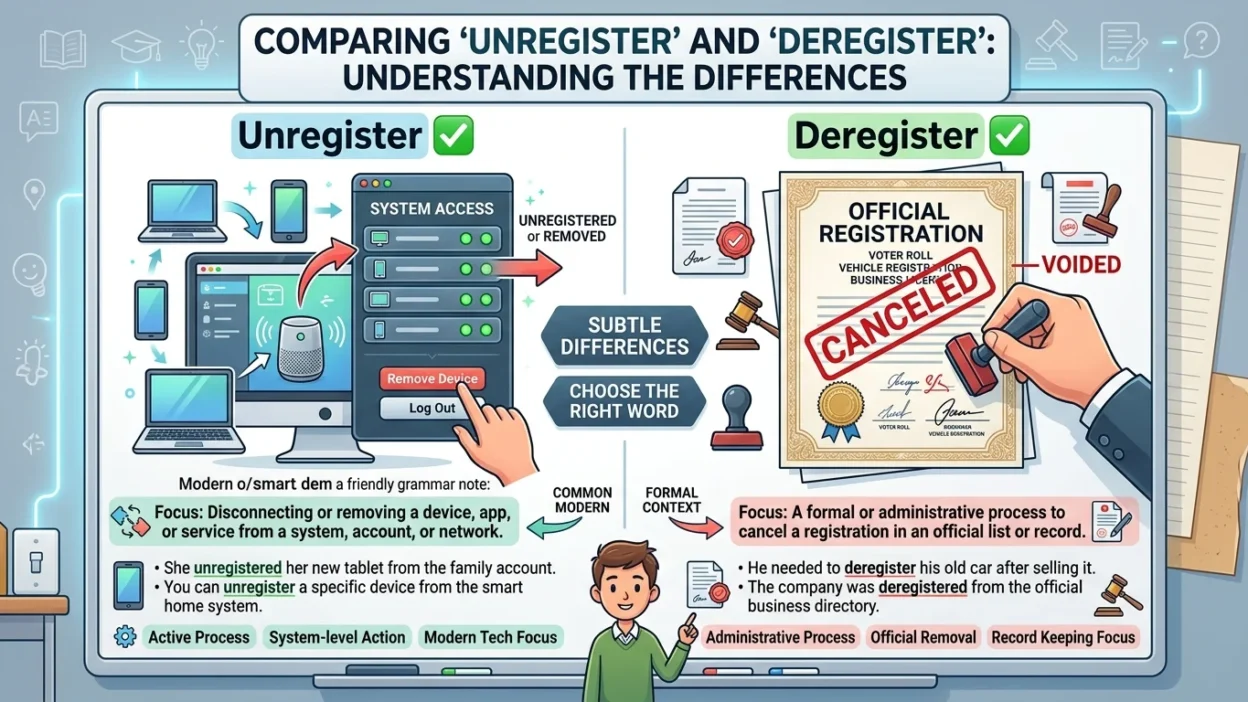
Unregister
Unregister is a verb.
Meaning
It means:
- To remove a device, account, service, or component from a system.
- To cancel a registration within software or technology.
Examples
- Please unregister your device before selling it.
- The app allows you to unregister your account.
- You must unregister the old printer.
- The administrator unregistered the server.
- Remember to unregister your email address from the service.
Deregister
Deregister is also a verb.
Meaning
It means:
- To officially remove something from a register.
- To cancel a legal, official, or administrative registration.
Examples
- The company decided to deregister the vehicle.
- You must deregister your business before closing it.
- The aircraft was deregistered after being retired.
- She deregistered from the course.
- The charity was deregistered by the authorities.
Comparison Table
| Feature | Unregister | Deregister |
|---|---|---|
| Correct English | ✅ Yes | ✅ Yes |
| Common in computing | ✅ Yes | Sometimes |
| Common in legal or official contexts | Rarely | ✅ Yes |
| Means remove from a register | ✅ Yes | ✅ Yes |
| Preferred for official registration | ❌ No | ✅ Yes |
When to Use Each
Use unregister when:
- Removing a device from a computer.
- Disconnecting software or services.
- Canceling a technical registration.
Use deregister when:
- Canceling an official registration.
- Removing a business, vehicle, organization, or aircraft from a legal register.
- Referring to government or administrative records.
Examples
- Please unregister your phone before resetting it.
- The software lets you unregister unused devices.
- I unregistered my old email account.
- You should unregister the product before returning it.
- The administrator unregistered the server.
- The owner deregistered the vehicle.
- The company was deregistered last year.
- She deregistered from the university course.
- The nonprofit was officially deregistered.
- They deregistered the aircraft after retirement.
- You must unregister the smartwatch before selling it.
- Businesses may need to deregister when they close permanently.
Common Mistakes
Many learners make these errors.
- Using unregister for official legal registrations.
- Using deregister when referring to software settings.
- Assuming both words are interchangeable in every context.
Correct:
- Please unregister the device.
- The business was deregistered.
Less natural:
- Please deregister the device.
- The business was unregistered.
Memory Trick
Remember this simple rule:
Unregister = Technology.
Deregister = Official records.
If a government or legal register is involved, choose deregister.
If it’s a device, app, or online account, choose unregister.
American vs British English
Both unregister and deregister are used in American and British English.
However, deregister is especially common in legal, government, and administrative contexts in both varieties.
Similar Words
You may also confuse these pairs:
- Register vs Deregister
- Register vs Unregister
- Activate vs Deactivate
- Enable vs Disable
- Connect vs Disconnect
- Install vs Uninstall
- Subscribe vs Unsubscribe
- Select vs Deselect
- Log In vs Log Out
- Sign Up vs Cancel Registration
Final Verdict
Both unregister and deregister are correct, but they are not always interchangeable. Unregister is generally preferred for technology, software, and digital services, while deregister is the standard choice for official, legal, and administrative registrations.
Choosing the right word based on the context will make your English sound more accurate and professional.
Remember This
Unregister = Remove from a computer or digital system. ✅
Deregister = Officially remove from a legal or administrative register. ✅
Choose the word that matches the situation.
FAQs
Which is correct, unregister or deregister?
Both are correct, but unregister is more common in technology, while deregister is preferred for legal and official registrations.
What does unregister mean?
It means to remove a device, account, or service from a computer system or digital platform.
What does deregister mean?
It means to officially remove a person, business, vehicle, or organization from a legal or administrative register.
Can I use unregister for a business?
Generally, deregister is the better choice because businesses are removed from official government registers.
Is deregister used in British and American English?
Yes. Both varieties commonly use deregister in legal and administrative contexts.
Is unregister used in software?
Yes. Unregister is widely used for devices, applications, accounts, and computer systems.
Are unregister and deregister interchangeable?
Sometimes, but deregister is preferred for official records, while unregister is more natural for technology related actions.
Conclusion
The difference between unregister and deregister depends on the context. Unregister is commonly used when removing a device, account, or service from a digital system, whereas deregister refers to officially removing something from a legal or administrative register.
By choosing the appropriate term, you can make your writing clearer, more precise, and more professional.

Christopher Thomas is a passionate writer and dream researcher dedicated to exploring the meanings behind dreams. As an author at DrameyHut, he creates insightful and easy-to-understand interpretations that help readers connect with their subconscious mind. His work focuses on guiding individuals toward self-discovery, clarity, and a deeper understanding of their inner thoughts.