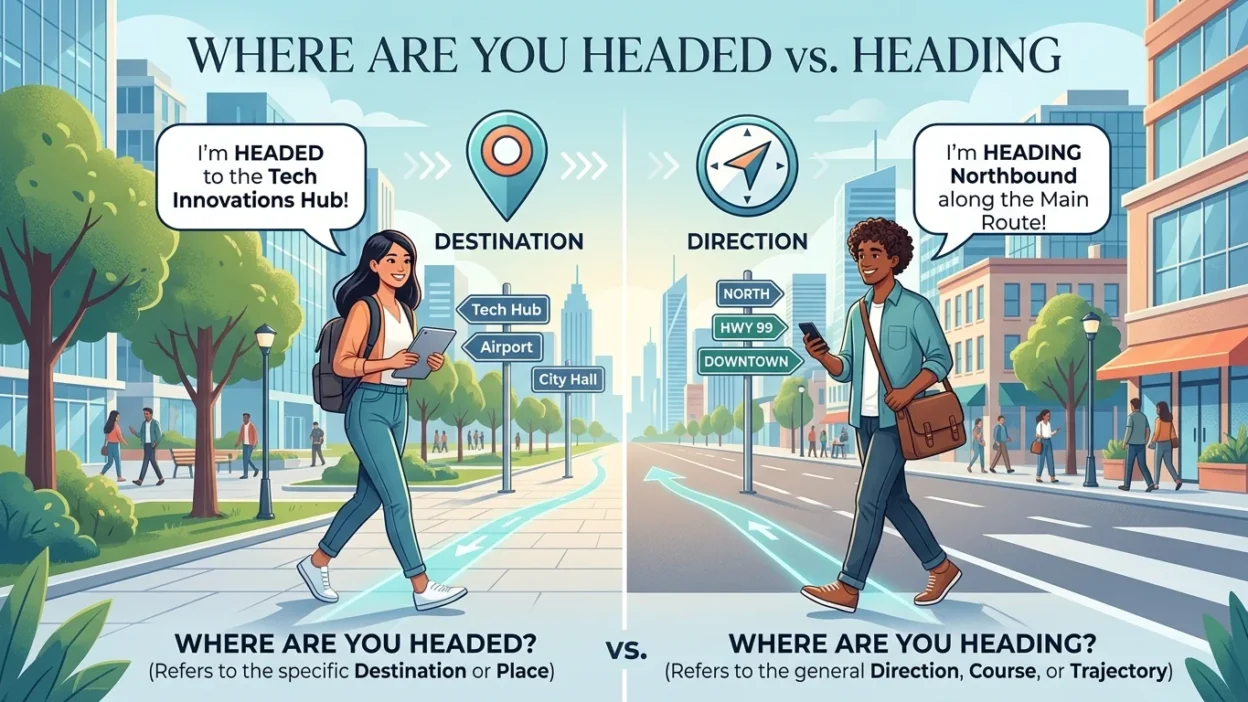
“Where are you headed?” and “Where are you heading?” are both correct English questions. They are commonly used when asking someone about their destination or where they are going.
Because headed and heading look like different grammatical forms, English learners sometimes wonder whether one expression is more correct than the other.
In everyday English, however, the difference is usually small. Both expressions can mean “Where are you going?” or “What is your destination?” The main difference is grammatical and stylistic.
“Where are you headed?” uses headed as an adjective or past participle meaning directed toward a particular place, while “Where are you heading?” uses the present participle heading to describe an action that is currently happening or developing. Context determines which sounds more natural.
Quick Answer
“Where are you headed?” and “Where are you heading?” are both correct. Both usually mean “Where are you going?” “Where are you headed?” often emphasizes your destination, while “Where are you heading?” can emphasize the direction or journey you are currently taking.
Why People Confuse It
The confusion comes from the words headed and heading.
At first glance, headed looks like a past tense verb, while heading looks like a present continuous verb. This can make learners wonder why “Where are you headed?” is correct when are is normally followed by an ing form in the present continuous.
The answer is that headed does not have to function as a simple past tense verb here.
In:
Where are you headed?
headed describes the direction or destination toward which someone is going.
It is similar to saying:
Where are you going?
On the other hand:
Where are you heading?
uses heading as the present participle of head.
The two expressions overlap heavily in everyday conversation.
First Word: Headed
Headed can mean going or directed toward a particular place, destination, or situation.
For example:
Where are you headed?
This asks about someone’s destination.
You can also use headed in statements:
I am headed home.
We are headed downtown.
She is headed to the airport.
They are headed in the right direction.
The construction is:
be + headed + destination
For example:
I am headed to work.
He is headed for New York.
We are headed home.
Here, headed focuses strongly on the destination or direction.
Is “headed” past tense here?
Not necessarily.
In “Where are you headed?”, headed functions as a past participle in a construction describing someone’s current direction or destination.
Compare:
Where are you headed?
with:
Where did you head?
The first asks about someone’s current destination.
The second asks about a past action.
Second Word: Heading
Heading is the present participle or gerund form of head.
In:
Where are you heading?
the structure is:
be + heading
This is the present continuous tense.
It describes an action that is happening now or around the present time.
For example:
Where are you heading?
I am heading home.
She is heading to the office.
We are heading toward the station.
The word heading can emphasize the process of going somewhere rather than simply the destination.
However, in everyday conversation, this distinction is often very subtle.
Comparison Table
| Expression | Meaning | Main Focus | Example |
|---|---|---|---|
| Where are you headed? | Where are you going? | Destination or direction | Where are you headed after work? |
| Where are you heading? | Where are you going? | Current movement or direction | Where are you heading now? |
| Where are you going? | What is your destination? | General | Where are you going? |
| Where did you head? | Where did you go? | Past movement | Where did you head after lunch? |
| Where are you headed to? | Where are you going? | Destination | Where are you headed to? |
| Where are you heading to? | Where are you going? | Destination | Where are you heading to? |
When to Use Each
Use “Where are you headed?” for destination
This version naturally asks about where someone is going.
Where are you headed?
You might ask this when you meet a friend who is walking somewhere.
Hey, where are you headed?
The question can sound casual and conversational.
Use “Where are you heading?” for current direction
This version can emphasize someone’s movement or direction.
Where are you heading?
For example, if someone starts walking away from you, you might ask:
Where are you heading?
It can also be used when discussing plans:
Where are you heading after work?
Use “Where are you going?” for the simplest option
If you want the most neutral and universally straightforward question, use:
Where are you going?
This works in almost every ordinary context.
“Where are you headed?” can sound slightly more destination focused
Compare:
Where are you headed?
with:
Where are you heading?
The first can sound slightly more focused on the destination.
The second can sound slightly more focused on the journey or direction.
However, native speakers often use them interchangeably.
Examples
Examples with “Where are you headed?”
- Where are you headed this morning?
- Where are you headed after work?
- Where are you headed with all those bags?
- Where are you headed for the weekend?
- Where are you headed next?
- Where are you headed now?
- Where are you headed in such a hurry?
- Where are you headed after the meeting?
Examples with “Where are you heading?”
- Where are you heading this afternoon?
- Where are you heading after class?
- Where are you heading now?
- Where are you heading for dinner?
- Where are you heading after the conference?
- Where are you heading with that suitcase?
- Where are you heading next?
- Where are you heading so early?
Natural conversation
Person A: Hey, where are you headed?
Person B: I am headed to the supermarket.
Or:
Person A: Where are you heading?
Person B: I am heading home.
Both conversations sound completely natural.
Common Mistakes
Mistake 1: Thinking “Where are you headed?” is grammatically wrong
It is completely correct.
Where are you headed?
is a standard English expression.
Mistake 2: Assuming “headed” always means past tense
The word headed can be the past tense of head:
She headed home yesterday.
But it can also function as a past participle in:
She is headed home.
These are different grammatical constructions.
Mistake 3: Thinking “heading” is always more correct
Some learners believe:
Where are you heading?
must be correct because are is followed by ing.
But:
Where are you headed?
is also grammatically correct.
The two expressions simply use different constructions.
Mistake 4: Using “Where are you head?”
This is incorrect.
Where are you head?
does not work because head needs the appropriate verb form.
Correct:
Where are you headed?
or:
Where are you heading?
Mistake 5: Assuming they always have different meanings
In ordinary conversation, the difference is often minimal.
Where are you headed?
and:
Where are you heading?
can both simply mean:
Where are you going?
Memory Trick
Use this simple trick:
Headed = destination
Heading = movement
Think:
Where are you headed?
means:
What destination are you headed toward?
And:
Where are you heading?
means:
What direction or place are you currently heading toward?
This is not an absolute rule because native speakers frequently use both expressions in the same situations, but it is a useful way to remember the slight difference.
American vs British English
Both “Where are you headed?” and “Where are you heading?” are used in American and British English.
There is no major grammatical difference between the two varieties.
American speakers commonly use:
Where are you headed?
and:
Where are you heading?
British speakers also use both expressions.
The choice usually depends more on personal preference, context, and conversational style than on whether someone speaks American or British English.
“Where are you going?” is also completely natural in both varieties.
Similar Words
Several expressions can communicate a similar idea.
Where are you going?
This is the most basic and neutral version.
Where are you going?
Where are you off to?
This is informal and conversational.
Where are you off to?
It means essentially the same thing as “Where are you going?”
Where are you bound?
This is more formal or literary.
Where are you bound?
It can ask about someone’s destination.
Where are you traveling?
This focuses more on travel.
Where are you traveling this summer?
Where are you on your way to?
This is another way to ask about someone’s destination.
Where are you on your way to?
What is your destination?
This is much more formal and is common in travel or official contexts.
What is your final destination?
FAQs
Is “Where are you headed?” correct?
Yes. “Where are you headed?” is grammatically correct and commonly used to ask someone about their destination or direction.
Is “Where are you heading?” correct?
Yes. “Where are you heading?” is also completely correct and commonly means “Where are you going?”
What is the difference between “Where are you headed?” and “Where are you heading?”
The difference is usually subtle. Headed can emphasize a destination, while heading can emphasize current movement or direction. In everyday English, they are often interchangeable.
Is “Where are you headed?” better than “Where are you heading?”
Neither is universally better. Both are natural. Choose headed when you want to focus slightly more on the destination and heading when you want to emphasize movement or direction.
Can I say “Where are you headed to?”
Yes. “Where are you headed to?” is common in informal spoken English. However, “Where are you headed?” is shorter and often sounds more natural.
Can I say “Where are you heading to?”
Yes. It is also used in conversational English. However, “Where are you heading?” is often preferred because where already asks for the destination.
Is “Where are you going?” more natural?
“Where are you going?” is the most neutral and straightforward option. However, “Where are you headed?” and “Where are you heading?” are also very natural.
Does “headed” mean past tense?
It can be the past tense of head, as in “She headed home yesterday.” But in “She is headed home,” it is part of a construction describing her current direction or destination.
Final Verdict
“Where are you headed?” and “Where are you heading?” are both correct. In most everyday situations, they mean essentially the same thing: “Where are you going?”
The slight difference is that headed can put more emphasis on the destination, while heading can put more emphasis on the current action or direction. For example, “Where are you headed after work?” naturally asks about someone’s destination, while “Where are you heading now?” can emphasize where the person is currently going.
If you want the simplest and most neutral expression, “Where are you going?” is always a safe choice.
Remember This
Where are you headed? = Where are you going?
Where are you heading? = Where are you going?
Both are correct.
A useful distinction is:
Headed → destination
Heading → movement or direction
But remember that this is only a general distinction. Native speakers regularly use both expressions interchangeably.
Conclusion
The expressions “Where are you headed?” and “Where are you heading?” are both natural and grammatically correct. They are commonly used in everyday conversations when asking about someone’s destination, plans, or direction. Neither expression is inherently more correct than the other.
The easiest way to remember the difference is to associate headed with a destination and heading with movement toward that destination. However, do not worry too much about separating them in ordinary conversation because their meanings overlap considerably. When in doubt, “Where are you going?” is the simplest neutral alternative.

Christopher Thomas is a passionate writer and dream researcher dedicated to exploring the meanings behind dreams. As an author at DrameyHut, he creates insightful and easy-to-understand interpretations that help readers connect with their subconscious mind. His work focuses on guiding individuals toward self-discovery, clarity, and a deeper understanding of their inner thoughts.