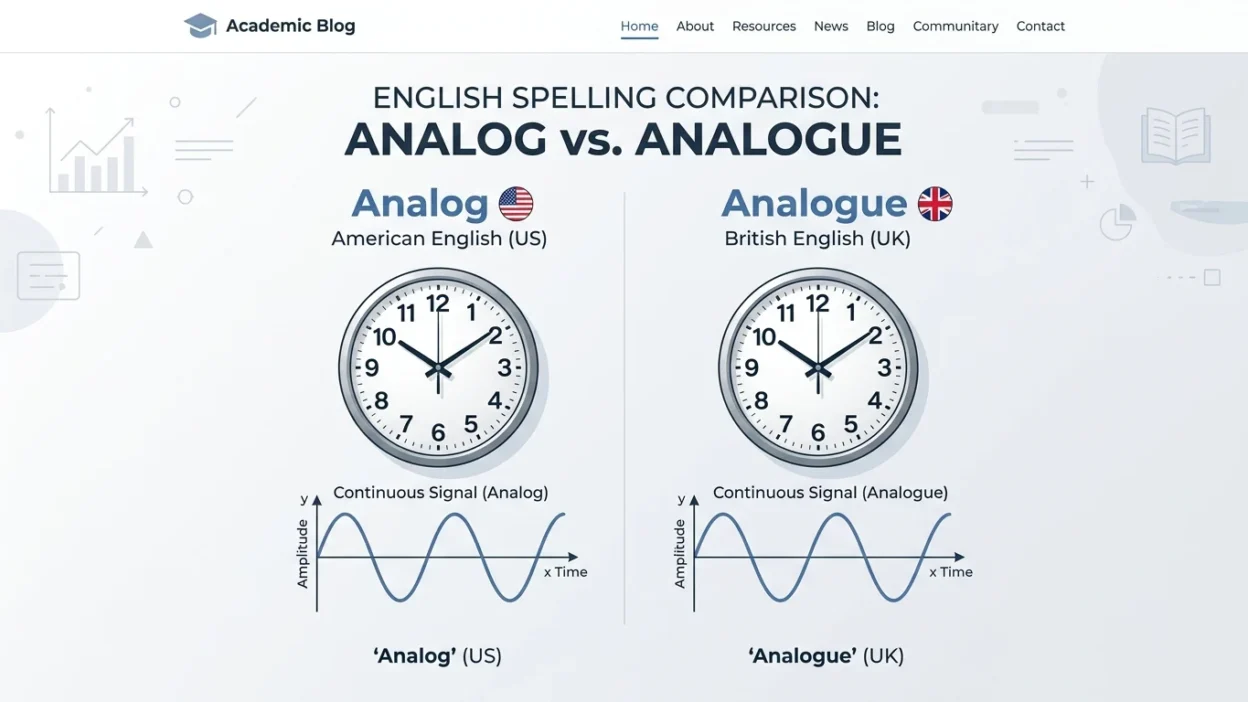
Analog and analogue have the same basic meaning, but the spelling you choose often depends on the variety of English you are using. In American English, analog is the standard spelling, while analogue is more common in British English. Both forms are correct.
The word can describe something that represents information through continuously varying physical quantities, especially in contrast with digital technology. For example, an analog clock displays time with hands, while a digital clock displays time using numerical digits. ‘
The word can also have broader meanings, including something that is comparable or similar to another thing. Understanding the spelling difference is especially useful when writing about technology, electronics, science, or comparisons.
Quick Answer
Analog and analogue are two spellings of the same word. Analog is preferred in American English, while analogue is generally preferred in British English. Both can refer to continuously varying technology or something that serves as a comparison or equivalent.
Why Do People Confuse Analog and Analogue?
The confusion comes from the extra ue in analogue.
The difference is mainly one of spelling rather than meaning:
American English: analog
British English: analogue
This is similar to other spelling differences between American and British English, such as:
color / colour
favorite / favourite
center / centre
However, there is one important detail. In modern technology, especially in American English, analog is overwhelmingly common in terms such as analog signal, analog audio, and analog clock.
Analog: Meaning and Usage
Analog is the standard American English spelling.
It can refer to technology or information represented by continuously changing physical quantities rather than discrete digital values.
Examples
- analog clock
- analog signal
- analog audio
- analog television
- analog recording
- analog device
- analog technology
- analog electronics
For example:
“I prefer the look of an analog clock.”
Here, analog describes a clock that traditionally uses hands to indicate the time.
The word can also mean something that is comparable to another thing.
“The company developed an analog of the existing system.”
In this sense, it means something that corresponds to or resembles another thing.
Analogue: Meaning and Usage
Analogue has the same meanings as analog but is the traditional British English spelling.
For example:
“I prefer an analogue clock.”
This means exactly the same thing as:
“I prefer an analog clock.”
The spelling analogue is especially common in British English and other varieties influenced by British spelling conventions.
Analog vs Analogue Comparison Table
| Feature | Analog | Analogue |
|---|---|---|
| Meaning | Same | Same |
| American English | Standard | Less common |
| British English | Used, especially in some technical contexts | Standard spelling |
| Technology | Very common | Very common |
| Noun | Yes, depending on context | Yes |
| Adjective | Yes | Yes |
| Pronunciation | Usually the same | Usually the same |
| Example | analog clock | analogue clock |
When to Use Analog
Use analog when following American English spelling conventions.
It is particularly common in:
- Technology writing
- Electronics
- Engineering
- Computer science
- American publications
- American academic writing
Examples
“The device converts analog signals into digital data.”
“He collects vintage analog cameras.”
“The studio specializes in analog recording equipment.”
“This analog clock needs a new battery.”
When to Use Analogue
Use analogue when following British English spelling conventions.
It is especially common in:
- British publications
- British academic writing
- British technical writing
- Countries that generally follow British spelling conventions
Examples
“The device converts analogue signals into digital data.”
“She enjoys using analogue cameras.”
“The laboratory has several analogue instruments.”
“The analogue clock stopped working.”
Analog vs Analogue in Technology
Both spellings are widely used in technical contexts, but regional spelling conventions usually determine the choice.
For example:
American English:
“The microphone produces an analog signal.”
British English:
“The microphone produces an analogue signal.”
The underlying technology is exactly the same.
Analog vs Digital
It is useful to understand analog because it is frequently contrasted with digital.
Analog
Information is represented through continuously varying values.
Examples include traditional analog clocks and many older recording systems.
Digital
Information is represented using discrete numerical values.
Examples include digital clocks, digital audio files, and digital photographs.
For example:
“The old system used analog technology, while the newer system uses digital technology.”
Analog or Analogue Clock?
Both are correct.
Use:
analog clock in American English.
analogue clock in British English.
An analog or analogue clock traditionally uses hands that move around a clock face.
For example:
“The classroom has an analogue clock on the wall.”
or
“The classroom has an analog clock on the wall.”
Both sentences have the same meaning.
Analog or Analogue Signal?
Again, both spellings are correct.
American English:
“The sensor produces an analog signal.”
British English:
“The sensor produces an analogue signal.”
A signal described as analog or analogue varies continuously rather than being represented solely as discrete digital values.
Analog as a Noun
Analog can also be used as a noun, particularly in American English.
It can refer to something that is comparable to another thing.
For example:
“This device is an analog of the earlier model.”
In British English, you will commonly see:
“This device is an analogue of the earlier model.”
The noun can also be used in technical contexts.
Common Mistakes
1. Thinking one spelling is wrong
Neither spelling is inherently wrong.
Analog is standard American English.
Analogue is standard British English.
2. Mixing spelling systems
If you are writing an American English article, consistency usually means choosing analog.
If you are writing in British English, analogue is generally the better choice.
3. Assuming the pronunciation is completely different
The two spellings are generally pronounced the same or very similarly.
The main difference is written rather than spoken.
4. Thinking analogue means something different
In most ordinary uses, analogue does not have a different meaning from analog. The difference is primarily regional spelling.
American vs British English
This is one of the clearest American and British spelling differences.
American English:
analog
British English:
analogue
For example:
American:
“Analog technology is still useful in some applications.”
British:
“Analogue technology is still useful in some applications.”
Both sentences are correct.
Analog vs Analogue vs Similar Words
Do not confuse these words with related terms such as:
Digital: Represented using discrete numerical values.
Equivalent: Equal or corresponding in value, function, or meaning.
Similar: Having qualities or characteristics in common.
Comparable: Able to be compared because of shared characteristics.
Replica: A copy or reproduction of something.
The exact meaning depends on how analog or analogue is being used.
Memory Trick
A simple way to remember the spelling is:
American = analog
British = analogue
Think of the British spelling as having the extra ue.
If your writing follows American English, use analog.
If your writing follows British English, use analogue.
Final Verdict
Analog and analogue are both correct spellings of the same word.
The main distinction is regional:
Analog = American English
Analogue = British English
Both can describe technology that uses continuously varying signals, such as an analog or analogue clock or signal. They can also describe something that corresponds to or resembles another thing.
For consistent writing, choose the spelling that matches the English variety you are using.
Frequently Asked Questions
Is analog or analogue correct?
Both are correct. Analog is the standard American English spelling, while analogue is the traditional British English spelling.
Is analog American or British?
Analog is primarily the American English spelling.
Is analogue British English?
Yes. Analogue is the standard traditional British English spelling.
Do analog and analogue mean the same thing?
Yes. They generally have the same meaning and pronunciation. The main difference is spelling.
Is it analog clock or analogue clock?
Both are correct. Use analog clock in American English and analogue clock in British English.
Is it analog signal or analogue signal?
Both are correct. The preferred spelling depends on the English variety being used.
Can analogue be used in American English?
Yes. It can appear in American English, especially in technical or specialized contexts, but analog is generally the standard American spelling.
What is the opposite of analog?
In technology, the usual contrasting term is digital.
Conclusion
Analog and analogue are not different words with different meanings. They are two regional spellings of the same word. Analog is generally preferred in American English, while analogue is preferred in British English and other varieties that follow British spelling conventions.
When writing about clocks, signals, electronics, audio, or older technology, either spelling can be correct as long as you follow the spelling conventions of your chosen variety of English. The simplest rule is to remember analog for American English and analogue for British English.
Remember This
Analog = American English
Analogue = British English
Both mean the same thing.

Nancy Lisa is a passionate writer and contributor at DrameyHut, focused on uncovering the deeper meanings behind dreams. She creates engaging and insightful content that helps readers interpret their dreams and understand their subconscious thoughts. Her work inspires self-reflection, clarity, and a stronger connection to inner emotions.