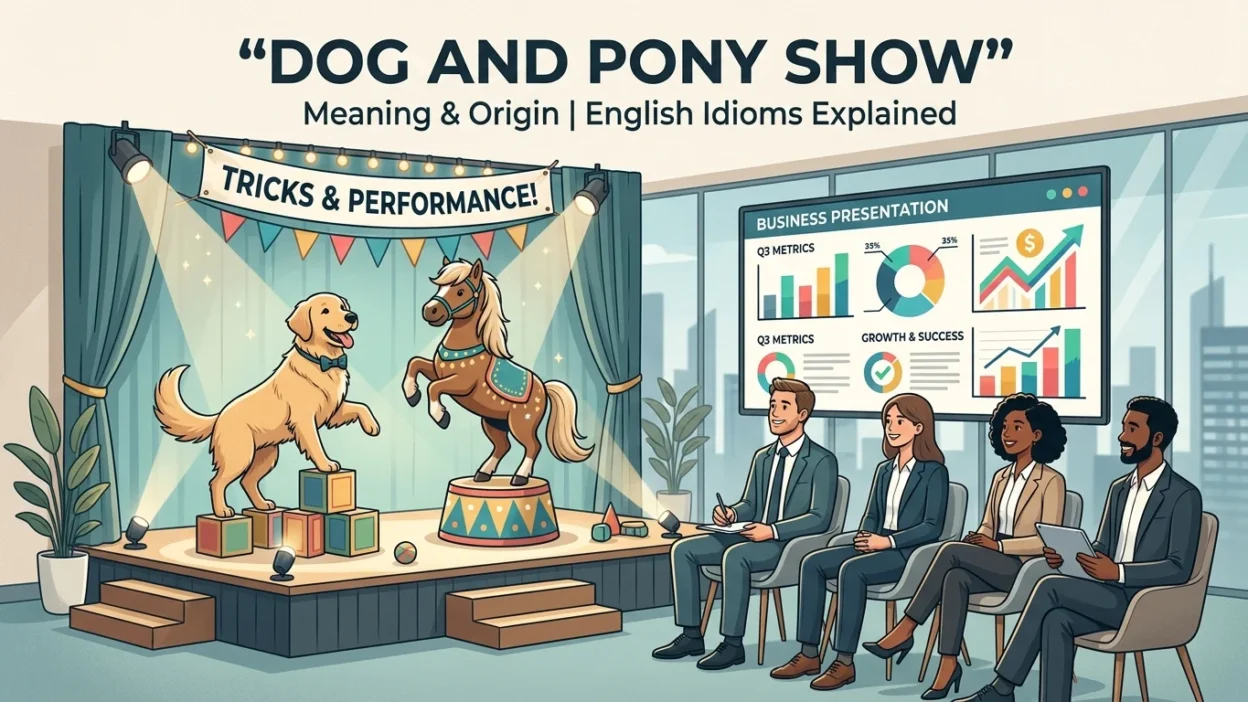
A dog and pony show is an informal English idiom for a carefully prepared presentation, performance, or display designed to impress people, often with more emphasis on appearance than substance. It is commonly used when a company, organization, politician, salesperson, or individual puts on an elaborate presentation to create a favorable impression.
The expression can be used literally in discussions of performances, but its modern use is usually figurative. For example, if a company gives executives an impressive presentation full of flashy slides and demonstrations but provides little useful information, someone might call it a dog and pony show. The phrase can therefore suggest that something looks impressive on the surface but may have limited practical value.
Quick Answer
Dog and pony show means an elaborate or impressive presentation designed to attract attention or impress an audience, sometimes with more emphasis on appearance than substance.
Example:
“The company gave investors a dog and pony show before asking for funding.”
What Does “Dog and Pony Show” Mean?
The idiom dog and pony show describes a highly organized presentation or performance intended to impress, entertain, persuade, or create a favorable impression.
It is often used when the speaker thinks the presentation contains too much showmanship and not enough substance.
For example:
“The meeting turned into a dog and pony show.”
This could mean that the meeting became a polished performance with presentations, demonstrations, speeches, and other attention grabbing elements rather than a straightforward discussion.
The phrase does not always mean that something is completely dishonest or useless. Sometimes it simply suggests that the presentation is overly elaborate or designed to impress.
Why Is It Called a “Dog and Pony Show”?
The expression comes from traveling entertainment shows that featured trained animals, including dogs and ponies.
These performances were designed to entertain audiences with tricks and displays.
Over time, the phrase developed a figurative meaning. Instead of referring to an actual animal performance, it came to describe a spectacle or elaborate presentation intended to impress an audience.
Today, the expression is particularly common in business and organizational settings.
Examples of “Dog and Pony Show”
- “The sales team put on a dog and pony show for the potential client.”
- “The presentation was more of a dog and pony show than a serious discussion.”
- “They gave investors a dog and pony show before launching the product.”
- “The meeting felt like a dog and pony show.”
- “We don’t need another dog and pony show. We need actual results.”
- “The company organized a dog and pony show to demonstrate its new technology.”
- “The executives were given a polished dog and pony show.”
- “The product demonstration was an impressive dog and pony show.”
- “The event became a dog and pony show with speeches, videos, and elaborate demonstrations.”
- “The consultant’s presentation was basically a dog and pony show.”
- “They put on a big dog and pony show for the visiting executives.”
- “The government department’s presentation was criticized as a dog and pony show.”
- “The interview process sometimes feels like a dog and pony show.”
- “The launch event was a flashy dog and pony show.”
- “Instead of a dog and pony show, the board wanted a straightforward report.”
Is “Dog and Pony Show” Negative?
Usually, dog and pony show has a somewhat negative or skeptical tone.
It often implies that someone is trying to impress an audience through presentation, spectacle, or showmanship rather than providing substantial information or meaningful results.
For example:
“The demonstration was a complete dog and pony show.”
This strongly suggests that the speaker was unimpressed by the substance behind the presentation.
However, the phrase can sometimes be used humorously or casually without being extremely critical.
Dog and Pony Show in Business
The expression is especially common in business.
A company might prepare a highly polished presentation for:
- Investors
- Potential customers
- Executives
- Clients
- Business partners
- Journalists
- Board members
For example:
“The startup put on a dog and pony show for potential investors.”
This suggests that the startup prepared an impressive presentation to persuade investors to take interest in the company.
The phrase may imply that the presentation focused heavily on appearances, demonstrations, and persuasive techniques.
Dog and Pony Show vs Presentation
These expressions are not exactly the same.
A presentation is a neutral word for an organized explanation or display.
A dog and pony show often suggests something more elaborate, flashy, or theatrical.
Compare:
“She gave a presentation about the new software.”
This is neutral.
“She gave a dog and pony show about the new software.”
This suggests that the presentation was particularly flashy or designed to impress.
Dog and Pony Show vs Showmanship
Showmanship means the ability to entertain or impress an audience through presentation and performance.
A dog and pony show is an event or presentation that may involve a lot of showmanship.
For example:
“The presentation relied heavily on showmanship.”
This is more neutral.
“The presentation was a dog and pony show.”
This is more likely to express skepticism or criticism.
Common Situations Where You Might Hear It
The idiom can appear in many contexts.
Business
“The sales team prepared a dog and pony show for the client.”
Politics
“Critics described the event as a dog and pony show.”
Workplace
“The management meeting turned into a dog and pony show.”
Product Launches
“The company held a dog and pony show to promote the new product.”
Interviews
“The interview process felt like a dog and pony show.”
Marketing
“The campaign presentation was a polished dog and pony show.”
Common Mistakes
1. Taking the expression literally
Most modern uses are figurative.
“The meeting was a dog and pony show.”
This usually has nothing to do with actual dogs or ponies.
2. Assuming it always means a dishonest presentation
The phrase can imply superficiality or excessive showmanship, but it does not automatically mean that someone is lying.
3. Using it in highly formal writing
The expression is informal. In formal writing, alternatives such as elaborate presentation, promotional display, or highly staged presentation may be more appropriate.
4. Thinking every impressive presentation is a dog and pony show
The phrase usually carries a critical or skeptical implication. A professional and informative presentation is not necessarily a dog and pony show.
American vs British English
Dog and pony show originated in American English and is particularly associated with American informal usage.
It is also understood in British English, especially through American media and business language, but it is more strongly associated with American English.
Similar Expressions
Depending on the context, similar expressions include:
Showpiece: Something designed to demonstrate quality or attract attention.
Publicity stunt: An action designed primarily to attract public attention.
Flashy presentation: A visually impressive presentation.
Smoke and mirrors: An expression suggesting that appearances are being used to conceal the reality of a situation.
Window dressing: Features added mainly to make something look better without substantially changing it.
Grandstand: To behave or perform in a way intended to attract attention or impress an audience.
These expressions are related, but they do not have exactly the same meaning.
Memory Trick
Think about an old traveling show featuring dogs and ponies performing tricks.
The audience is watching the performance because it is entertaining and impressive.
So remember:
Dog and pony show = a presentation with lots of show.
It is especially useful when something seems designed to impress more than inform.
Final Verdict
Dog and pony show is an informal idiom meaning an elaborate, highly prepared presentation or performance intended to impress an audience.
It often has a skeptical or critical tone, suggesting that there may be more showmanship than substance.
For example:
“The company put on a dog and pony show for the investors.”
The easiest way to remember it is:
Dog and pony show = an impressive display that may be more about appearance than substance.
Frequently Asked Questions
What does “dog and pony show” mean in simple English?
It means a flashy or carefully prepared presentation designed to impress people.
Is “dog and pony show” an insult?
It can be critical, especially when it suggests that a presentation focuses on appearance rather than substance. However, the exact tone depends on context.
Is “dog and pony show” a metaphor?
Yes. Its modern use is figurative and comes from entertainment shows featuring trained dogs and ponies.
Where did the phrase “dog and pony show” come from?
It is associated with traveling entertainment shows that featured trained animals performing for audiences. The expression later developed its figurative business and organizational meaning.
Can I use “dog and pony show” in business English?
Yes. It is common in informal business conversations, especially when someone wants to criticize an overly elaborate presentation.
Does “dog and pony show” mean fake?
Not necessarily. It can suggest that something is overly focused on presentation or appearance, but it does not automatically mean that the information is false.
What is another way to say “dog and pony show”?
Depending on the context, you could say flashy presentation, elaborate presentation, staged display, publicity stunt, or showpiece.
Is “dog and pony show” American English?
Yes. The idiom is strongly associated with American English, although it is also understood in British English.
Conclusion
The expression dog and pony show refers to an elaborate presentation or performance designed to impress, entertain, or persuade an audience. In modern usage, it is especially common when talking about businesses, organizations, presentations, product demonstrations, and other situations where appearance and showmanship are important.
The phrase often carries a skeptical tone because it can suggest that there is more presentation than substance. However, it does not necessarily mean that the information being presented is false or worthless. Context determines how critical the speaker intends to be.
Remember This
Dog and pony show = an elaborate display designed to impress, often with more emphasis on showmanship than substance.
Example: “The sales team put on a dog and pony show for the potential client.”

Nancy Lisa is a passionate writer and contributor at DrameyHut, focused on uncovering the deeper meanings behind dreams. She creates engaging and insightful content that helps readers interpret their dreams and understand their subconscious thoughts. Her work inspires self-reflection, clarity, and a stronger connection to inner emotions.