If someone says that a project has been “put on the back burner,” they usually mean that the project has been delayed or given less attention for now. It has not necessarily been canceled. Instead, it has become a lower priority while something more urgent or important receives attention.
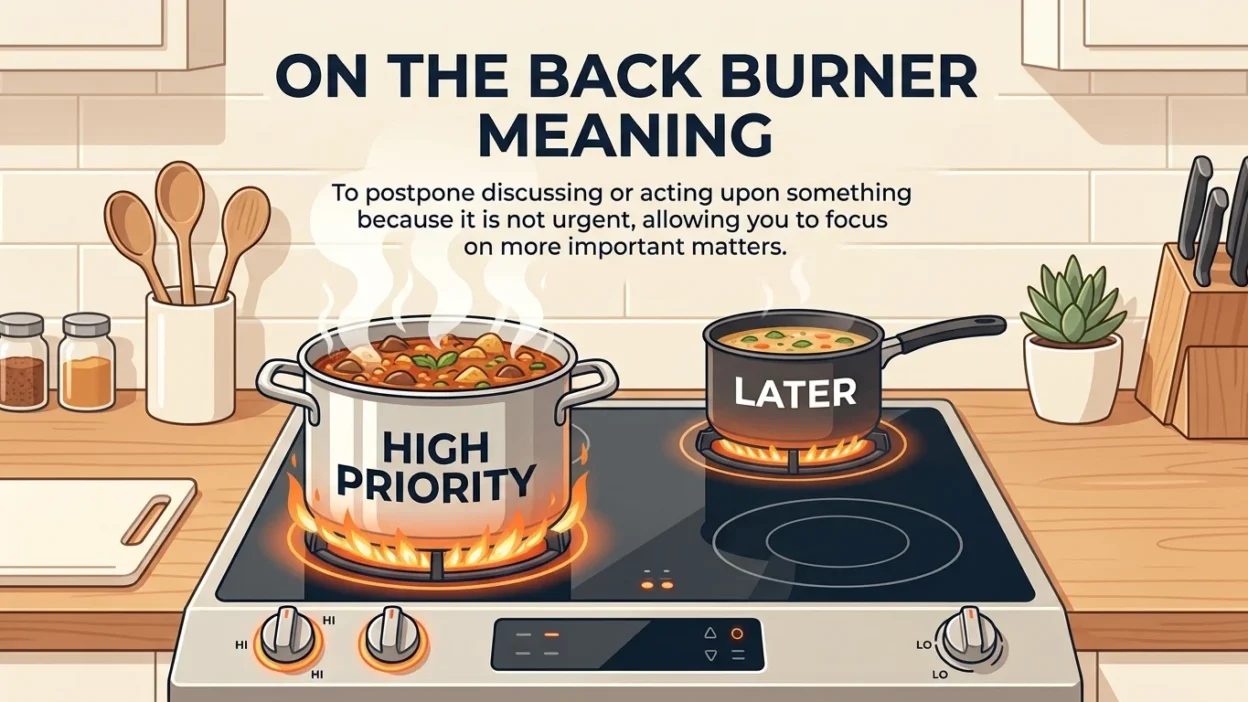
The expression comes from cooking. A stove has several burners, and a cook may place a pot on a back burner when it does not need immediate attention.
The same idea is used figuratively for plans, projects, decisions, and responsibilities. Understanding this idiom is useful because it appears frequently in everyday conversations, workplaces, news articles, and professional communication.
Quick Answer
On the back burner means that something is temporarily given less attention or priority because other matters are more important at the moment. It usually suggests postponement rather than cancellation.
Example:
“We’ve put the renovation project on the back burner until next year.”
What Does “On the Back Burner” Mean?
On the back burner is an idiom meaning that something is being delayed, postponed, or treated as a lower priority.
It can describe:
- A project
- A plan
- A decision
- A goal
- An idea
- A task
- A personal ambition
- A business proposal
For example:
“My plans to learn Spanish are on the back burner right now.”
This means the person still has the goal of learning Spanish, but they are not giving it much attention at the moment.
Why Is It Called “The Back Burner”?
The expression comes from cooking.
Imagine a stove with several burners. A cook might place something that needs less immediate attention on a back burner, while keeping something that requires constant attention on a front burner.
This physical arrangement became a metaphor for priorities.
Front burner = high priority
Back burner = lower priority
So when something is on the back burner, it is not necessarily forgotten. It simply does not require immediate attention.
Examples of “On the Back Burner”
- “We’ve put the project on the back burner for now.”
- “Her plans to travel are on the back burner while she finishes college.”
- “The company put the expansion plan on the back burner.”
- “I’ve had to put my writing on the back burner because of work.”
- “The committee decided to leave the proposal on the back burner.”
- “My fitness goals have been on the back burner lately.”
- “We’re putting the renovation on the back burner until we have enough money.”
- “The new product idea is currently on the back burner.”
- “He put his vacation plans on the back burner.”
- “The issue has been on the back burner for several months.”
- “I don’t want to abandon the idea, but I need to put it on the back burner.”
- “The company has several projects on the back burner.”
- “She put her dream of opening a restaurant on the back burner.”
- “The decision has been put on the back burner while we gather more information.”
- “We can return to that discussion later. It’s on the back burner for now.”
“Put Something on the Back Burner” vs “Be on the Back Burner”
These two forms are closely related but grammatically different.
Put Something on the Back Burner
This means to postpone or reduce the priority of something.
Example:
“We decided to put the project on the back burner.”
Someone actively made the decision to give the project less attention.
Be on the Back Burner
This describes the resulting situation.
Example:
“The project is on the back burner.”
The project is currently a low priority.
A useful way to remember the difference is:
Put = the action
Be = the situation
Is “On the Back Burner” Negative?
Not necessarily.
The expression can suggest that something is less important for now, but it does not automatically mean that the idea is bad or permanently abandoned.
For example:
“I’ve put my novel on the back burner while I focus on my exams.”
This does not mean the person has given up writing. They simply have another priority at the moment.
The context determines whether the postponement is temporary or indefinite.
Does “On the Back Burner” Mean Canceled?
Usually, no.
Being on the back burner generally means something is postponed or receiving less attention, not necessarily canceled.
Compare:
On the back burner:
“We’ve put the trip on the back burner.”
This suggests the trip may happen later.
Canceled:
“We canceled the trip.”
This clearly means the trip will not happen as planned.
Therefore, on the back burner usually leaves the possibility of returning to the matter later.
On the Back Burner vs Put on Hold
These expressions are similar but have slightly different emphasis.
| Expression | Meaning |
|---|---|
| On the back burner | Lower priority for now |
| Put on hold | Temporarily stopped or paused |
| Postponed | Delayed until a later time |
| Canceled | Decided not to continue |
| Forgotten | No longer remembered or considered |
| Abandoned | Given up completely |
For example:
“The project is on the back burner.”
The project is not a current priority.
“The project is on hold.”
Work on the project has temporarily stopped.
The two expressions can overlap, but on the back burner focuses more strongly on priority.
On the Back Burner vs Front Burner
These expressions are opposites in terms of priority.
On the Back Burner
Means something is receiving less attention.
“The marketing campaign is on the back burner.”
On the Front Burner
Means something is receiving immediate or significant attention.
“The safety issue is on the front burner.”
So you can remember:
Front burner = important now
Back burner = less important now
Common Mistakes
Mistake 1: Saying “in the back burner”
The standard expression is:
on the back burner
Not:
in the back burner
Correct:
“The project is on the back burner.”
Mistake 2: Assuming it means permanently canceled
It usually means postponed or deprioritized, not permanently canceled.
Mistake 3: Using it only for physical cooking
The literal cooking meaning exists, but in everyday conversation the expression is very often figurative.
“We put the proposal on the back burner.”
This is about priorities, not cooking.
Mistake 4: Confusing “back burner” with “backburner”
For the idiom, the standard phrase is generally written as:
on the back burner
When Should You Use “On the Back Burner”?
You can use this idiom when something is still relevant but is not currently receiving much attention.
It works especially well when discussing:
Work:
“The new project is on the back burner.”
Education:
“I’ve put that course on the back burner.”
Personal goals:
“My plans to learn guitar are on the back burner.”
Business:
“The expansion has been put on the back burner.”
Relationships and social plans:
“We’ve had to put our vacation plans on the back burner.”
It is generally informal to neutral and is common in both conversation and professional communication.
American vs British English
On the back burner is widely understood in both American and British English.
There is no major difference in meaning.
For example:
American English:
“The project is on the back burner.”
British English:
“The project is on the back burner.”
The idiom is common enough to be easily understood in both varieties.
Similar Expressions
Depending on the context, you can replace on the back burner with:
- Put on hold
- Postponed
- Delayed
- Deprioritized
- Set aside
- Put off
- Leave for later
- Given lower priority
- Temporarily shelved
However, these expressions are not always exact equivalents.
On the back burner emphasizes that something has become a lower priority.
Memory Trick
Think about a stove.
A pot on the front burner needs your attention now.
A pot on the back burner can wait.
So:
Back burner = “It can wait for now.”
This makes the idiom easy to remember.
Final Verdict
On the back burner means that something has been given less attention or priority for the time being.
It usually suggests that the matter has been postponed, not permanently canceled.
For example:
“We’ve put the project on the back burner until next month.”
The easiest way to remember it is:
Front burner = priority now.
Back burner = priority later.
Frequently Asked Questions
What does “on the back burner” mean in simple English?
It means something is not a priority right now and will probably be dealt with later.
Does “on the back burner” mean canceled?
No. It usually means postponed or given lower priority. The matter may be reconsidered later.
What is an example of “on the back burner”?
“We’ve put our vacation plans on the back burner because we need to save money.”
What is the opposite of “on the back burner”?
On the front burner is the common opposite. It means something is receiving immediate attention or is a high priority.
Is “put on the back burner” correct?
Yes. Put something on the back burner means to postpone it or make it a lower priority.
Is “in the back burner” correct?
No. The standard idiom is on the back burner.
Is “on the back burner” formal?
It is generally informal to neutral. It is common in everyday speech and can also appear in professional communication.
What is another way to say “on the back burner”?
Depending on the context, you can say put on hold, postponed, delayed, set aside, or given lower priority.
Conclusion
The idiom on the back burner describes something that is still relevant but is receiving less attention because other matters currently have greater priority. It comes from cooking, where something placed on a back burner can be left to cook while the cook focuses on something else.
Remember that the expression usually suggests delay rather than cancellation. If you put a plan on the back burner, you may still return to it later. The phrase is especially useful when talking about projects, goals, decisions, plans, and responsibilities that have temporarily become less important.
Remember This
On the back burner = temporarily given lower priority or postponed.
Example: “We put the project on the back burner until next year.”

Daniel Charles is a dedicated author and dream interpretation enthusiast at DrameyHut. He specializes in analyzing dream symbols and meanings, offering clear and insightful content for readers. His work aims to help individuals understand their subconscious thoughts, gain clarity, and explore the deeper messages hidden within their dreams.