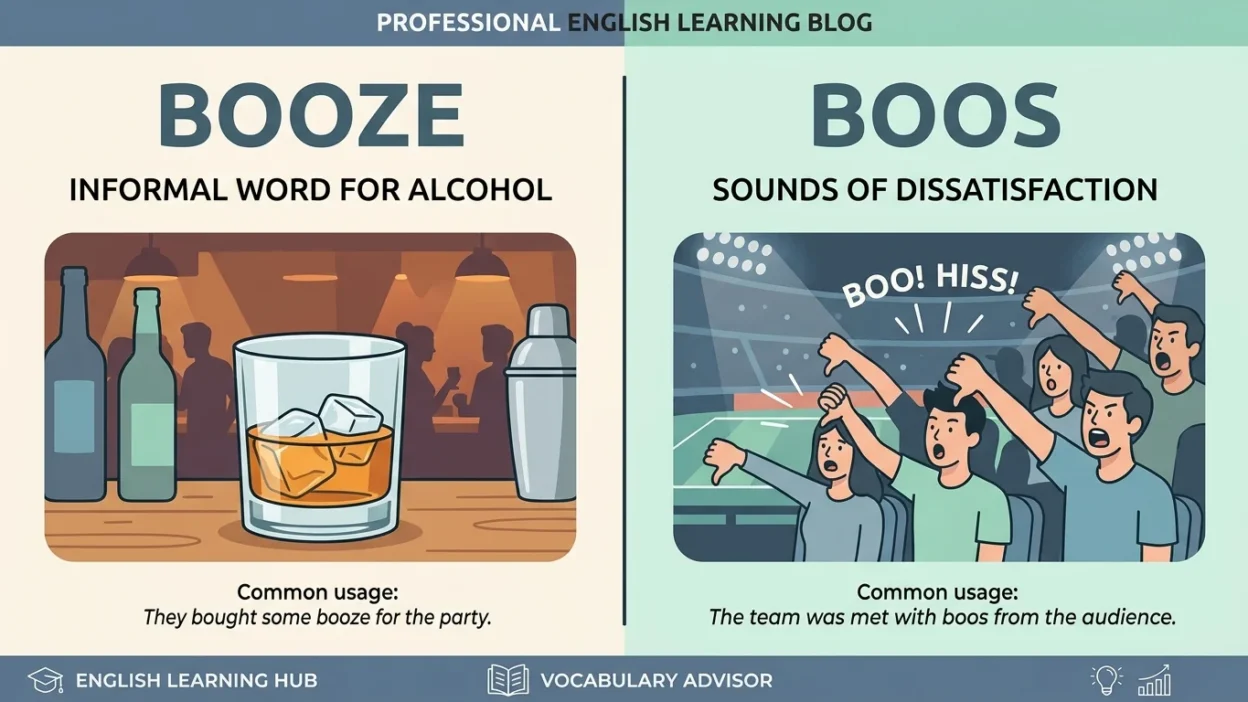
“Booze” and “boos” look and sound similar, but they have completely different meanings. One word is commonly used as an informal term for alcoholic drinks, while the other refers to expressions of disapproval from an audience.
Understanding the difference between booze and boos is important because confusing these words can completely change the meaning of a sentence. For example, “The crowd gave him boos” means the audience showed disapproval, while “They brought some booze to the party” means they brought alcoholic drinks.
The words may be easy to mix up because they have similar spellings and pronunciation, but their grammatical roles and meanings are quite different. Let’s look at exactly what each word means, how to use it correctly, and how to remember the difference.
Quick Answer
Booze is an informal noun meaning alcoholic drinks or alcohol. Boos is the plural form of “boo,” meaning expressions of disapproval or the sound people make to show that they dislike something. For example, “They brought booze to the party” and “The player heard boos from the crowd.”
Why People Confuse Booze and Boos
People often confuse booze and boos because both words contain similar letters and can refer to things heard or experienced in social situations.
However, their meanings are completely different.
Booze refers to alcohol.
There was plenty of booze at the party.
Boos refers to expressions of disapproval.
The referee received boos from the crowd.
Another reason for confusion is that both words are short and informal. However, looking at the letters after the initial boo can help you distinguish them.
Booze
Booze is an informal word for alcohol or alcoholic drinks.
It is usually used as a noun, although “booze” can also function as a verb in informal English.
Booze as a Noun
When “booze” is a noun, it means alcoholic beverages in general.
They bought some booze for the party.
There was no booze at the event.
He decided to give up booze.
The word does not normally refer to one particular type of alcoholic drink. It can refer generally to beer, wine, spirits, or other alcoholic beverages.
Booze as a Verb
“Booze” can also be used as an informal verb meaning to drink alcohol, especially heavily.
They spent the evening boozing with friends.
He used to booze a lot when he was younger.
The verb is informal and is not usually appropriate in formal writing.
Is Booze Formal?
No. Booze is informal.
In formal writing, words such as alcohol, alcoholic beverages, or alcoholic drinks are usually more appropriate.
Boos
Boos is the plural form of the noun boo.
A boo is a sound or expression made by people to show disapproval, dislike, or dissatisfaction.
The player was greeted with boos.
The singer heard boos from the audience.
The referee received loud boos from the crowd.
“Boos” is especially common when talking about sports, performances, political speeches, or public events.
Boo as a Verb
“Boo” can also be a verb.
The audience booed the performer.
Fans booed the referee.
The past tense is booed, not “boosed.”
The noun plural is:
boos
The past tense of the verb is:
booed
These forms should not be confused.
Booze vs Boos Comparison Table
| Word | Part of Speech | Meaning | Example |
|---|---|---|---|
| Booze | Noun | Alcohol or alcoholic drinks | They bought some booze. |
| Booze | Verb | To drink alcohol | They spent the night boozing. |
| Boo | Noun | An expression of disapproval | The player heard a boo. |
| Boos | Noun | Multiple expressions of disapproval | The player heard boos. |
| Boo | Verb | To show disapproval by making a “boo” sound | The crowd began to boo. |
| Booed | Verb | Showed disapproval in the past | The crowd booed the referee. |
When to Use Booze and Boos
Use booze when you are talking about alcohol.
We need to buy some booze for the celebration.
Use boos when you are talking about multiple expressions of disapproval.
The actor received boos from the audience.
A simple question can help:
Is the sentence talking about alcohol?
If yes, use booze.
Is the sentence talking about people showing disapproval?
If yes, use boos.
Examples of Booze
- They brought some booze to the party.
- There was plenty of booze at the celebration.
- He decided to stop drinking booze.
- We do not allow booze inside the building.
- The store sells beer, wine, and other kinds of booze.
- They spent the evening drinking booze with their friends.
- She gave up booze several years ago.
- The party had plenty of food but very little booze.
- He bought some booze before the weekend.
- The hotel does not provide free booze.
- They were looking for a place that served cheap booze.
- Too much booze can lead to poor decisions.
Examples of Boos
- The referee received boos from the crowd.
- The politician was greeted with loud boos.
- The actor heard boos after the performance.
- The player walked off the field to a chorus of boos.
- The crowd responded with boos when the decision was announced.
- The singer expected applause but heard boos instead.
- The team was met with boos after losing the match.
- The referee ignored the boos from the spectators.
- The performer heard a few boos from the back of the theater.
- The controversial decision caused loud boos throughout the stadium.
- The fans expressed their disappointment with boos.
- The audience became quiet after the boos stopped.
Booze vs Boo
It is also useful to understand the difference between booze and boo.
Booze means alcohol.
He does not drink booze.
Boo can refer to an expression of disapproval.
The audience gave the actor a boo.
“Boo” can also be used as a verb.
The fans began to boo.
So the extra s in “boos” usually indicates that there is more than one expression of disapproval.
Common Mistakes
1. Using “boos” when you mean alcohol
Incorrect:
We bought some boos for the party.
Correct:
We bought some booze for the party.
Remember that booze has a z sound at the end and means alcohol.
2. Using “booze” when you mean disapproval
Incorrect:
The crowd gave the referee booze.
Correct:
The crowd gave the referee boos.
The audience gives boos, not “booze.”
3. Confusing “boos” with “booed”
“Boos” is generally a plural noun.
The player heard boos.
“Booed” is the past tense of the verb.
The crowd booed the player.
Do not write:
The crowd boos the player yesterday.
Instead:
The crowd booed the player yesterday.
4. Assuming “booze” is formal
“Booze” is an informal term for alcohol.
In formal contexts, alcohol or alcoholic beverages is usually better.
5. Thinking the words have related meanings
Although they look similar, booze and boos are unrelated in meaning.
One concerns alcohol, while the other concerns disapproval.
Memory Trick
Here is an easy way to remember the difference:
Booze = alcohol
Think of the Z in “booze” as reminding you of a relaxed social setting where people might be drinking.
Boos = disapproval
Think of boos as the sounds coming from a crowd that does not like something.
You can remember:
Booze goes in a glass. Boos come from a crowd.
That simple distinction makes the difference much easier to remember.
American vs British English
Booze and boos are used in both American and British English.
There is no major difference in their basic meanings.
In both varieties:
booze = alcohol
boos = expressions of disapproval
However, “booze” is informal in both American and British English. Depending on the context, British English may use “booze” quite casually in everyday conversation.
For formal writing in either variety, alcohol is generally more appropriate.
Similar Words
Alcohol
A neutral and widely used term for alcoholic drinks.
The restaurant does not serve alcohol.
Alcoholic Drinks
A more explicit expression referring to beverages containing alcohol.
The event offers a variety of alcoholic drinks.
Drinks
In some contexts, “drinks” can refer to alcoholic beverages.
They went out for drinks.
Liquor
A term often used for distilled alcoholic beverages such as whiskey, vodka, or rum.
The store sells liquor.
Applause
The opposite of boos in many performance situations.
The performer received loud applause.
Jeers
Expressions of mockery or disapproval.
The player was met with jeers from the crowd.
Catcalls
Loud comments, shouts, or noises directed toward someone, often in a mocking or inappropriate way.
The performer was distracted by catcalls.
Final Verdict
Booze and boos have completely different meanings.
Booze is an informal word for alcohol or alcoholic drinks.
Boos is the plural of boo, meaning sounds or expressions of disapproval.
Compare:
They brought booze to the party.
The crowd gave the team boos.
The easiest memory trick is:
Booze goes in a glass. Boos come from a crowd.
Once you connect “booze” with alcohol and “boos” with audience disapproval, the difference becomes easy to remember.
FAQs
What is the difference between booze and boos?
Booze means alcohol or alcoholic drinks, while boos means expressions of disapproval from people.
Is booze a slang word?
Yes. “Booze” is an informal term for alcohol. It is common in casual conversation but may be unsuitable for formal writing.
What does boos mean?
“Boos” is the plural of “boo.” It refers to sounds people make to show disapproval or dislike.
Is booze singular or plural?
“Booze” is generally an uncountable noun when it means alcohol.
We bought some booze.
It does not normally become “boozes” when referring to alcohol in general.
What is the past tense of boo?
The past tense is booed.
The crowd booed the referee.
Can booze be a verb?
Yes. Informally, “to booze” means to drink alcohol, often heavily.
Are booze and boos pronounced the same?
They are not exactly the same. “Booze” ends with a voiced z sound, while “boos” normally ends with an unvoiced s sound.
Is booze a formal word?
No. “Booze” is informal. In formal contexts, use alcohol or alcoholic beverages instead.
Conclusion
The difference between booze and boos is simple once you focus on their meanings. Booze refers to alcohol and is an informal word commonly used in casual conversation. Boos, on the other hand, refers to sounds of disapproval made by an audience or crowd.
Although these words look similar, they belong to different semantic categories. When you see booze, think about alcohol. When you see boos, think about a crowd expressing dissatisfaction. This distinction will help you avoid spelling and vocabulary mistakes in both everyday English and writing.
Remember This
Booze = alcohol
They brought some booze to the party.
Boos = expressions of disapproval
The crowd responded with boos.
Easy memory trick:
Booze goes in a glass. Boos come from a crowd.

Christopher Thomas is a passionate writer and dream researcher dedicated to exploring the meanings behind dreams. As an author at DrameyHut, he creates insightful and easy-to-understand interpretations that help readers connect with their subconscious mind. His work focuses on guiding individuals toward self-discovery, clarity, and a deeper understanding of their inner thoughts.