Polite and courteous are closely related English adjectives that both describe respectful and considerate behavior. In many situations, they can be used interchangeably, but they are not always identical in tone or emphasis. Understanding the small difference can help you choose the more natural word for a particular situation.
If someone says, “She was polite to everyone,” the sentence means that she behaved respectfully and used appropriate manners. If someone says, “She was courteous to everyone,” the meaning is similar, but “courteous” can place slightly more emphasis on showing consideration, respect, and good manners toward other people.
Both words are positive, and neither suggests that the person is necessarily warm or friendly. The main difference is that polite is more common and general, while courteous often sounds more formal and emphasizes considerate treatment of others.
Quick Answer
Polite and courteous both mean showing good manners and respect toward others. Polite is more common and can describe everyday manners, language, or behavior. Courteous is slightly more formal and emphasizes consideration and respectful treatment of other people.
Why People Confuse Polite and Courteous
People confuse polite and courteous because their meanings overlap considerably.
Both words can describe someone who:
- uses good manners
- treats others with respect
- behaves appropriately
- avoids being rude
- shows consideration for others
For example:
He was polite to the waiter.
He was courteous to the waiter.
Both sentences are correct.
The difference is mainly one of usage, tone, and emphasis, rather than a completely different definition.
Polite
Polite means behaving or speaking in a way that shows good manners, respect, and consideration for others.
It is one of the most common words in English for describing good manners.
For example:
She is always polite to her teachers.
Please be polite to our guests.
He gave me a polite response.
“Polite” can describe a person’s behavior, speech, request, response, or manner.
Polite in Everyday English
“Polite” is especially common in everyday situations.
Please say thank you. It is polite.
He was polite when he asked for help.
She politely declined the invitation.
It is natural in conversations between friends, family members, teachers, coworkers, and strangers.
Polite Can Describe Language
You can also describe words or expressions as polite.
Could you please help me?
This is a polite request.
Similarly:
Would you mind closing the window?
This is a polite way to make a request.
Courteous
Courteous means showing respect, consideration, and good manners toward other people.
It has essentially the same basic meaning as “polite,” but it often sounds more formal.
For example:
The staff were courteous and professional.
He was courteous to everyone he met.
Please be courteous to other passengers.
“Courteous” often highlights the way someone considers other people’s comfort, needs, or feelings.
Courteous in Formal Situations
“Courteous” is particularly useful in professional, public, and formal contexts.
For example:
The customer service representative was courteous and helpful.
Drivers should be courteous to other road users.
The staff provided courteous service.
In these examples, “courteous” emphasizes respectful and considerate treatment.
Polite vs Courteous Comparison Table
| Feature | Polite | Courteous |
|---|---|---|
| Basic meaning | Showing good manners and respect | Showing good manners, respect, and consideration |
| Commonness | Very common | Less common |
| Tone | Neutral and everyday | Slightly more formal |
| Everyday conversation | Very natural | Natural but somewhat formal |
| Professional contexts | Very common | Very common |
| Focus | Manners and appropriate behavior | Respectful and considerate treatment |
| Example | She was polite to the guest. | She was courteous to the guest. |
When to Use Polite
Use polite when talking about ordinary good manners or respectful language.
Talking About Behavior
The children were very polite.
Talking About Requests
That is a polite way to ask for help.
Talking About Responses
He gave me a polite answer.
Talking About Social Rules
It is polite to say thank you.
“Polite” is usually the safest choice when you are unsure which word to use.
When to Use Courteous
Use courteous when you want to emphasize respectful and considerate treatment, especially in a formal or professional context.
For example:
The hotel staff were courteous and professional.
Please be courteous to other customers.
The driver was courteous enough to let the pedestrian cross.
“Courteous” is particularly natural when describing customer service, professional behavior, public behavior, or interactions between strangers.
Polite vs Courteous in Professional English
Both words work well in professional English.
Compare:
The receptionist was polite.
This simply says that the receptionist behaved well and used good manners.
The receptionist was courteous.
This can suggest that the receptionist treated the customer with respect and consideration.
You might see “courteous” more often in formal evaluations, business communication, customer service descriptions, and professional writing.
For example:
Our employees are expected to provide courteous service.
This sounds more formal than:
Our employees are expected to provide polite service.
Both are grammatically correct.
Examples of Polite
- She is always polite to her neighbors.
- It is polite to say thank you when someone helps you.
- He politely asked me to wait outside.
- The student gave a polite answer.
- Please be polite to your guests.
- She was polite even though she disagreed with him.
- He made a polite request.
- It is polite to listen while someone else is speaking.
- The children were very polite at dinner.
- She politely declined the offer.
- He used polite language during the conversation.
- The customer remained polite throughout the discussion.
Examples of Courteous
- The hotel staff were courteous and professional.
- Please be courteous to other passengers.
- The driver was courteous enough to let us merge.
- The receptionist provided courteous service.
- He was courteous to everyone at the meeting.
- The staff remained courteous despite the difficult situation.
- Employees should always be courteous to customers.
- She gave the visitor a courteous welcome.
- The waiter was courteous and attentive.
- He was courteous when discussing the disagreement.
- The company is known for its courteous customer service.
- Please remain courteous when communicating with other members of the team.
Polite vs Courteous: Are They Interchangeable?
Often, yes.
For example:
He was polite to the customer.
He was courteous to the customer.
Both sentences communicate that he treated the customer respectfully.
However, replacing one with the other can slightly change the tone.
Polite tends to sound more ordinary and conversational.
Courteous tends to sound more formal and can emphasize consideration toward others.
This is why “courteous service” is a very common phrase in professional contexts.
Common Mistakes
1. Thinking Polite and Courteous Have Completely Different Meanings
They do not.
Their meanings overlap significantly. Both describe respectful and well mannered behavior.
2. Thinking Courteous Is Always Better Than Polite
“Courteous” is not a stronger or superior version of “polite.”
The appropriate word depends on the context.
3. Using Courteous in Every Casual Situation
“Courteous” is correct in everyday English, but “polite” is often more natural.
For example:
My brother was polite to my friend.
This sounds very natural.
My brother was courteous to my friend.
This is correct but may sound somewhat formal depending on the context.
4. Thinking Polite Means Friendly
Being polite does not necessarily mean being warm, affectionate, or friendly.
Someone can behave politely while remaining emotionally distant.
He was polite but not particularly friendly.
This is completely natural.
5. Confusing Courteous With Courteousness
The noun form is courtesy, not “courteousness” in ordinary standard usage.
Thank you for your courtesy.
The staff treated us with courtesy.
The adjective is:
courteous
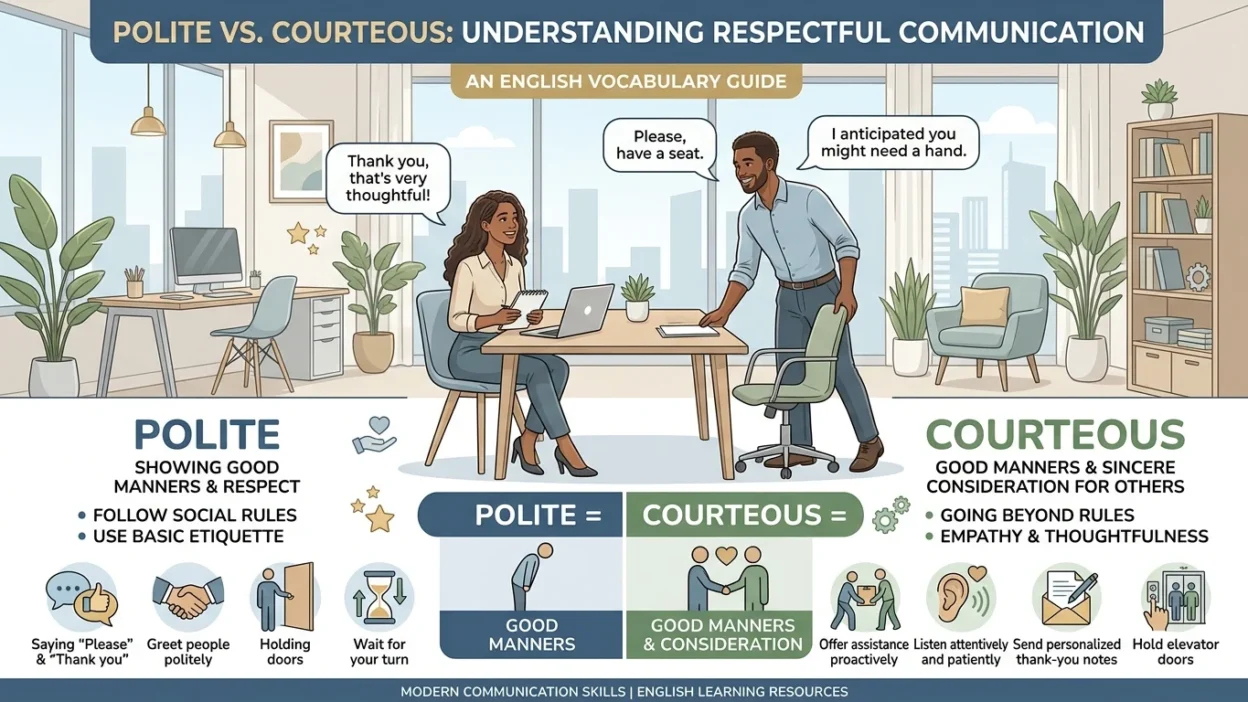
Memory Trick
Use this simple memory trick:
Polite = good manners
Courteous = good manners plus consideration
This is not an absolute grammatical rule, because the meanings overlap, but it is useful for remembering the typical difference in emphasis.
Think of courteous as the word you might use when someone is consciously considering other people’s comfort or needs.
For example:
Please be courteous to other passengers.
The idea is not simply “have good manners.” It also suggests consider the people around you.
American vs British English
Polite and courteous are standard in both American and British English.
There is no major difference in their meanings between the two varieties.
“Polite” is very common in both varieties, especially in everyday conversation.
“Courteous” is also widely understood and used, particularly in formal, professional, customer service, and public contexts.
For example:
American English: The staff were polite and helpful.
British English: The staff were polite and helpful.
Both are completely natural.
Similar Words
Respectful
Showing respect toward someone.
She was respectful toward her teacher.
Civil
Polite and reasonably respectful, especially during disagreement.
They remained civil during the argument.
Well Mannered
Having good social manners.
The children were well mannered.
Considerate
Careful about other people’s feelings, needs, or comfort.
He was considerate of his coworkers.
Respectable
Worthy of respect or socially acceptable, depending on context.
She has a respectable reputation.
Gracious
Kind, pleasant, and courteous, especially in social interactions.
The host was gracious to all the guests.
Cordial
Friendly and polite, especially in a formal or professional relationship.
They maintained a cordial relationship.
Polite vs Courteous vs Considerate
These three words are related but have slightly different focuses.
Polite focuses on good manners.
She was polite to the waiter.
Courteous focuses on respectful and considerate treatment.
The driver was courteous to other road users.
Considerate focuses particularly on thinking about another person’s needs or feelings.
He was considerate of his elderly neighbor.
Someone can be polite without being particularly considerate.
For example, a person might say “please” and “thank you” while still ignoring someone else’s needs.
Final Verdict
Polite and courteous are very similar words, and both describe respectful behavior and good manners.
The main difference is that polite is more common and general, while courteous is slightly more formal and often emphasizes consideration for other people.
Use polite for everyday manners, respectful language, requests, and ordinary social behavior. Use courteous when you want a more formal tone or when emphasizing respectful and considerate treatment, especially in professional and public situations.
A simple way to remember the distinction is:
Polite = good manners.
Courteous = good manners with consideration for others.
FAQs
What is the difference between polite and courteous?
Both mean showing good manners and respect. “Polite” is more common and general, while “courteous” is slightly more formal and often emphasizes consideration for others.
Is courteous more formal than polite?
Generally, yes. “Courteous” often sounds more formal or professional, while “polite” is extremely common in everyday English.
Can polite and courteous be used interchangeably?
Often, yes. In many sentences, either word can describe respectful behavior without significantly changing the meaning.
Is courteous a synonym for polite?
Yes. “Courteous” is a close synonym of “polite,” although it can carry a slightly stronger emphasis on consideration and respectful treatment.
Can someone be polite but not friendly?
Yes. Being polite means following good manners and showing respect. It does not necessarily mean that someone is warm, friendly, or emotionally close.
What is the noun of courteous?
The common noun is courtesy.
Thank you for your courtesy.
Which is better, polite or courteous?
Neither is universally better. “Polite” is generally more natural for everyday situations, while “courteous” can be more suitable in formal or professional contexts.
What is a good synonym for courteous?
Depending on the context, good alternatives include polite, respectful, considerate, civil, gracious, cordial, and well mannered.
Conclusion
Polite and courteous both describe people who behave with good manners and respect. Their meanings overlap so much that they can often be substituted for each other without creating a grammatical problem. The main distinction is one of tone and emphasis rather than a completely different meaning.
“Polite” is the more common everyday choice and works naturally when talking about respectful language, requests, responses, and social behavior. “Courteous” has a slightly more formal tone and is particularly useful when describing considerate treatment in professional, public, or customer service situations.
Remember This
Polite = good manners
Courteous = good manners and consideration
She was polite to the guest.
The hotel staff were courteous to the guests.
When you want the natural everyday word, polite is usually the easiest choice. When you want a more formal expression that highlights respectful treatment, courteous is a useful alternative.

Nancy Lisa is a passionate writer and contributor at DrameyHut, focused on uncovering the deeper meanings behind dreams. She creates engaging and insightful content that helps readers interpret their dreams and understand their subconscious thoughts. Her work inspires self-reflection, clarity, and a stronger connection to inner emotions.