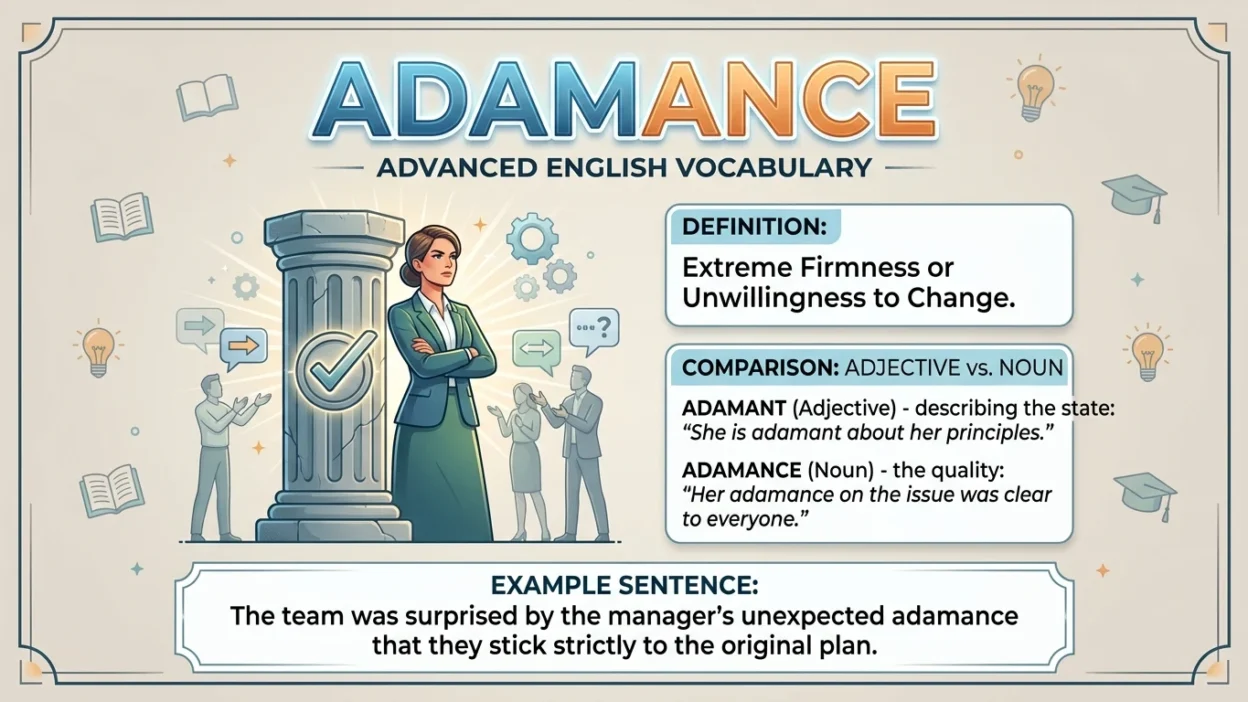
Adamance is a formal English noun that means the quality of being very firm or unwilling to change your opinion, decision, or position. If someone shows adamance, they strongly maintain their position even when other people try to persuade them to reconsider.
For example, if you say, “She showed adamance about leaving the company,” you mean that she was extremely firm about her decision and did not want to change her mind. The word is closely related to the adjective adamant, which means firmly determined or unwilling to change.
“Adamance” is less common than “adamant,” but it can be useful when you need a noun to describe someone’s firmness or inflexibility. Understanding its meaning, pronunciation, common collocations, and relationship with “adamant” can help you use it naturally and accurately.
Quick Answer
Adamance means firmness, determination, or unwillingness to change one’s opinion or decision. It is the noun form related to adamant. For example, “His adamance surprised everyone” means that his strong refusal to change his position surprised everyone.
What Does Adamance Mean?
Adamance refers to the quality of being adamant, especially being extremely firm about a particular opinion, decision, or position.
In simple words:
Adamance = strong firmness or determination
For example:
Her adamance about the decision surprised her colleagues.
This means she was very firm about her decision and was unwilling to reconsider it.
Adamance can sometimes have a positive sense of determination, but it can also suggest stubbornness or inflexibility, depending on the context.
Adamance Definition
A simple definition of adamance is:
The quality of being firm and unwilling to change one’s position, opinion, or decision.
For example:
His adamance made it clear that he would not change his mind.
The sentence emphasizes his strong and unchanging position.
Adamance and Adamant
The easiest way to understand adamance is to connect it with adamant.
Adamant is an adjective.
She was adamant about her decision.
Adamance is a noun.
Her adamance was obvious.
The basic relationship is:
adamant → adamance
Similar adjective and noun pairs include:
important → importance
elegant → elegance
arrogant → arrogance
persistent → persistence
“Adamance” follows a similar pattern, although it is considerably less common than “adamant.”
What Does Adamant Mean?
Adamant means firmly determined or unwilling to change one’s mind.
For example:
He was adamant that he had done nothing wrong.
This means he strongly maintained that position.
When we turn the idea into a noun, we can use adamance:
His adamance about his innocence was clear.
Therefore:
Adamant describes someone or something.
Adamance names the quality of being adamant.
Adamance Pronunciation
“Adamance” is commonly pronounced approximately as:
AD uh mans
The main stress falls on the first syllable.
The pronunciation is closely related to the word adamant.
How to Use Adamance in a Sentence
“Adamance” is normally used as a noun.
It often appears with words such as:
his adamance
her adamance
their adamance
adamance about
adamance in
adamance regarding
For example:
His adamance about the issue was unexpected.
Her adamance regarding the policy created tension.
Their adamance surprised everyone in the room.
Adamance About
One common pattern is:
adamance about + noun or gerund
For example:
Her adamance about staying surprised everyone.
His adamance about the decision was frustrating.
Their adamance about maintaining the schedule was understandable.
Here, “about” introduces the subject of the person’s firm position.
Adamance Regarding
“Regarding” can also follow “adamance,” particularly in formal writing.
His adamance regarding the proposal caused disagreement.
This construction sounds more formal than everyday alternatives.
In ordinary conversation, you would probably say:
He was adamant about the proposal.
rather than:
He showed adamance regarding the proposal.
Adamance vs Determination
These words are related but not identical.
Determination usually has a positive or neutral meaning and emphasizes a strong desire to achieve something.
Her determination helped her finish the project.
Adamance emphasizes firmness and unwillingness to change a position.
Her adamance prevented her from reconsidering the decision.
Determination is often about achieving a goal.
Adamance is often about maintaining a position.
Adamance vs Stubbornness
These words can overlap, but their connotations differ.
Stubbornness usually has a negative meaning. It suggests that someone refuses to change even when changing might be sensible.
His stubbornness made the situation worse.
Adamance simply describes extreme firmness. It can be negative, neutral, or occasionally positive depending on context.
Her adamance about protecting the children was understandable.
So “adamance” does not automatically mean that someone is being unreasonable.
Adamance vs Persistence
Persistence means continuing to pursue something despite difficulties or obstacles.
Her persistence eventually paid off.
Adamance means remaining firm about a position or decision.
His adamance prevented any compromise.
A persistent person keeps trying.
An adamant person keeps holding their position.
Adamance Comparison Table
| Word | Part of Speech | Meaning | Typical Tone |
|---|---|---|---|
| Adamance | Noun | Extreme firmness or unwillingness to change | Neutral to negative |
| Adamant | Adjective | Firmly determined or unwilling to change | Neutral to negative |
| Determination | Noun | Strong desire and commitment to achieve something | Usually positive |
| Stubbornness | Noun | Unreasonable refusal to change | Usually negative |
| Persistence | Noun | Continuing despite difficulty | Usually positive |
| Firmness | Noun | Strength and decisiveness in a position | Neutral |
Examples of Adamance
- His adamance about the decision surprised everyone.
- Her adamance made it clear that she would not change her mind.
- The manager’s adamance about the deadline frustrated the team.
- Their adamance regarding the proposal caused a lengthy discussion.
- His adamance about maintaining the rules was understandable.
- She showed considerable adamance during the negotiations.
- The employee’s adamance about leaving the position was obvious.
- His adamance prevented the two sides from reaching an agreement.
- Her adamance about protecting her family was respected by everyone.
- The committee was surprised by his adamance on the issue.
- Despite repeated requests, his adamance did not change.
- Her adamance about following the plan helped the team stay focused.
Common Mistakes
1. Confusing Adamance With Adamant
Adamant is an adjective.
He is adamant about his decision.
Adamance is a noun.
His adamance about his decision is clear.
Do not use “adamance” where an adjective is required.
2. Using Adamance When Adamant Sounds More Natural
“Adamance” is grammatically possible, but adamant is much more common in everyday English.
Instead of:
She expressed adamance about leaving.
A more natural sentence may be:
She was adamant about leaving.
3. Assuming Adamance Always Means Stubbornness
Adamance describes strong firmness, but it does not automatically mean unreasonable behavior.
Context determines whether the firmness is viewed positively or negatively.
4. Confusing Adamance With Determination
Determination usually focuses on achieving a goal.
Adamance usually focuses on refusing to change a position, opinion, or decision.
5. Using Adamance in Very Casual Conversation
Although correct, “adamance” can sound formal or uncommon.
In everyday English, speakers often use:
He was adamant.
rather than:
He showed adamance.
Memory Trick
Remember:
Adamant = firm
Adamance = firmness
The ending ance often turns an adjective into a noun describing a quality.
So:
adamant → adamance
Think:
Adamant describes the person. Adamance describes the quality.
For example:
She is adamant.
Her adamance is obvious.
American vs British English
Adamance and adamant are used in both American and British English.
There is no major difference in their meanings between the two varieties.
However, adamant is much more common in ordinary English than “adamance” in both varieties.
In professional, academic, or formal writing, “adamance” may appear when the writer needs a noun to describe someone’s firm position.
Similar Words
Adamant
Firmly determined and unwilling to change.
He was adamant about his decision.
Firmness
The quality of being firm or decisive.
Her firmness impressed the team.
Determination
A strong commitment to achieving something.
His determination helped him succeed.
Stubbornness
Refusal to change one’s mind, often despite good reasons.
His stubbornness caused problems.
Inflexibility
An unwillingness to adapt or compromise.
The policy was criticized for its inflexibility.
Resolve
Firm determination to do something.
She showed great resolve.
Persistence
Continued effort despite difficulty.
His persistence eventually produced results.
Is Adamance a Real Word?
Yes, adamance is a real English word.
It is a noun related to adamant and means the quality of being extremely firm or unwilling to change.
However, it is less common than “adamant.”
If you are writing ordinary conversational English, the adjective “adamant” will often sound more natural.
For example:
She was adamant about her decision.
This is generally more natural than:
She showed adamance about her decision.
Is Adamance Positive or Negative?
“Adamance” is not inherently positive or negative.
Its meaning depends on the context.
Positive or understandable:
His adamance about protecting his family was admirable.
Negative:
Her adamance prevented any compromise.
Neutral:
His adamance about the issue was obvious.
Therefore, the surrounding context determines how the word is interpreted.
Final Verdict
Adamance means extreme firmness or unwillingness to change an opinion, decision, or position.
It is the noun related to adamant.
The easiest distinction is:
Adamant = firmly determined
Adamance = the quality of being firmly determined
“Adamance” is a legitimate English word, but it is less common than “adamant.” In everyday conversation, adamant will usually sound more natural. Use “adamance” when you specifically need a noun to describe someone’s strong and unchanging position.
FAQs
What does adamance mean in simple words?
Adamance means being very firm and unwilling to change your mind or position.
Is adamance a correct word?
Yes. “Adamance” is a legitimate English noun meaning the quality of being adamant.
What is the adjective form of adamance?
The related adjective is adamant.
She was adamant about her decision.
Is adamance the same as stubbornness?
Not exactly. Both involve firmness, but “stubbornness” usually has a more negative meaning. Adamance can be neutral or positive depending on the context.
What is a synonym for adamance?
Depending on context, synonyms include firmness, determination, resolve, inflexibility, persistence, and stubbornness.
Is adamance commonly used?
It is recognized English, but it is much less common than adamant. In everyday English, “adamant” is usually the more natural choice.
Can I say “adamance about”?
Yes.
His adamance about the decision was obvious.
However, “he was adamant about the decision” is generally more natural.
What is the difference between adamant and adamance?
“Adamant” is an adjective describing someone who is extremely firm. “Adamance” is a noun describing the quality of being extremely firm.
Conclusion
Adamance is a useful but relatively uncommon noun meaning extreme firmness or unwillingness to change a position. It is closely connected to the much more familiar adjective adamant. When you understand this relationship, the word becomes much easier to recognize and use.
In everyday English, “adamant” is usually the more natural choice. However, “adamance” can be useful in formal or analytical writing when you need to discuss someone’s firmness as a quality. Depending on context, it can suggest determination, firmness, inflexibility, or stubbornness.
Remember This
Adamant = firmly determined
Adamance = the quality of being firmly determined
She was adamant about her decision.
Her adamance was obvious.
The simplest memory trick is:
Adamant describes. Adamance names the quality.

Daniel Charles is a dedicated author and dream interpretation enthusiast at DrameyHut. He specializes in analyzing dream symbols and meanings, offering clear and insightful content for readers. His work aims to help individuals understand their subconscious thoughts, gain clarity, and explore the deeper messages hidden within their dreams.