The words cartel and mafia are often used interchangeably in movies, news reports, and everyday conversations about organized crime. However, they do not mean exactly the same thing. Each describes a different type of organization, structure, and criminal activity.
Understanding cartel vs mafia becomes easier when you look at what each group is designed to do. A cartel is generally associated with controlling a market or coordinating illegal trade, while a mafia is usually a structured criminal organization involved in a broader range of activities.
Quick Answer
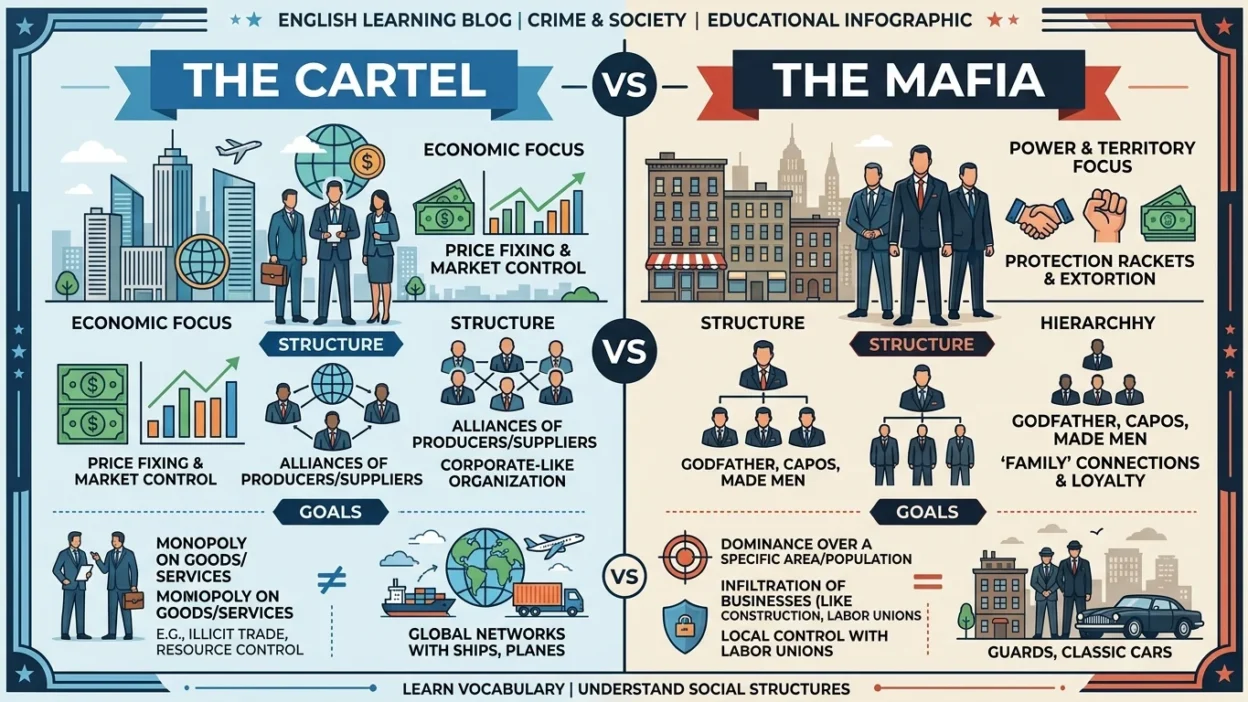
A cartel is an organization or group that coordinates to control a market, trade, or illegal business, especially drug trafficking. A mafia is a structured organized crime group that may engage in extortion, protection rackets, trafficking, gambling, and other crimes.
Why People Confuse Them
Both cartels and mafias can:
- Operate secretly
- Make large amounts of money
- Use intimidation or violence
- Have organized leadership
- Control illegal businesses
- Operate across multiple regions or countries
The main difference is their organizational purpose and traditional structure.
Cartel
A cartel is a group of independent individuals or organizations that cooperate to control or dominate a particular market or trade.
In discussions of organized crime, drug cartel is the most familiar use of the word.
A criminal cartel may coordinate:
- Production
- Transportation
- Distribution
- Pricing
- Territory
- Supply routes
For example, several criminal groups might cooperate to control the production and distribution of illegal drugs.
Importantly, cartel does not always mean a criminal organization. In economics, a cartel can refer to businesses that cooperate to control prices or restrict competition, which is generally illegal under competition laws in many jurisdictions.
Mafia
A mafia generally refers to a hierarchical or structured organized crime group.
The term is historically associated with the Sicilian Mafia, but it is also commonly used more broadly for organized criminal organizations.
Mafia style organizations may be involved in:
- Extortion
- Illegal gambling
- Money laundering
- Racketeering
- Smuggling
- Fraud
- Protection rackets
- Drug trafficking
A mafia organization can therefore participate in many different criminal businesses rather than focusing on one particular market.
Comparison Table
| Feature | Cartel | Mafia |
|---|---|---|
| Basic meaning | Group coordinating to control a market or trade | Organized criminal group |
| Common association | Drug trafficking | Racketeering and organized crime |
| Main focus | Controlling trade, supply, or territory | Multiple criminal activities |
| Structure | Can involve cooperating groups | Often hierarchical |
| Can be noncriminal? | Yes | Generally refers to criminal organizations |
| Violence | May be used | May be used |
| Drug trafficking | Common in criminal cartels | Possible |
| Extortion | Possible | Common association |
| Market control | Central concept | May occur |
When to Use Each
Use cartel when discussing a group that coordinates to control a particular market, trade, supply chain, or territory.
Example:
Authorities disrupted a drug cartel operating across several countries.
Use mafia when referring to a broader organized criminal organization or a group with a traditional hierarchical criminal structure.
Example:
The investigation uncovered links to a powerful mafia organization.
Examples
- The authorities launched an investigation into the drug cartel.
- The cartel controlled major trafficking routes.
- Several groups were accused of cooperating as a cartel.
- The cartel attempted to control the supply of illegal drugs.
- The mafia was involved in extortion and illegal gambling.
- Police investigated the mafia’s financial network.
- The organization operated like a traditional mafia.
- The cartel expanded its operations into another region.
- The mafia allegedly used legitimate businesses to conceal illegal income.
- The two groups had different organizational structures.
Common Mistakes
Calling every organized crime group a cartel
Not every organized crime organization is a cartel.
A cartel usually has a particular focus on coordinating or controlling trade, supply, markets, or territory.
Assuming every cartel is a drug cartel
The word cartel has a broader meaning.
For example, an economic cartel can involve businesses coordinating prices or production.
Assuming mafia only means the Italian Mafia
The term has historical connections to Sicily, but mafia is also used more broadly to describe organized criminal groups or mafia style organizations.
Memory Trick
Think of the words this way:
Cartel = Control
A cartel is often associated with controlling a market, supply, trade, or territory.
Mafia = Organization
A mafia is generally a broader organized criminal group involved in multiple activities.
American vs British English
There is no major difference between American and British English in the basic meanings of cartel and mafia.
Both varieties use cartel for groups that coordinate to control a market or trade and mafia for organized criminal organizations.
Similar Words
You may also encounter these terms:
- Organized crime
- Crime syndicate
- Criminal organization
- Gang
- Mob
- Drug trafficking organization
- Racketeering group
- Criminal network
- Smuggling organization
- Underworld
These terms are related but do not necessarily mean exactly the same thing.
Final Verdict
The simplest distinction is that a cartel is primarily defined by coordination and control of a market, trade, supply, or territory, while a mafia is generally defined as a structured organized criminal organization involved in a range of illegal activities.
A cartel can therefore be a type of organized criminal enterprise, while mafia describes a broader organizational concept. The terms can overlap, but they are not exact synonyms.
Remember This
Cartel = Control of trade or market
Mafia = Organized criminal organization
A cartel may focus heavily on controlling a particular business or supply chain, while a mafia organization can operate across several different criminal activities.
FAQs
Is a cartel the same as a mafia?
No. The terms can overlap, but they describe different concepts. A cartel generally involves coordination to control trade or a market, while a mafia is a broader organized criminal organization.
Are all cartels involved in drugs?
No. Cartel has a broader meaning and can refer to economic agreements between businesses as well as criminal organizations. However, drug cartel is its most familiar criminal use.
Is the mafia a cartel?
A mafia organization can participate in cartel like activities, but the terms are not interchangeable. A mafia is generally characterized by its organized criminal structure.
Which is more powerful, a cartel or a mafia?
There is no universal answer. Their size, resources, territory, leadership, and activities vary considerably from organization to organization.
What is the difference between a gang and a cartel?
A gang is generally a smaller or less formally organized group, while a cartel typically involves organized coordination around a particular market, trade, or criminal enterprise.
Does “mafia” always mean Italian organized crime?
No. Although the word has historical roots in Sicily, mafia is now also used more broadly for organized criminal groups with similar structures or characteristics.
Can a cartel be legal?
Yes. In economics, a cartel can refer to businesses coordinating prices, production, or markets. Such arrangements are illegal or heavily restricted in many jurisdictions because they can harm competition.
Conclusion
Although cartel and mafia are sometimes used as synonyms, they have distinct meanings. A cartel is generally characterized by cooperation or coordination to control a particular market, trade, supply, or territory.
A mafia, by contrast, is typically a structured criminal organization involved in various illegal activities.
The easiest way to remember the distinction is cartel means control, while mafia means organized criminal structure. Their activities can overlap, but the words should not automatically be treated as interchangeable.

Joseph Richard is the administrator and a dedicated author at DrameyHut, overseeing the platform’s operations and content quality. Alongside his administrative role, he writes insightful articles on dream meanings, helping readers understand their subconscious mind. His work supports the mission of providing clear, meaningful, and engaging dream interpretations.