Many English learners confuse she has and she have because both forms come from the verb have. The choice may seem small, but it is an important subject verb agreement rule in English.
The good news is that the rule is easy to remember. With she, use has in the present simple. Have is used with I, you, we, they, and plural subjects. Once you understand this pattern, choosing between she has and she have becomes much easier.
Quick Answer
She has is correct in standard English when she is the subject. She have is incorrect in ordinary present simple sentences. Use has with he, she, and it, while have is used with I, you, we, and they.
Why People Confuse It
The confusion comes from the verb have, which has two present tense forms:
- Have
- Has
The form depends on the subject.
| Subject | Correct form |
|---|---|
| I | have |
| You | have |
| He | has |
| She | has |
| It | has |
| We | have |
| They | have |
So:
She has a car. ✅
They have a car. ✅
She Has
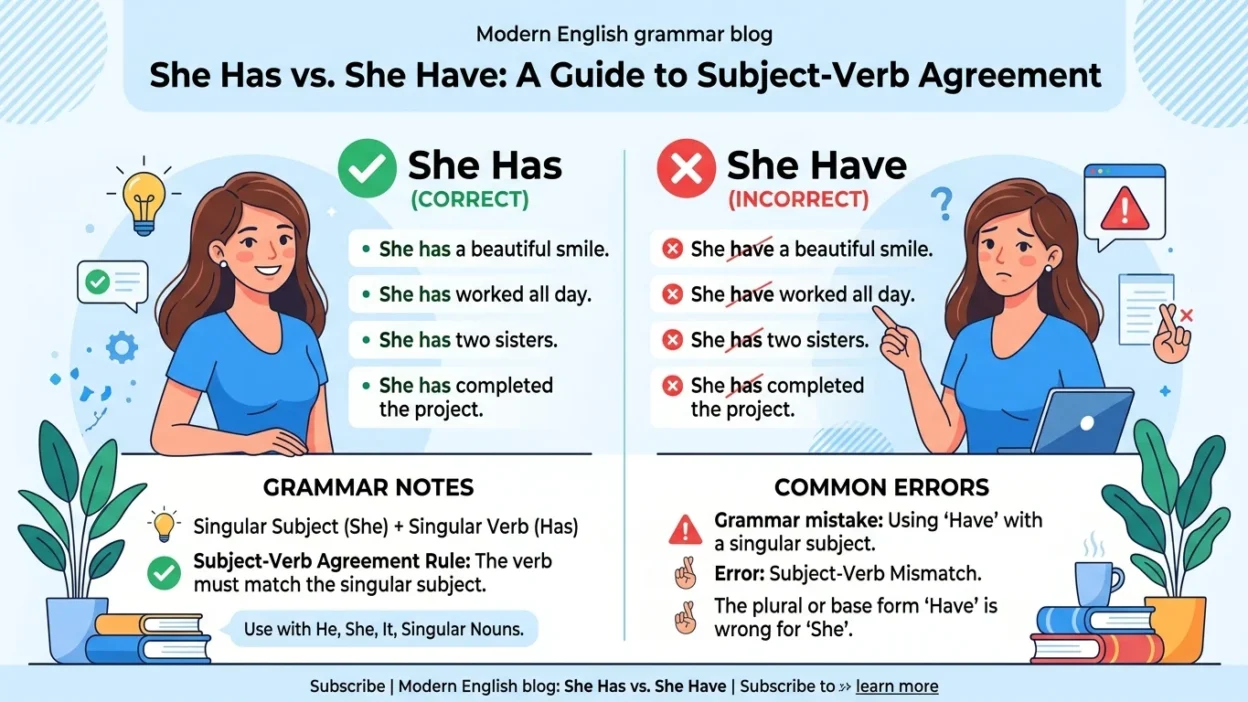
She has is the correct form when she is the subject of a present simple sentence.
Examples
- She has a new phone.
- She has two brothers.
- She has a meeting today.
- She has enough experience.
- She has a beautiful voice.
- She has an important question.
It can also be used for present perfect constructions:
- She has finished her work.
- She has already left.
- She has seen that movie.
She Have
She have is generally incorrect in standard English when she is the subject.
❌ She have a car.
✅ She has a car.
❌ She have two children.
✅ She has two children.
However, have can appear near she when another verb or auxiliary requires it.
For example:
Does she have a car? ✅
Here, does carries the present tense, so the main verb remains have.
Similarly:
She doesn’t have a car. ✅
Comparison Table
| Sentence | Correct? | Reason |
|---|---|---|
| She has a car. | ✅ | Has agrees with she |
| She have a car. | ❌ | Incorrect subject verb agreement |
| Does she have a car? | ✅ | Does takes the third person marking |
| She doesn’t have a car. | ✅ | Does not + base verb |
| She has finished. | ✅ | Present perfect |
| She have finished. | ❌ | Incorrect auxiliary form |
When to Use Each
Use she has in ordinary affirmative present tense sentences:
- She has a job.
- She has a problem.
- She has enough time.
Use have after auxiliary verbs such as does, doesn’t, can, will, should, may, might, must, and similar modal or auxiliary verbs.
- Does she have time?
- She doesn’t have time.
- She can have another chance.
- She will have dinner later.
- She should have more information.
Examples
- She has a new computer.
- She has three sisters.
- She has an appointment tomorrow.
- She has enough money.
- She has a lot of experience.
- She has finished the assignment.
- Does she have a passport?
- Does she have any questions?
- She doesn’t have enough time.
- She doesn’t have a car.
- She will have an opportunity tomorrow.
- She should have more information.
Common Mistakes
Mistake 1: Using “have” directly after she
❌ She have a new job.
✅ She has a new job.
Mistake 2: Using “has” after does
❌ Does she has a car?
✅ Does she have a car?
After does, use the base form have.
Mistake 3: Using “has” after doesn’t
❌ She doesn’t has a problem.
✅ She doesn’t have a problem.
Again, doesn’t already carries the third person form, so use have.
Memory Trick
Remember this simple rule:
He → has
She → has
It → has
But:
I → have
You → have
We → have
They → have
And remember:
Does + she + have
Not:
Does + she + has
American vs British English
There is no meaningful difference between American and British English regarding the basic rule.
Both varieties use:
She has a car. ✅
Does she have a car? ✅
The same subject verb agreement rule applies in both forms of English.
Similar Grammar Questions
You may also want to learn:
- He Has vs He Have
- It Has vs It Have
- They Have vs They Has
- I Have vs I Has
- She Does vs She Do
- She Is vs She Are
- She Was vs She Were
- She Has vs She Had
- Has vs Have
- Has Been vs Have Been
Final Verdict
She has is correct when she is the subject of an affirmative present simple sentence.
She has a car. ✅
She have a car. ❌
However, use have after does, doesn’t, and modal verbs:
Does she have a car? ✅
She doesn’t have a car. ✅
She will have a car. ✅
Remember This
She + has ✅
Does she + have ✅
She doesn’t + have ✅
The easiest rule is:
She has, but does she have?
FAQs
Is “she has” correct?
Yes. She has is the correct present simple form when she is the subject.
Is “she have” grammatically correct?
No, not in a standard affirmative present simple sentence. Say she has.
Why do we say “does she have” instead of “does she has”?
Because does already carries the third person singular form. The main verb returns to its base form, have.
Is “she doesn’t have” correct?
Yes. She doesn’t have a car is correct.
Is “she has” present tense?
Yes. Has is the third person singular present form of have.
What is correct: “she has a car” or “she have a car”?
She has a car is correct.
Can “she have” ever be correct?
In standard modern English, she have can occur in some special grammatical constructions, such as certain subjunctive or dialectal uses, but it is not the normal present simple form. For everyday English, use she has.
Conclusion
The difference between she has and she have comes down to subject verb agreement. When she is the subject in an affirmative present simple sentence, use has.
However, when another auxiliary such as does, doesn’t, can, will, or should comes before the verb, use the base form have. Remember the simple pattern: she has, but does she have?

Daniel Charles is a dedicated author and dream interpretation enthusiast at DrameyHut. He specializes in analyzing dream symbols and meanings, offering clear and insightful content for readers. His work aims to help individuals understand their subconscious thoughts, gain clarity, and explore the deeper messages hidden within their dreams.