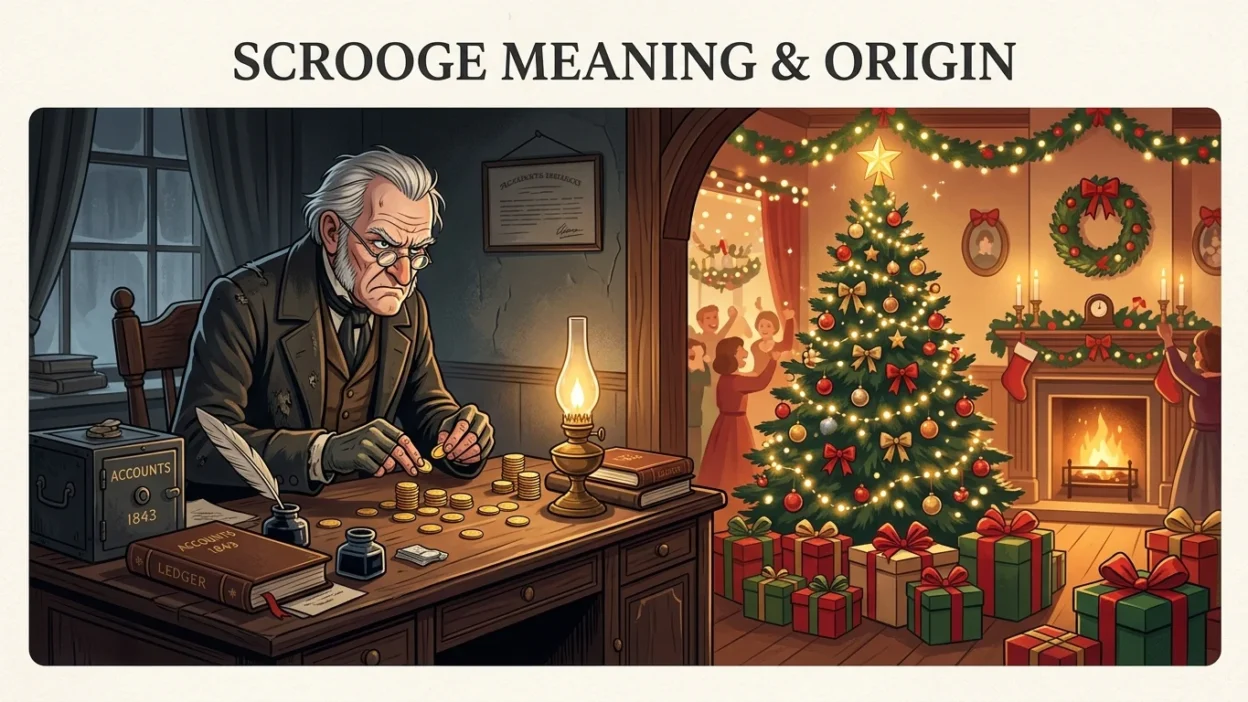
A Scrooge is a person who is extremely unwilling to spend money or share what they have, especially someone who seems unnecessarily stingy or miserly. The word comes from Ebenezer Scrooge, the famously miserly character in Charles Dickens’s 1843 novel A Christmas Carol.
Today, Scrooge can be used as a common noun to describe someone who refuses to spend money, give gifts, or participate generously in celebrations. It is especially common around Christmas, but the word can be used throughout the year. For example, if someone refuses to contribute to a group gift even though they can easily afford it, someone might jokingly call them a Scrooge. The word usually has a negative or teasing tone and suggests a lack of generosity.
Quick Answer
Scrooge means a stingy, miserly, or ungenerous person. The word comes from Ebenezer Scrooge, the wealthy but miserly character in Charles Dickens’s A Christmas Carol. Today, it is often used humorously for someone who dislikes spending or giving.
What Does Scrooge Mean?
A Scrooge is someone who is extremely reluctant to spend money or be generous.
For example:
“Don’t be such a Scrooge. Buy yourself a decent meal!”
Here, the speaker is accusing the person of being unnecessarily unwilling to spend money.
The word can also describe someone who seems to dislike generosity, celebrations, or other people’s enjoyment.
Who Was Ebenezer Scrooge?
Ebenezer Scrooge is the central character in Charles Dickens’s novella A Christmas Carol, published in 1843.
At the beginning of the story, Scrooge is portrayed as wealthy but extremely miserly, cold, and unwilling to help others. He dislikes Christmas and considers generosity a waste of money.
After being visited by supernatural figures, Scrooge changes his attitude and becomes much more generous and caring.
Because of this character, Scrooge became a general word for a miserly or ungenerous person.
Is Scrooge a Real Word?
Yes.
Scrooge began as a character’s name, but it has become a common noun in English.
For example:
“He is such a Scrooge.”
This means:
“He is very stingy or ungenerous.”
The word is normally capitalized when referring specifically to the character Scrooge, but scrooge can also be used as a common noun in informal writing.
Examples of Scrooge
- “Don’t be a Scrooge. Everyone deserves a Christmas present.”
- “My uncle is a bit of a Scrooge when it comes to spending money.”
- “He refused to contribute to the office gift and everyone called him a Scrooge.”
- “Stop being such a Scrooge and join us for dinner.”
- “She is not a Scrooge; she simply prefers to save her money.”
- “The company was criticized for acting like a Scrooge during the holidays.”
- “He became known as the neighborhood Scrooge because he never gave to charity.”
- “Don’t be a Scrooge about the decorations.”
- “My brother can be a Scrooge when we go shopping.”
- “The store owner was jokingly called a Scrooge because he refused to offer discounts.”
- “Nobody wants to be known as a Scrooge during the holiday season.”
- “He has a reputation for being a Scrooge, but he is actually generous with close friends.”
Scrooge as an Adjective
Scrooge is primarily used as a noun, but you may also see related forms such as Scrooge like or Scrooge ish in informal English.
For example:
“His Scrooge like attitude made the holiday party awkward.”
However, these forms are less standard than simply saying:
“His miserly attitude made the holiday party awkward.”
Scrooge vs Miser
Scrooge and miser are closely related, but they are not exactly the same.
A miser is a person who is extremely unwilling to spend money.
A Scrooge can mean a miser, but it can also describe someone who is generally ungenerous or unwilling to participate in enjoyable activities.
For example:
“He is a miser who refuses to spend money.”
“Don’t be such a Scrooge. Come celebrate with us.”
The second sentence can be about attitude and generosity, not simply money.
Scrooge vs Stingy
Stingy means unwilling to spend, give, or share.
Scrooge is a noun used to describe a person who behaves in a miserly or ungenerous way.
Compare:
“He is stingy.”
“He is a Scrooge.”
Both suggest a lack of generosity, but Scrooge has a strong cultural connection to Ebenezer Scrooge and is often used humorously.
Scrooge vs Grinch
Scrooge and Grinch are sometimes used similarly, especially around Christmas, but they come from different characters.
Scrooge comes from A Christmas Carol and is associated especially with miserliness and lack of generosity.
Grinch comes from Dr. Seuss’s How the Grinch Stole Christmas! and is associated with disliking Christmas, joy, or celebration.
Someone can therefore be called a Scrooge because they are stingy, while someone can be called a Grinch because they seem to dislike holiday cheer.
Is Calling Someone a Scrooge Insulting?
It can be.
The word usually has a negative or teasing tone, but the seriousness depends on context.
Among friends:
“Don’t be a Scrooge!”
This may be playful.
In a serious situation:
“The company is behaving like a Scrooge by refusing to support its employees.”
This is more clearly critical.
Scrooge and Christmas
The word is particularly common during the Christmas season because of A Christmas Carol.
You might hear:
“Don’t be a Scrooge this Christmas.”
This means:
“Be generous and enjoy the Christmas spirit.”
It can refer to refusing to buy gifts, contribute to celebrations, decorate, or participate in holiday activities.
Common Mistakes
1. Thinking Scrooge only means rich
Scrooge was wealthy, but the word does not simply mean rich person.
It means someone who is miserly or ungenerous.
2. Thinking every saver is a Scrooge
Being careful with money does not automatically make someone a Scrooge.
The word usually suggests excessive unwillingness to spend, give, or share.
3. Confusing Scrooge with Grinch
Both can describe unpleasant holiday attitudes, but their meanings are not identical.
Scrooge is especially associated with miserliness and lack of generosity.
Grinch is especially associated with dislike of Christmas or holiday cheer.
4. Assuming Scrooge is always serious
It is often used humorously.
“Don’t be a Scrooge. Get another slice of pizza!”
The speaker may simply be teasing someone for being reluctant to spend or share.
American vs British English
Scrooge is widely used in both American and British English.
The reference to Ebenezer Scrooge is well known in both varieties.
The meaning is essentially the same:
Scrooge = a miserly or ungenerous person.
Similar Words
Depending on the context, similar words include:
Miser: Someone extremely unwilling to spend money.
Stingy: Unwilling to spend or share.
Cheap: Unwilling to spend money, sometimes implying poor generosity.
Miserly: Extremely unwilling to spend or give.
Ungenerous: Not willing to give or share enough.
Tightfisted: Very unwilling to spend or give money.
Grinch: Someone who seems to dislike Christmas or holiday cheer.
These words overlap, but their tone and exact meanings differ.
Memory Trick
Remember the character from A Christmas Carol.
Scrooge = “No money, no gifts, no generosity.”
If someone is unnecessarily unwilling to spend, give, or share, you can remember the word Scrooge.
Final Verdict
A Scrooge is a stingy, miserly, or ungenerous person.
The word comes from Ebenezer Scrooge, the wealthy but miserly character in Charles Dickens’s A Christmas Carol. Today, it is commonly used as a noun, especially when teasing or criticizing someone for being unwilling to spend, give, or participate generously.
For example:
“Don’t be a Scrooge. Buy your friends a Christmas gift!”
Frequently Asked Questions
What does Scrooge mean in simple English?
Scrooge means a person who is very stingy, miserly, or ungenerous.
Why is someone called a Scrooge?
Someone may be called a Scrooge because they are unwilling to spend money, give gifts, share, or participate generously.
Is Scrooge an insult?
It can be, but it is often used playfully or humorously depending on the situation.
Is Scrooge only related to Christmas?
No. Although the word is strongly associated with Christmas because of A Christmas Carol, it can describe a stingy person at any time of year.
What is the difference between a Scrooge and a Grinch?
A Scrooge is especially associated with being miserly or ungenerous. A Grinch is especially associated with disliking Christmas, happiness, or holiday cheer.
Is Scrooge a noun?
Yes. For example:
“He is a Scrooge.”
What is the opposite of a Scrooge?
Possible opposites include generous person, philanthropist, giver, or simply generous depending on the sentence.
Where did the word Scrooge come from?
It comes from Ebenezer Scrooge, a character created by Charles Dickens in A Christmas Carol, published in 1843.
Conclusion
The word Scrooge has become much more than the name of a fictional character. Today, it commonly describes someone who is miserly, stingy, or unwilling to be generous. The word is particularly common during Christmas because Ebenezer Scrooge is one of literature’s most famous miserly characters.
Calling someone a Scrooge can be serious criticism, but it is often playful. If a friend refuses to contribute to a gift or complains about spending money during a celebration, you might jokingly say, “Don’t be such a Scrooge!”
Remember This
Scrooge = a stingy, miserly, or ungenerous person.
The word comes from Ebenezer Scrooge in Charles Dickens’s A Christmas Carol.
Example: “Don’t be a Scrooge. Be generous this Christmas.”

Daniel Charles is a dedicated author and dream interpretation enthusiast at DrameyHut. He specializes in analyzing dream symbols and meanings, offering clear and insightful content for readers. His work aims to help individuals understand their subconscious thoughts, gain clarity, and explore the deeper messages hidden within their dreams.