
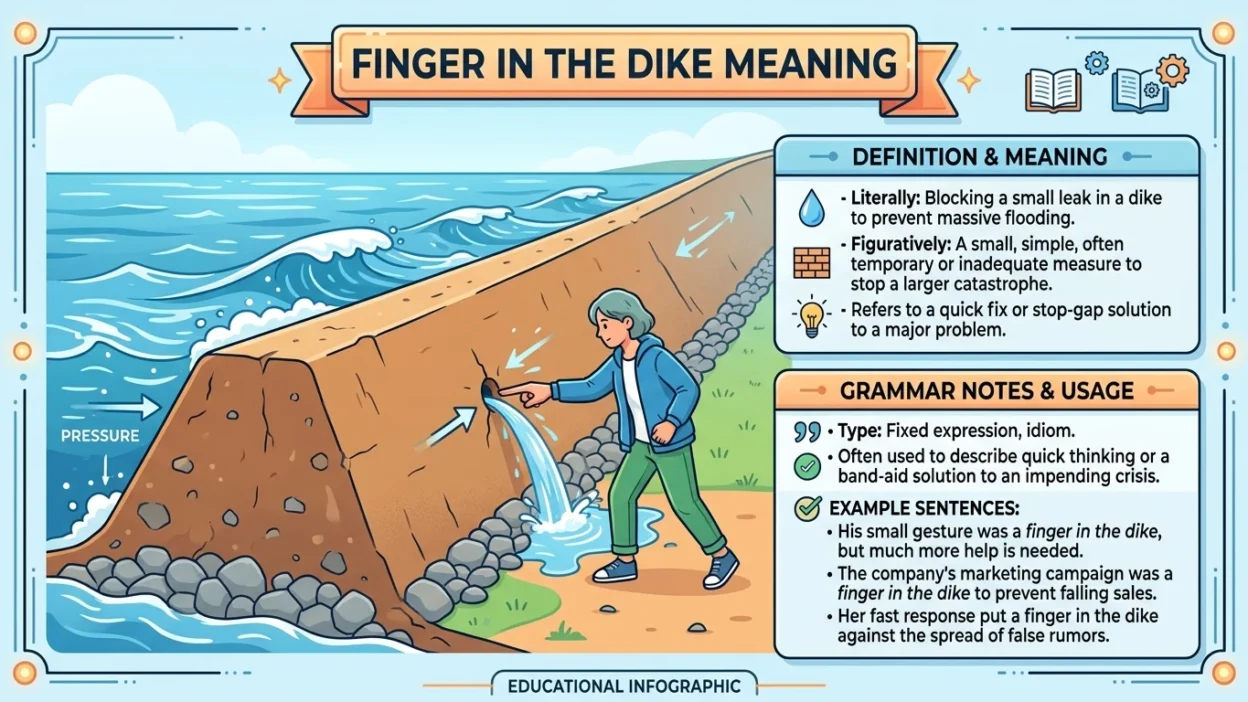
The phrase “finger in the dike” is an English idiom that describes a person trying to stop a serious problem from getting worse by dealing with a small part of it. It comes from the image of plugging a hole in a dike with a finger to prevent water from breaking through.
The expression is often used when someone’s action provides a temporary solution, but the larger problem still requires much more attention. It can also suggest that a person is working hard to prevent disaster despite having limited resources.
Quick Answer
“Finger in the dike” means trying to prevent a larger problem or disaster by dealing with a small part of it. It usually suggests a temporary or inadequate solution to a much bigger problem.
What Does “Finger in the Dike” Mean?
A dike is a structure designed to hold back water and prevent flooding.
The phrase comes from a famous story about a boy who supposedly noticed a small hole in a dike and put his finger into it to stop the water from escaping.
The story is often associated with Hans Brinker, although the finger in the dike episode does not actually appear in the original novel Hans Brinker, or the Silver Skates.
Over time, the image became an idiom for trying to prevent a much larger disaster by addressing a small immediate problem.
Examples
- We’re just putting a finger in the dike by fixing these individual errors.
- Hiring temporary workers is only a finger in the dike while the company addresses its staffing shortage.
- These emergency measures are basically a finger in the dike.
- Repairing one damaged pipe is like putting a finger in the dike when the entire system needs replacement.
- The extra funding may be nothing more than a finger in the dike.
- We’re putting our fingers in the dike instead of solving the underlying problem.
- Updating the old software is just another finger in the dike.
Is “Finger in the Dike” Literal or Figurative?
It can be used literally when someone actually puts a finger into a hole, but in modern English it is usually figurative.
For example:
We’re putting a finger in the dike rather than addressing the real cause.
Here, nobody is actually dealing with a dike. The speaker means that the action is only temporarily containing a larger problem.
“Finger in the Dike” vs “Band-Aid Solution”
These expressions are similar.
Finger in the dike emphasizes trying to prevent a larger problem from becoming a disaster.
Band-Aid solution emphasizes a temporary fix that does not address the underlying cause.
For example:
Increasing the budget by 2% is just a finger in the dike.
This suggests the increase may temporarily help but will not solve the larger issue.
Common Mistakes
Using it to mean a permanent solution
The phrase usually suggests that the action is temporary or insufficient.
Taking it literally
In modern usage, the expression is generally an idiom about containing a larger problem.
Confusing “dike” with “dyke”
In this idiom, dike means an embankment or barrier designed to control water.
Memory Trick
Think of it this way:
Small hole + finger → temporary protection from a big flood.
So:
Finger in the dike = Small action trying to contain a big problem.
American vs British English
The expression is understood in both American and British English, although it is not especially common in casual conversation.
You may encounter it more often in journalism, business writing, politics, and discussions about crisis management.
Similar Expressions
You may also hear:
- Band-Aid solution
- Stopgap measure
- Temporary fix
- Put out fires
- Treat the symptom, not the cause
- Contain the damage
- Plug a hole
- Paper over the cracks
Final Verdict
“Finger in the dike” means taking a small or temporary action to prevent a much larger problem from getting worse. The expression comes from the image of using a finger to plug a hole in a dike and stop floodwater from breaking through.
When someone says their efforts are “just a finger in the dike,” they usually mean that they are containing the problem rather than actually solving its underlying cause.
Remember This
Finger in the dike = A small temporary action to contain a much bigger problem. ✅
Example:
“Fixing this one leak is just a finger in the dike. The entire plumbing system needs to be replaced.”
FAQs
What does “finger in the dike” mean?
It means trying to prevent a larger problem or disaster by dealing with a small part of it.
Is “finger in the dike” an idiom?
Yes. It is an idiomatic expression usually used figuratively.
Is “finger in the dike” a temporary solution?
Usually, yes. The expression often implies that the action is only containing the problem rather than solving its root cause.
Where does “finger in the dike” come from?
It comes from a traditional story about a boy who supposedly plugged a hole in a dike with his finger to prevent flooding.
Is “finger in the dike” still commonly used?
It is understood in modern English but is less common than expressions such as band-aid solution, temporary fix, or stopgap measure.
What is another way to say “finger in the dike”?
Depending on the context, you can say temporary fix, stopgap measure, band-aid solution, or putting out fires.
Conclusion
The idiom “finger in the dike” describes an attempt to keep a serious problem under control by addressing only a small part of it. It often carries the idea that the solution is temporary and that a more fundamental fix is needed.
If someone says they are “putting a finger in the dike,” they are essentially saying, “I’m preventing things from getting worse for now, but this isn’t solving the real problem.”

Nancy Lisa is a passionate writer and contributor at DrameyHut, focused on uncovering the deeper meanings behind dreams. She creates engaging and insightful content that helps readers interpret their dreams and understand their subconscious thoughts. Her work inspires self-reflection, clarity, and a stronger connection to inner emotions.