Many English learners confuse giving and given because both forms come from the verb give. However, they have different grammatical functions and are used in different sentence structures. Knowing when to use each form can make your English sound much more natural.
The key difference is simple: giving is the present participle or gerund of give, while given is the past participle. The correct choice depends on if you are describing an ongoing action, using a perfect or passive structure, or introducing a condition or fact.
Quick Answer
Giving means actively giving or providing something, while given is the past participle of give. Use giving in continuous forms or as a gerund, and use given with have, has, had, in passive constructions, or to mean considering a particular fact or situation.
Why People Confuse It
Both words come from the same verb:
Give → Giving → Given
But they do not work the same way.
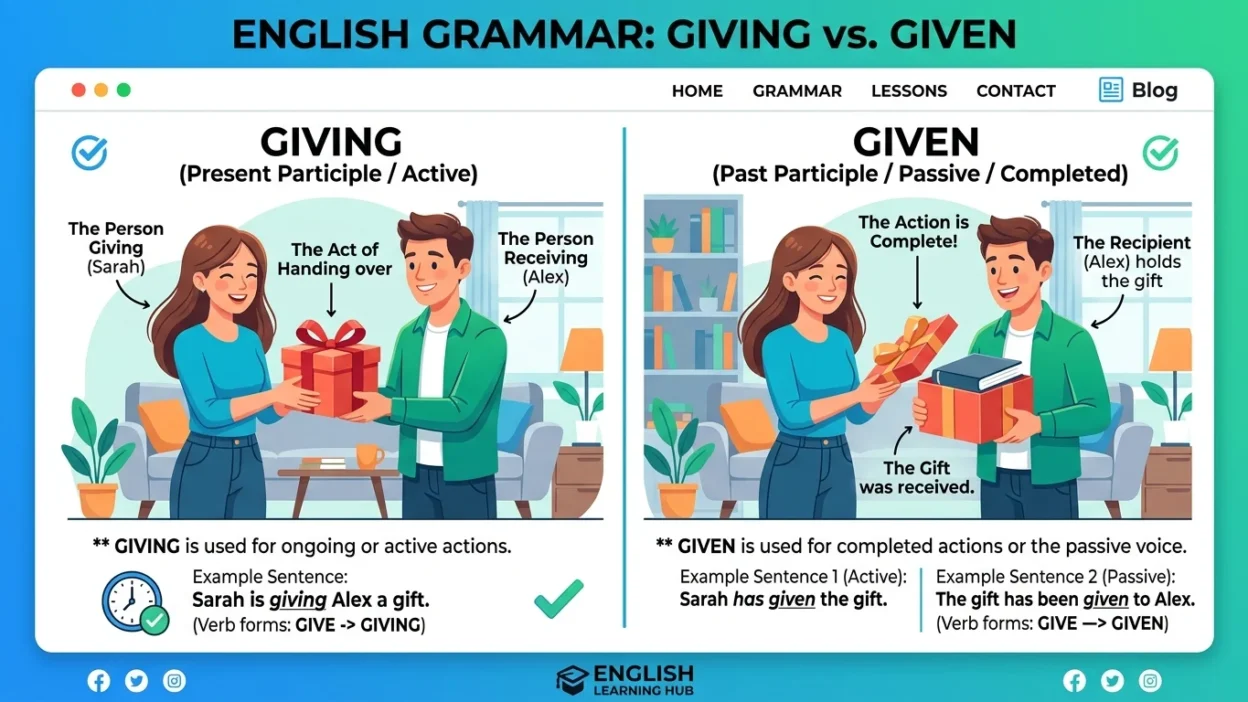
Giving usually describes an action that is happening or an activity.
Given is commonly used in perfect tenses, passive voice, or expressions such as given that and given the circumstances.
Giving
Giving is the present participle and gerund form of give.
Meaning
It can describe:
- An action happening now
- An ongoing activity
- The act of providing something
- A tendency or willingness to provide
Examples
- She is giving me some advice.
- He is giving a presentation.
- Giving is better than receiving.
- They are giving away free samples.
- Thank you for giving me this opportunity.
Given
Given is the past participle of give.
It is used in several important ways.
With Perfect Tenses
- She has given me the information.
- He had given his answer already.
- They have given us enough time.
In Passive Voice
- He was given a second chance.
- We were given clear instructions.
- She was given an award.
To Mean “Considering”
Given can also mean considering or taking into account.
- Given the circumstances, we decided to leave.
- Given his experience, he should get the job.
- Given the weather, the event may be canceled.
Comparison Table
| Feature | Giving | Given |
|---|---|---|
| Base verb | Give | Give |
| Grammar form | Present participle / gerund | Past participle |
| Continuous tense | ✅ Yes | ❌ No |
| Perfect tense | ❌ No | ✅ Yes |
| Passive voice | ❌ No | ✅ Yes |
| Means “considering” | ❌ No | ✅ Yes |
| Example | She is giving advice. | She has given advice. |
When to Use Each
Use giving when the action is ongoing or when give functions as a gerund.
- I am giving him a chance.
- Giving advice can be difficult.
- She enjoys giving gifts.
Use given when:
- Using a perfect tense.
- Forming a passive sentence.
- Meaning “considering” or “taking into account.”
- He has given me a book.
- She was given a promotion.
- Given the situation, we should wait.
Examples
- She is giving me excellent advice.
- He enjoys giving gifts to his friends.
- They are giving us another opportunity.
- Giving your time can make a difference.
- Thank you for giving me a chance.
- She has given me the information.
- He had given his approval.
- We were given clear instructions.
- She was given an important responsibility.
- Given the circumstances, we should postpone the meeting.
- Given his experience, he is the right person for the job.
- They have given us plenty of time.
Common Mistakes
1. Using “given” after “is” for an ongoing action
❌ She is given me advice.
✅ She is giving me advice.
2. Using “giving” after “has”
❌ She has giving me the information.
✅ She has given me the information.
3. Confusing passive and active structures
❌ The teacher gave giving him an award.
✅ The teacher gave him an award.
✅ He was given an award.
Memory Trick
Remember the basic pattern:
Give → Giving → Given
Think:
Is / am / are + giving
Has / have / had + given
Was / were + given
For example:
She is giving me a book. ✅
She has given me a book. ✅
She was given a book. ✅
American vs British English
There is no significant difference between American and British English in the basic use of giving and given.
Both varieties follow the same grammatical rules.
Similar Words
You may also want to understand these related verb forms:
- Give vs Gave vs Given
- Take vs Took vs Taken
- Go vs Went vs Gone
- See vs Saw vs Seen
- Write vs Wrote vs Written
- Eat vs Ate vs Eaten
- Give vs Giving
- Give vs Given
- Giving vs Gave
- Given vs Gave
Final Verdict
Giving and given are both correct forms of give, but they have different grammatical functions.
Use giving for an ongoing action or as a gerund:
She is giving me advice. ✅
Use given as a past participle or to mean considering:
She has given me advice. ✅
Given the circumstances, we should leave. ✅
Remember This
Giving = happening or being done
Given = past participle or considering
A simple pattern to remember is:
is/am/are → giving
has/have/had → given
was/were → given
FAQs
What is the difference between giving and given?
Giving is the present participle or gerund of give, while given is its past participle.
Is “giving” present or past tense?
Giving is not a tense by itself. It is the present participle and is used in continuous tenses, such as is giving.
Is “given” the past tense of give?
No. The simple past tense is gave. Given is the past participle.
What is the past participle of give?
The past participle of give is given.
Can “given” mean “considering”?
Yes. For example: Given the circumstances, we decided to leave.
Is “giving” a gerund?
It can be. In Giving is important, giving functions as a gerund because it acts as a noun.
What is correct: “has given” or “has giving”?
Has given is correct.
She has given me the information. ✅
She has giving me the information. ❌
Conclusion
The difference between giving and given becomes easy once you recognize their grammatical roles. Giving is used for ongoing actions and activities, while given is the past participle used with perfect tenses and passive constructions. Given can also mean considering when it introduces a fact or circumstance.
Remember the basic pattern give, giving, given, and pay attention to the helping verb around the word. This will help you choose the correct form naturally and avoid common English grammar mistakes.

Christopher Thomas is a passionate writer and dream researcher dedicated to exploring the meanings behind dreams. As an author at DrameyHut, he creates insightful and easy-to-understand interpretations that help readers connect with their subconscious mind. His work focuses on guiding individuals toward self-discovery, clarity, and a deeper understanding of their inner thoughts.