
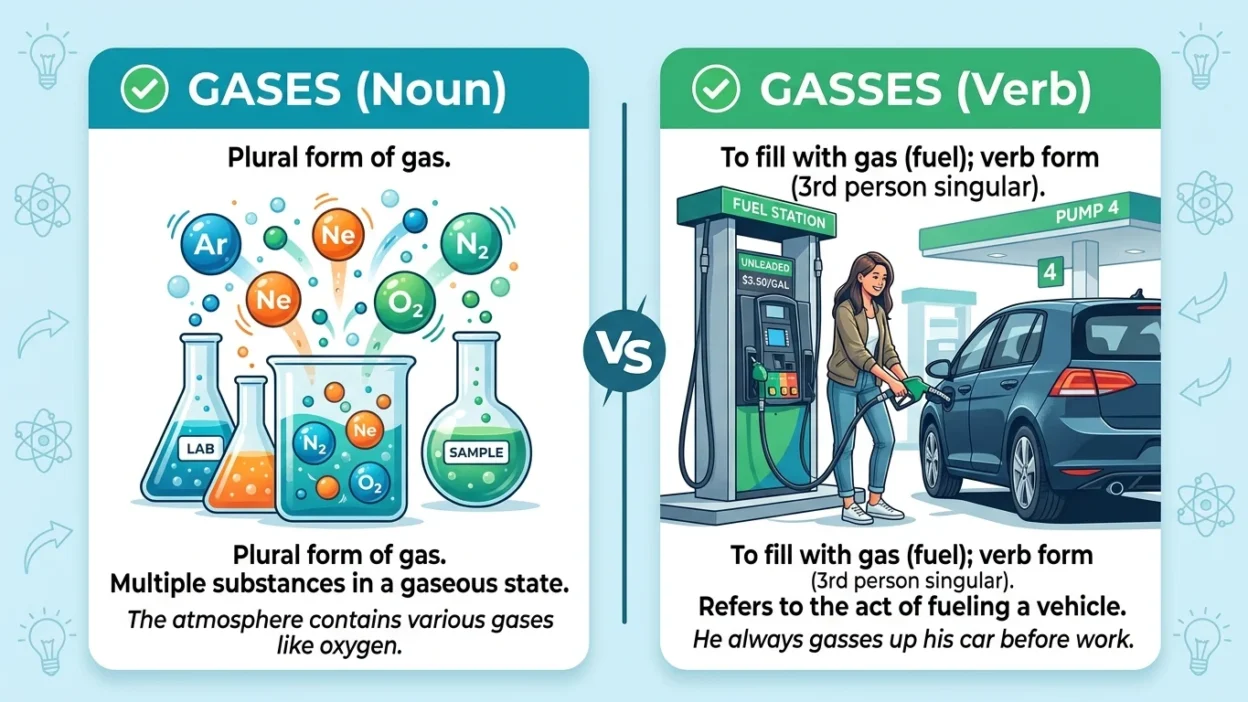
Gases and gasses look almost identical, but they are not interchangeable in standard English. The correct spelling depends on the word you are trying to use.
Gases is the plural of gas, while gasses is a form of the verb gas, meaning to expose someone or something to gas or to fill something with gas. Because gases is much more common, it is easy to assume that gasses is simply a spelling mistake. In fact, both words can be correct, but they have different grammatical functions.
Quick Answer
Gases is the plural of gas: Oxygen and nitrogen are gases. Gasses is a verb form of gas, meaning to expose to or fill with gas: The fumes gassed the workers. In ordinary plural usage, gases is the correct spelling.
Why People Confuse It
The confusion comes from the fact that gas can be both a noun and a verb.
As a noun:
one gas → two gases
As a verb:
to gas → gasses in third person singular present tense
So the extra s changes the grammatical role rather than simply changing the pronunciation.
Gases
Gases is the plural form of the noun gas.
A gas is a state of matter that does not have a fixed shape or volume.
Examples
- Oxygen and hydrogen are gases.
- Greenhouse gases contribute to climate change.
- Several gases were detected in the laboratory.
- The atmosphere contains several different gases.
- Some gases are highly flammable.
Singular and Plural
One gas
Two gases
Several gases
The standard plural spelling is gases, not gasses.
Gasses
Gasses is a verb form of gas.
Specifically, it can be the third person singular present tense of the verb gas.
For example:
The chemical gasses the material.
However, this use is relatively uncommon in everyday English.
Gas can mean to expose something to gas or treat it with gas.
You may encounter gasses in technical, industrial, scientific, or specialized contexts.
Comparison Table
| Word | Grammar | Meaning | Example |
|---|---|---|---|
| Gas | Noun | A state of matter or gaseous substance | Oxygen is a gas. |
| Gases | Plural noun | More than one gas | Several gases were detected. |
| Gas | Verb | To expose or treat with gas | The chemical can gas the material. |
| Gasses | Verb | Third person singular of gas | The substance gasses the material. |
When to Use Each
Use gases when you are talking about more than one gas.
Different gases have different properties.
Use gasses only when gas is being used as a verb and the subject is singular in the present tense.
The chemical gasses the chamber.
In most everyday writing about multiple substances in gaseous form, gases is the word you need.
Examples
- Oxygen and nitrogen are gases.
- The atmosphere contains several gases.
- Greenhouse gases affect the climate.
- Some gases are invisible.
- The laboratory detected toxic gases.
- Different gases have different densities.
- The machine gasses the material.
- The chemical gasses the chamber.
- The process gasses the product.
- Several gases escaped from the container.
Common Mistakes
Using “gasses” as the plural of gas
❌ The container holds several gasses.
✅ The container holds several gases.
When gas is a noun, its standard plural is gases.
Thinking “gases” is always the only possible form
Although gases is the normal plural noun, gasses can be grammatically valid when it is the third person singular form of the verb gas.
Confusing “gas” with “gases”
Remember:
Gas = one
Gases = more than one
Methane is a gas.
Methane and carbon dioxide are gases.
Memory Trick
Use this simple rule:
Gases = plural noun
Gasses = verb
Think:
Gas → gases when you’re counting types of gas.
Gas → gasses when someone or something is performing the action.
For most everyday sentences, if you mean more than one gas, choose gases.
American vs British English
Both American and British English use gases as the standard plural of gas.
The verb form gasses can also occur in both varieties, although the verb gas and its forms are relatively uncommon in ordinary conversation.
Similar Words
You may also encounter these words:
- Gas
- Gaseous
- Vapor
- Vapour
- Fumes
- Emissions
- Aerosols
- Particles
- Atmosphere
- Greenhouse gases
Be careful with vapor/vapour because American and British English use different spellings.
Final Verdict
Gases and gasses can both be correct, but they are used differently.
Gases = plural of gas.
Oxygen and nitrogen are gases. ✅
Gasses = a verb form of gas.
The chemical gasses the material. ✅
If you are talking about multiple substances in the gaseous state, gases is almost certainly the word you need.
Remember This
Gases = more than one gas ✅
Gasses = verb form of gas ✅
So:
Several gases were released. ✅
But:
The chemical gasses the material. ✅
FAQs
Is it gases or gasses?
Both can be correct, but they have different meanings. Gases is the plural of gas, while gasses is a verb form of gas.
What is the plural of gas?
The standard plural is gases.
One gas, two gases.
Is “gasses” a real word?
Yes. Gasses can be the third person singular present form of the verb gas, although this usage is relatively uncommon.
Is “greenhouse gasses” correct?
No, when referring to multiple greenhouse gases, the standard spelling is:
Greenhouse gases ✅
What is the difference between gas and gases?
Gas refers to one gaseous substance or the state of matter, while gases is the plural form.
Why is the plural of gas “gases” instead of “gasses”?
The standard plural spelling follows the usual English plural pattern and is written gases. Gasses has a different grammatical function as a verb form.
Is “gasses” used in American English?
Yes, gasses can be used as a verb in American English, although the noun plural gases is much more common.
Conclusion
The difference between gases and gasses is mainly grammatical. Gases is the plural noun you use when referring to more than one gas. Gasses is a verb form meaning that something exposes or treats another thing with gas.
For everyday writing, especially when discussing chemistry, science, pollution, or the atmosphere, remember the simple rule: one gas, several gases. If you’re talking about the action of treating something with gas, gasses may be appropriate.

Nancy Lisa is a passionate writer and contributor at DrameyHut, focused on uncovering the deeper meanings behind dreams. She creates engaging and insightful content that helps readers interpret their dreams and understand their subconscious thoughts. Her work inspires self-reflection, clarity, and a stronger connection to inner emotions.