Proved and proven are both correct forms of the verb prove, but they are not always used in exactly the same way. This is one of those English grammar questions where both options can be right, depending on the sentence and the variety of English being used.
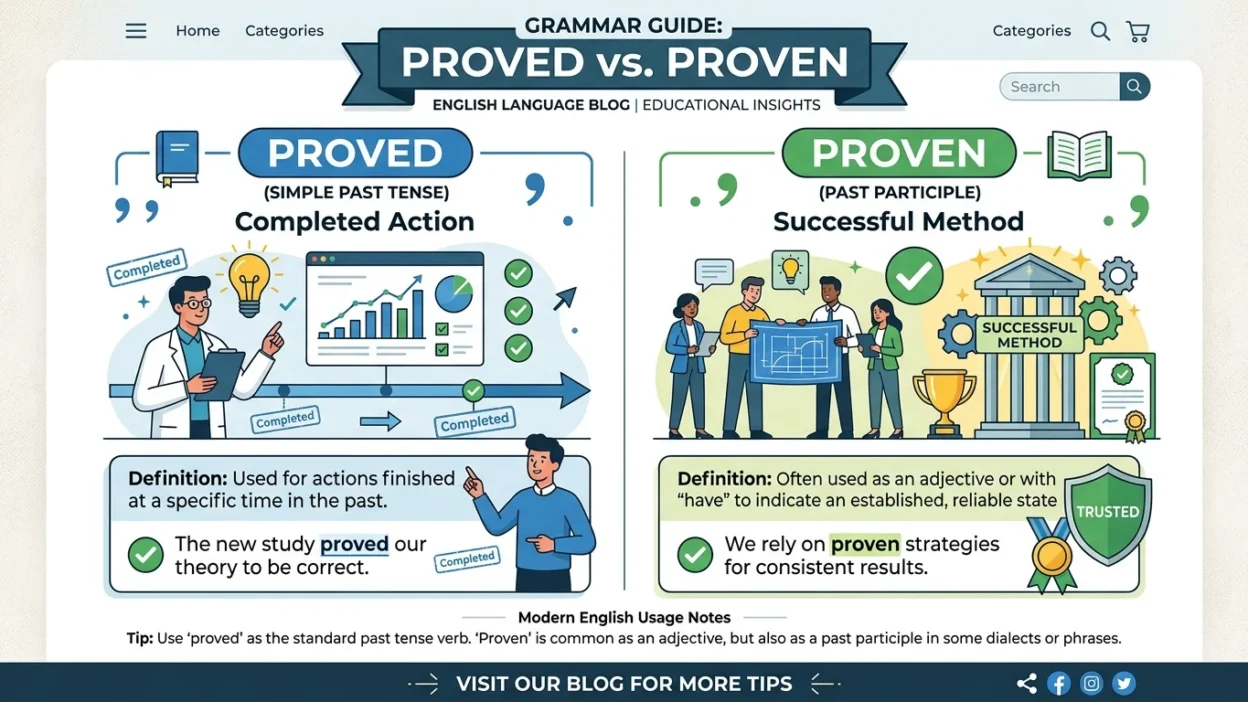
The main difference is that proved is the traditional past tense and past participle of prove, while proven is commonly used as a past participle, especially before a noun or with forms of have and be. In modern English, both are widely accepted.
Quick Answer
Proved and proven are both correct. Proved is the simple past and can also be a past participle. Proven is mainly used as a past participle and is especially common in phrases such as “a proven method” and “has proven effective.”
Why People Confuse It
The confusion comes from the fact that prove has two commonly accepted past participle forms:
Prove → proved
Prove → proven
For example:
She proved that she was right. ✅
She has proven that she was right. ✅
The important point is that proved and proven are not simply two different spellings of the same grammatical form in every situation.
Proved
Proved is the simple past form of prove.
It can also function as a past participle.
Simple Past
He proved his point.
She proved that the theory was correct.
The experiment proved successful.
Past Participle
Proved can also follow auxiliary verbs:
The method has proved effective.
His concerns have proved justified.
So proved is perfectly standard in both American and British English.
Proven
Proven is traditionally used as a past participle.
It is especially common when describing something that has already demonstrated its effectiveness, reliability, or truth.
Examples
This is a proven method.
She has proven herself to be an excellent leader.
The treatment has proven effective.
He has proven his ability to succeed.
Proven is particularly common when it comes directly before a noun.
Comparison Table
| Form | Common Use | Example |
|---|---|---|
| Proved | Simple past | She proved her point. |
| Proved | Past participle | The method has proved effective. |
| Proven | Past participle | The method has proven effective. |
| Proven | Before a noun | This is a proven method. |
When to Use Each
Use proved when you are talking about a completed action in the simple past.
He proved that he was innocent.
Use proved or proven after has, have, or had.
She has proved her ability.
She has proven her ability.
Both are acceptable.
Use proven particularly naturally before a noun:
a proven strategy
a proven technique
a proven solution
a proven method
Examples
- She proved that she was right.
- He proved his point.
- The experiment proved successful.
- They proved their ability to solve the problem.
- The method has proved effective.
- The method has proven effective.
- She has proven herself to be a capable leader.
- He has proved his commitment to the project.
- This is a proven strategy.
- We need a proven solution.
- The technique has proven reliable.
- His concerns have proved justified.
Common Mistakes
Using “proven” as the simple past
❌ She proven that she was right.
✅ She proved that she was right.
When you are using the simple past by itself, use proved.
Using “proved” incorrectly with “has”
Proved is actually possible here.
The method has proved effective. ✅
So it is incorrect to assume that has proved is always wrong.
Has proven is also correct:
The method has proven effective. ✅
Thinking “proven” is always better
It isn’t.
For simple past sentences, proved is the correct choice.
Memory Trick
Remember this simple pattern:
Yesterday → proved
She proved her point yesterday.
Has/have/had → proved or proven
She has proved her point.
She has proven her point.
Before a noun → proven
a proven method
American vs British English
Both proved and proven are used in American and British English.
There is, however, a slight difference in preference and style.
Proven is especially common in American English as a past participle and before nouns.
Proved is also widely accepted and remains common in British English and formal writing.
In modern English, neither form should automatically be considered incorrect.
Similar Words
Other English verbs have multiple accepted past forms or participles:
- Learned vs learnt
- Burned vs burnt
- Leaped vs leapt
- Spelled vs spelt
- Dreamed vs dreamt
- Proved vs proven
- Gotten vs got
- Shone vs shined
These differences often depend on grammar, region, or context.
Final Verdict
Proved and proven are both correct.
Use proved as the simple past:
She proved her point. ✅
Use proved or proven as a past participle:
She has proved her point. ✅
She has proven her point. ✅
Use proven especially naturally before a noun:
This is a proven method. ✅
Remember This
Prove → proved → proven
The easiest rule is:
Simple past = proved
Past participle = proved or proven
Before a noun = proven is especially common
So:
She proved it. ✅
She has proven it. ✅
A proven method. ✅
FAQs
Is “proved” or “proven” correct?
Both are correct. Proved is the simple past and can also be a past participle. Proven is commonly used as a past participle.
Is “she proven it” correct?
No.
❌ She proven it.
✅ She proved it.
If you use proven, you need an auxiliary verb:
✅ She has proven it.
Is “has proved” correct?
Yes. Has proved is completely correct.
The method has proved effective.
Has proven is also correct.
The method has proven effective.
Is “proven” more correct than “proved”?
No. Neither is universally more correct. The appropriate form depends on the grammatical structure and style.
Is “proven” a past tense?
Traditionally, proven is a past participle rather than the simple past. The simple past is proved.
Should I say “a proven method” or “a proved method”?
A proven method is the natural and widely preferred expression.
What is the past tense of prove?
The simple past tense is proved.
He proved his point.
What is the past participle of prove?
Both proved and proven can function as past participles.
She has proved her ability.
She has proven her ability.
Conclusion
The choice between proved and proven depends mainly on grammar and context. Proved is the standard simple past form, while proven is commonly used as a past participle, especially before nouns and in expressions describing something that has demonstrated its effectiveness.
The easiest rule to remember is “She proved it” for the simple past and “She has proven it” for a common past participle construction. However, “She has proved it” is also perfectly correct.

Daniel Charles is a dedicated author and dream interpretation enthusiast at DrameyHut. He specializes in analyzing dream symbols and meanings, offering clear and insightful content for readers. His work aims to help individuals understand their subconscious thoughts, gain clarity, and explore the deeper messages hidden within their dreams.