
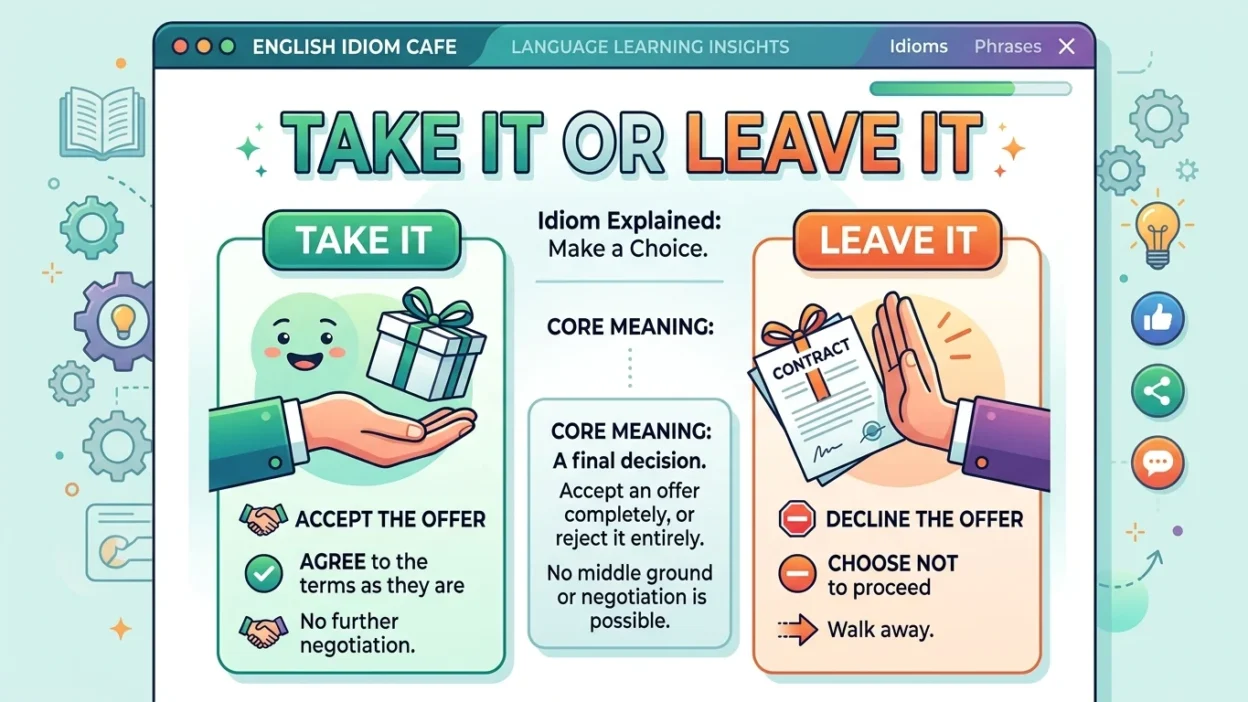
“Take it or leave it” is a common English expression used when someone is offering something and saying that the other person can either accept it or refuse it. It often suggests that the offer is final and not open to negotiation.
The expression can sound neutral, confident, or even slightly blunt depending on the situation. It is commonly used when discussing prices, offers, deals, suggestions, or conditions. For example, if someone says, “I’ll sell it to you for $50, take it or leave it,” they mean $50 is the final price, and you can either accept it or walk away.
Quick Answer
“Take it or leave it” means accept an offer or refuse it. It often implies that the person making the offer is not willing to negotiate or change the terms.
Example: I’ll sell it for $100. Take it or leave it.
Why People Use It
The expression is useful when someone wants to make it clear that there are only two choices:
Take it = Accept the offer
Leave it = Reject the offer
It can be used seriously or casually.
I can give you $50 for it. Take it or leave it.
This usually means the speaker is not offering a higher price.
Take It or Leave It
The phrase literally presents two options:
Take it → accept it
Leave it → reject it
The word it refers to whatever is being offered.
For example:
I’ll give you my old laptop for $200. Take it or leave it.
Here, it refers to the offer of buying the laptop for $200.
Meaning in Different Situations
In Negotiations
The phrase often means “This is my final offer.”
I’ll pay you $500 for the car. Take it or leave it.
In Business
It can communicate that the terms are fixed.
These are the terms of the contract. Take it or leave it.
In Everyday Conversation
It can simply mean “You can accept my suggestion or not.”
I can make pasta for dinner. Take it or leave it.
In this context, it may sound playful rather than aggressive.
Comparison Table
| Expression | Meaning | Tone |
|---|---|---|
| Take it or leave it | Accept or reject the offer | Firm |
| It’s up to you | You can decide | Neutral |
| Your choice | You decide | Neutral |
| Final offer | No further negotiation | Firm |
| If you want it, it’s yours | Accept if interested | Friendly |
| Think it over | Consider the offer | Softer |
When to Use It
Use take it or leave it when:
- You are making an offer.
- You do not want to negotiate further.
- You want someone to make a decision.
- The terms are fixed.
- You are giving someone a choice between accepting and rejecting something.
Example
I can offer you $800 for the job. Take it or leave it.
This strongly suggests that $800 is the maximum the speaker is willing to offer.
Examples
- I’ll sell it for $50. Take it or leave it.
- That’s my final offer. Take it or leave it.
- You can have the last piece. Take it or leave it.
- I’ll give you $100 for it. Take it or leave it.
- These are the terms of the deal. Take it or leave it.
- I can finish the work by Friday. Take it or leave it.
- I’ll give you my old phone for $75. Take it or leave it.
- That’s the best price I can offer. Take it or leave it.
- I can drive you there, but you’ll have to leave early. Take it or leave it.
- You can join us for dinner, take it or leave it.
Common Mistakes
Saying “take or leave it”
Take or leave it is also possible and very common.
Take it or leave it.
Take or leave it.
Both can be used, but “take it or leave it” is the fuller expression.
Thinking it always sounds rude
Not necessarily.
The tone depends on the situation.
Here’s some cake. Take it or leave it.
This could be playful.
But:
That’s my final price. Take it or leave it.
This sounds much firmer.
Using it when negotiation is still possible
If you’re genuinely inviting someone to negotiate, take it or leave it may send the wrong message because it usually implies that the offer is final.
Memory Trick
Think of the expression as two simple choices:
Take it = Yes
Leave it = No
So:
Take it or leave it = Accept it or reject it.
American vs British English
“Take it or leave it” is common in both American and British English.
The meaning is essentially the same in both varieties.
It is widely used in:
- Everyday conversation
- Business discussions
- Negotiations
- Shopping
- Informal writing
- Movies and television
Similar Expressions
Depending on the tone, you can use:
- It’s your choice.
- It’s up to you.
- That’s my final offer.
- Accept it or reject it.
- That’s the best I can do.
- No negotiations.
- The choice is yours.
- You can accept it or pass.
“Take it or leave it” is usually more direct than “It’s up to you.”
Final Verdict
“Take it or leave it” means accept the offer or reject it. It often carries the additional idea that the offer is final and cannot be negotiated.
For example:
I’ll sell it for $200. Take it or leave it.
The speaker is saying that $200 is the price, and the other person must decide whether to accept or reject the offer.
Remember This
Take it = Accept it
Leave it = Reject it
Take it or leave it = Accept my offer or walk away.
FAQs
What does “take it or leave it” mean?
It means accept an offer or reject it. It often suggests that the offer is final and cannot be negotiated.
Is “take it or leave it” rude?
It can sound firm or blunt, especially during a negotiation. However, it can also be playful or casual depending on the context and tone.
Is “take it or leave it” an idiom?
Yes. It is a common English idiomatic expression used when someone gives another person a choice between accepting and rejecting an offer.
What is another way to say “take it or leave it”?
You can say “That’s my final offer,” “Accept it or reject it,” or “That’s the best I can do.”
Can I use “take it or leave it” in business English?
Yes, but use it carefully. It can sound quite firm and may be perceived as unwillingness to negotiate.
What does “take it or leave it” mean in a relationship?
Depending on context, it can mean “Accept me or my offer as it is, or reject it.” It can sound quite firm or uncompromising.
Is “take it or leave it” the same as “it’s up to you”?
Not exactly. “It’s up to you” is usually neutral, while “take it or leave it” often implies that the offer or conditions are fixed.
Conclusion
“Take it or leave it” is a useful English expression meaning accept an offer or reject it. It is especially common when someone is making a firm offer and does not want to negotiate further.
Remember the simple formula: take it means accept it, and leave it means reject it. If you want a softer and more polite alternative, “It’s up to you” is usually a better choice.

Christopher Thomas is a passionate writer and dream researcher dedicated to exploring the meanings behind dreams. As an author at DrameyHut, he creates insightful and easy-to-understand interpretations that help readers connect with their subconscious mind. His work focuses on guiding individuals toward self-discovery, clarity, and a deeper understanding of their inner thoughts.