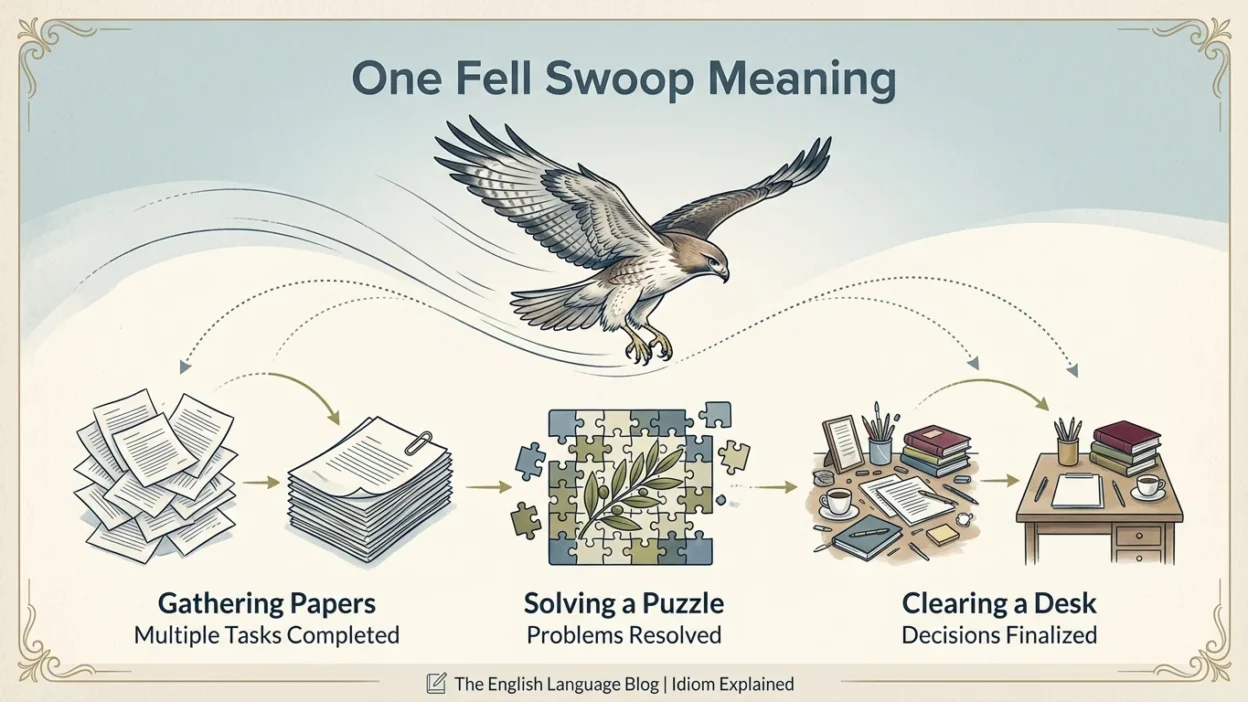
“One fell swoop” is an English expression meaning all at once, in a single action, or with one sudden movement. It is commonly used when several things happen or are accomplished at the same time.
You will often hear the phrase in the form “in one fell swoop.” For example, “She solved three problems in one fell swoop” means she solved all three problems with one action. The expression can describe something efficient and convenient, but it can also describe something sudden or destructive, depending on context.
The phrase has a long history in English and is famously associated with Shakespeare. Although “fell” may look like the past tense of “fall,” that is not the meaning here. In this expression, fell means fierce, fearless, or deadly, while swoop refers to a sudden downward movement or attack.
Quick Answer
“One fell swoop” means doing several things at once with a single action. The phrase often appears as “in one fell swoop.” It can describe efficiency, sudden action, or even destruction, depending on the situation.
Why Do People Confuse “One Fell Swoop”?
The phrase can be confusing because fell has several meanings in English.
Most people know “fell” as the past tense of fall:
“He fell down.”
But in “one fell swoop,” fell has a different meaning. It is an adjective meaning fierce, deadly, or destructive.
The expression therefore has nothing to do with falling.
What Does “One Fell Swoop” Mean?
“One fell swoop” means in a single action or all at once.
It can describe accomplishing several tasks simultaneously:
“We cleaned all the rooms in one fell swoop.”
This means the rooms were dealt with through one overall action or process.
It can also describe several events happening suddenly:
“The storm destroyed several buildings in one fell swoop.”
Here, the expression emphasizes the sudden and powerful nature of the event.
What Does “Fell” Mean in “One Fell Swoop”?
In this expression, fell is an old adjective meaning fierce, fearless, cruel, or deadly.
It is related to an older use of the word that is still occasionally found in expressions such as:
“a fell enemy”
The word is much less common in ordinary modern English.
So:
fell = fierce or deadly
swoop = sudden downward movement or attack
Together, the expression originally had a much more violent image than the neutral way we often use it today.
What Does “Swoop” Mean?
A swoop is a sudden movement downward, especially by a bird attacking or catching something.
For example:
“The eagle swooped down toward the fish.”
The word can also be used figuratively for a sudden action.
That is why “one fell swoop” can describe something happening quickly and decisively.
Origin of “One Fell Swoop”
The expression is famously associated with William Shakespeare’s Macbeth.
In the play, Macduff discovers that Macbeth has ordered the killing of his wife and children. He describes the attack using the expression “at one fell swoop.”
The original image was violent and sudden, similar to a bird making a deadly attack in one movement.
Over time, the expression became broader and is now frequently used for ordinary situations involving several things being accomplished at once.
“In One Fell Swoop” vs “At One Fell Swoop”
Both forms can be found.
In one fell swoop is very common in modern English.
At one fell swoop is the older form and is also correct.
For everyday modern writing and conversation, “in one fell swoop” is a very natural choice.
Examples of “One Fell Swoop”
- “She finished all three assignments in one fell swoop.”
- “We can solve both problems in one fell swoop.”
- “He cleaned the entire house in one fell swoop.”
- “The new policy addressed several issues in one fell swoop.”
- “She bought everything she needed in one fell swoop.”
- “The storm damaged several buildings in one fell swoop.”
- “The manager reorganized three departments in one fell swoop.”
- “By changing the schedule, we solved several problems in one fell swoop.”
- “The company closed several offices in one fell swoop.”
- “He answered all my questions in one fell swoop.”
- “The new software update fixed several bugs in one fell swoop.”
- “The team completed several important tasks in one fell swoop.”
When Should You Use “One Fell Swoop”?
Use the expression when you want to emphasize that multiple things were handled through one action or at essentially the same time.
It works especially well when several separate tasks, problems, decisions, or consequences are connected.
For example:
“The new system saves time, reduces costs, and improves accuracy in one fell swoop.”
The sentence emphasizes that one change produces several results.
Is “One Fell Swoop” Formal or Informal?
“One fell swoop” is a well established English idiom that can be used in both casual and professional contexts.
For example:
“The merger eliminated several administrative problems in one fell swoop.”
This sounds perfectly natural in professional writing.
However, the expression can sometimes sound slightly colorful or literary because of its historical connection with Shakespeare.
Common Mistakes
Mistake 1: Thinking “fell” means “fallen”
It does not.
In this expression, fell means fierce, deadly, or destructive.
Mistake 2: Saying “one foul swoop”
“Foul swoop” is a common mistaken version.
The traditional expression is:
one fell swoop
Not:
one foul swoop
Mistake 3: Thinking the phrase always means something bad
It does not.
You can use it for positive or neutral situations:
“She bought all her groceries in one fell swoop.”
There is nothing negative about this sentence.
Mistake 4: Assuming it always means literally one physical movement
Modern usage is broader.
It can mean accomplishing several related things through one action or decision.
Mistake 5: Confusing it with “at one time”
The phrases overlap, but “one fell swoop” emphasizes one decisive action that handles multiple things.
One Fell Swoop vs At Once
| Expression | Meaning | Example |
|---|---|---|
| One fell swoop | Several things handled through one action | “We solved three problems in one fell swoop.” |
| At once | Immediately or simultaneously | “They all arrived at once.” |
| All at once | Everything happening simultaneously | “The lights went out all at once.” |
| In one go | Accomplished in a single attempt | “I finished it in one go.” |
| In one move | Accomplished through one action | “She solved the problem in one move.” |
One Fell Swoop vs In One Go
These expressions can be similar, but they are not always interchangeable.
In one fell swoop emphasizes dealing with multiple things through one action.
“The manager solved several problems in one fell swoop.”
In one go usually emphasizes completing something in a single attempt.
“I finished the book in one go.”
So, “one fell swoop” is especially useful when one action affects several things.
Memory Trick
Remember:
One action + many results = one fell swoop.
You can also remember:
Fell does not mean fallen.
In this idiom, fell = fierce or deadly.
American vs British English
“One fell swoop” is used in both American and British English.
The meaning is essentially the same in both varieties.
The expression is well established and widely understood, although speakers may choose simpler alternatives such as all at once, in one go, or in a single move depending on the context.
Similar Expressions
Here are some expressions with related meanings:
All at once: everything happens simultaneously.
In one go: something is completed in a single attempt.
In one move: something is accomplished through one action.
In a single stroke: something is accomplished through one decisive action.
At the same time: two or more things happen simultaneously.
In one action: several results are achieved through one action.
Final Verdict
“One fell swoop” means doing several things at once or accomplishing multiple results through one action.
The phrase is not about falling. Here, fell is an old adjective meaning fierce or deadly, while swoop refers to a sudden downward movement.
Although the original expression had a violent image, modern English often uses “in one fell swoop” in completely ordinary situations involving efficiency, convenience, or multiple results from one action.
FAQs
What does “one fell swoop” mean?
It means accomplishing several things through one action or having several things happen at the same time.
Is “one fell swoop” correct?
Yes. “One fell swoop” is the traditional and standard expression.
Is it “one fell swoop” or “one foul swoop”?
The standard expression is one fell swoop. “One foul swoop” is a common mistaken version.
What does “fell” mean in “one fell swoop”?
Here, fell is an old adjective meaning fierce, fearless, deadly, or destructive. It does not mean the past tense of “fall.”
Is “one fell swoop” formal?
It can be used in both formal and informal English. It is also somewhat colorful because of its literary history.
What is another way to say “one fell swoop”?
Depending on context, you can say all at once, in one go, in one move, in a single action, or at the same time.
Who made “one fell swoop” famous?
The expression is famously associated with William Shakespeare’s Macbeth, although the wording has a longer linguistic history.
Can “one fell swoop” describe something positive?
Yes. For example, you can say, “She solved several problems in one fell swoop.” The phrase itself does not have to describe something negative.
Conclusion
“One fell swoop” is a useful English idiom for describing a situation in which several things are accomplished through one action or happen together. It is especially effective when one decision, movement, or event produces several results.
The expression may seem strange because of the word “fell,” but its meaning becomes clearer when you know that “fell” is an old adjective meaning fierce or deadly. The phrase originally carried a more violent image, but modern speakers commonly use it in neutral situations involving efficiency and simultaneous results.
Remember This
One fell swoop = several things handled through one action.
And remember:
“Fell” does not mean “fallen” in this expression.

Christopher Thomas is a passionate writer and dream researcher dedicated to exploring the meanings behind dreams. As an author at DrameyHut, he creates insightful and easy-to-understand interpretations that help readers connect with their subconscious mind. His work focuses on guiding individuals toward self-discovery, clarity, and a deeper understanding of their inner thoughts.