Many English learners wonder whether they should say He is risen or He has risen. Both expressions appear in English, but they are used in different contexts. One is a traditional religious phrase, while the other follows modern English grammar.
Understanding the difference between He is risen vs He has risen will help you choose the correct expression for everyday conversations, writing, or religious discussions.
Quick Answer
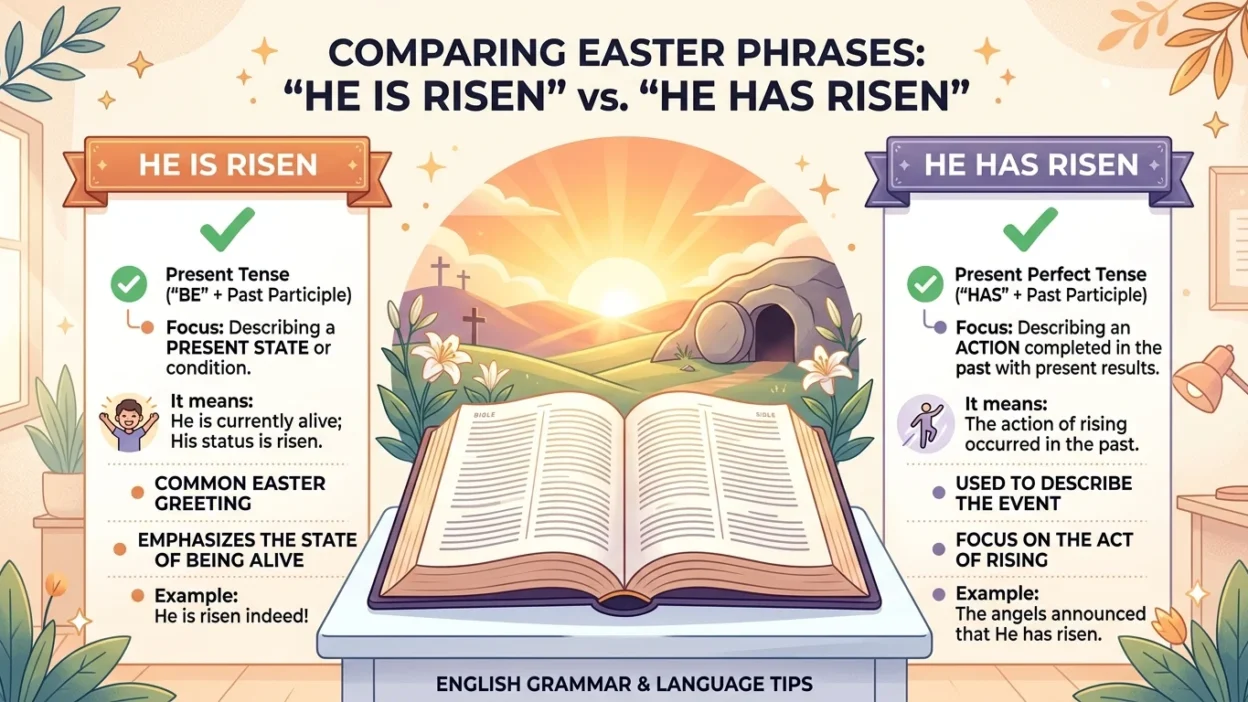
He has risen is the correct form in modern English grammar. He is risen is a traditional Christian expression used to celebrate the resurrection of Jesus Christ. Both are correct, but they are used in different contexts.
Why People Confuse It
The confusion happens because both expressions come from the verb rise.
In modern English, rise forms the present perfect with has:
- He has risen.
However, older forms of English sometimes used be as the helping verb with verbs of movement, which is why He is risen appears in the Bible, hymns, and Christian worship.
He Is Risen
He is risen is a traditional religious expression.
Meaning
It means that Jesus Christ has risen from the dead.
Today, it is mainly used in Christianity, especially during Easter celebrations.
Examples
- He is risen! Alleluia!
- Christians proclaim, “He is risen!”
- The pastor announced, “He is risen indeed!”
- Easter celebrates that He is risen.
- Millions rejoice because He is risen.
He Has Risen
He has risen is the grammatically correct form in modern English.
Meaning
It means that someone has stood up, moved upward, or, in a religious context, has risen from the dead.
Examples
- He has risen from his chair.
- The sun has risen.
- Christ has risen from the dead.
- He has risen above his difficulties.
- Prices have risen again this year.
Comparison Table
| Feature | He Is Risen | He Has Risen |
|---|---|---|
| Grammatically correct today | Limited to traditional religious use | ✅ Yes |
| Traditional Christian expression | ✅ Yes | ✅ Yes |
| Used in everyday English | ❌ No | ✅ Yes |
| Common in modern writing | Mainly religious | ✅ Yes |
| Refers to the resurrection of Jesus | ✅ Yes | ✅ Yes |
When to Use Each
Use He is risen when:
- Celebrating Easter.
- Quoting the Bible.
- Writing Christian messages or hymns.
- Referring to the traditional Easter greeting.
Use He has risen when:
- Following modern English grammar.
- Talking about someone or something that has risen.
- Writing general English outside traditional religious expressions.
Examples
- He is risen! Alleluia!
- Christians around the world proclaim, “He is risen!”
- The congregation replied, “He is risen indeed!”
- Easter reminds believers that He is risen.
- The hymn begins with the words “He is risen.”
- He has risen from his seat.
- The sun has risen over the mountains.
- Christ has risen from the dead.
- The water level has risen overnight.
- He has risen to become the company’s CEO.
- Temperatures have risen this week.
- She said he has risen above every challenge.
Common Mistakes
Many learners make these errors.
- Using He is risen in everyday non-religious situations.
- Thinking He is risen is the normal modern grammar form.
- Assuming He has risen cannot refer to Jesus.
Correct:
- Christ has risen from the dead. (Modern grammar)
- Christ is risen! (Traditional Christian expression)
Incorrect:
- He is risen from his chair.
- The sun is risen.
Memory Trick
Remember this simple rule:
Has risen = Modern English.
Is risen = Traditional Easter expression.
If you’re talking about Jesus during Easter, He is risen is the familiar traditional greeting.
For everything else, use has risen.
American vs British English
Both American and British English follow the same rule.
He has risen is the standard grammatical form.
He is risen remains a respected traditional expression in Christian worship and religious literature.
Similar Words
You may also confuse these verb forms:
- Has gone vs Is gone
- Has come vs Is come
- Has fallen vs Is fallen
- Has grown vs Is grown
- Has become vs Is become
- Rose vs Risen
- Raise vs Rise
- Lay vs Lie
- Sat vs Seated
- Gone vs Went
Final Verdict
Both He is risen and He has risen are correct, but they serve different purposes. He has risen follows modern English grammar and is appropriate in everyday writing and speech. He is risen is a traditional Christian expression that has been preserved in worship, Scripture translations, hymns, and Easter greetings.
Choosing the right form depends on your context. If you’re celebrating Easter or quoting traditional Christian language, He is risen is the preferred expression. In general English, He has risen is the standard choice.
Remember This
He has risen = Modern English grammar. ✅
He is risen = Traditional Christian Easter expression. ✅
Use the one that matches your context.
FAQs
Which is correct, He is risen or He has risen?
Both are correct. He has risen is standard modern English, while He is risen is a traditional Christian expression.
Why do Christians say He is risen?
The phrase comes from older English translations and Christian tradition, where be was sometimes used as the helping verb with verbs like rise.
Is He has risen grammatically correct?
Yes. It is the correct present perfect form in modern English.
Can I say Christ has risen?
Yes. Christ has risen is grammatically correct and is commonly used in modern Bible translations and Christian writing.
Is He is risen only used for Jesus?
Today, yes. It is almost exclusively used in reference to the resurrection of Jesus Christ.
Do British and American English use these expressions differently?
No. Both varieties recognize He has risen as the standard grammatical form while preserving He is risen as a traditional religious expression.
What is the traditional Easter response?
The traditional greeting is:
He is risen!
Response:
He is risen indeed!
Conclusion
The difference between He is risen and He has risen lies in grammar and tradition. He has risen is the standard present perfect form used in modern English, while He is risen is a historic Christian expression that continues to be used during Easter and in religious worship.
By understanding the context, you can confidently choose the appropriate expression. Use He has risen for modern grammar and He is risen when using the traditional Easter proclamation.

Christopher Thomas is a passionate writer and dream researcher dedicated to exploring the meanings behind dreams. As an author at DrameyHut, he creates insightful and easy-to-understand interpretations that help readers connect with their subconscious mind. His work focuses on guiding individuals toward self-discovery, clarity, and a deeper understanding of their inner thoughts.