Many English learners wonder whether the correct word is emasculate or demasculate. Since many English words begin with the prefix de-, it’s easy to assume that demasculate is also a standard word. However, only one of these forms is widely accepted in modern English.
Understanding the difference between emasculate vs demasculate will help you avoid a common vocabulary mistake and use the correct word in both spoken and written English.
Quick Answer
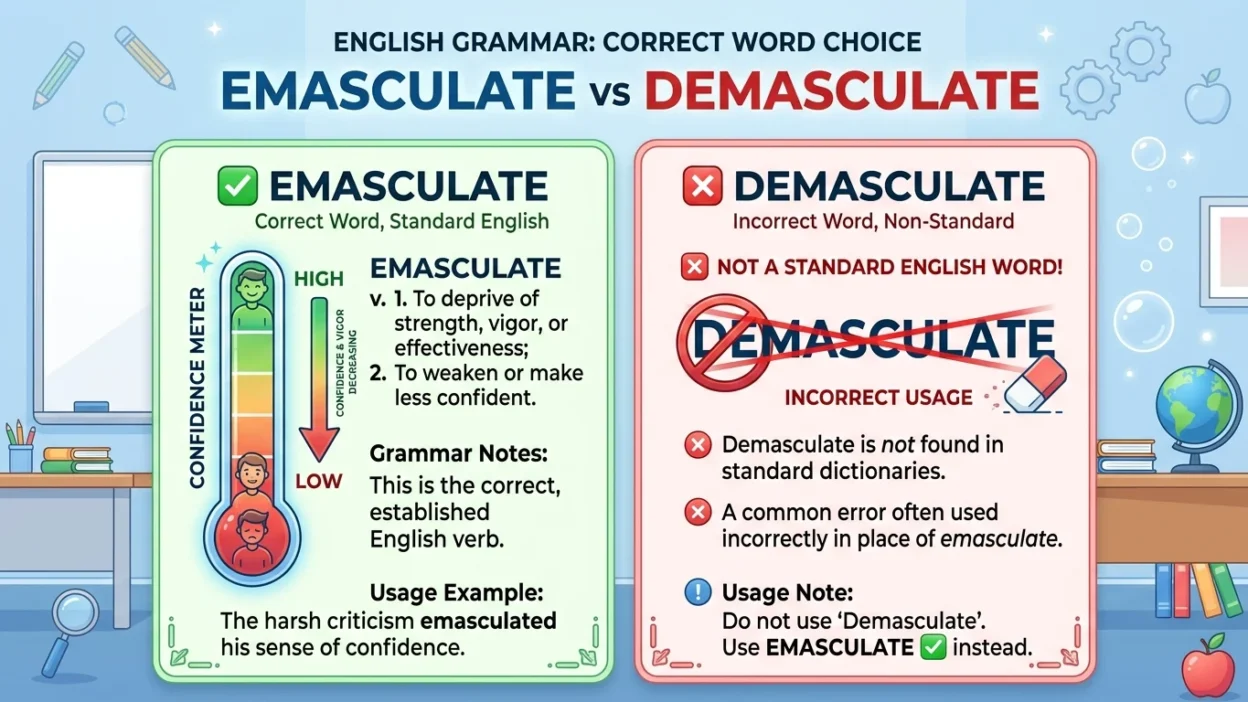
Emasculate is the correct and standard English word. Demasculate is not a standard English word and is considered incorrect in modern English. Always use emasculate.
Why People Confuse It
The confusion happens because many English verbs begin with the prefix de-, such as deactivate, devalue, and decompose.
This leads some learners to assume that demasculate is the opposite or an alternative form of emasculate. In reality, emasculate already carries its own meaning and does not require the prefix de-.
Emasculate
Emasculate is a verb.
Meaning
It means:
- To deprive someone of strength, confidence, or authority.
- To weaken or make something less effective.
- Historically, it could also mean to castrate, although this sense is less common in everyday use.
Examples
- Constant criticism can emasculate a person’s confidence.
- The new regulations emasculated the committee’s authority.
- He felt emasculated after being publicly mocked.
- The decision emasculated the organization’s influence.
- Harsh comments should never be used to emasculate someone.
Demasculate
Demasculate is not a standard English word.
It does not appear in major modern dictionaries as an accepted word.
If you mean to weaken someone’s confidence or authority, use emasculate instead.
Comparison Table
| Feature | Emasculate | Demasculate |
|---|---|---|
| Correct standard English | ✅ Yes | ❌ No |
| Found in major dictionaries | ✅ Yes | ❌ No |
| Means to weaken or deprive of strength | ✅ Yes | ❌ No |
| Suitable for formal writing | ✅ Yes | ❌ No |
| Recommended for learners | ✅ Yes | ❌ No |
When to Use Each
Use emasculate when:
- Referring to weakening someone’s confidence or authority.
- Describing a reduction in strength or effectiveness.
- Writing formal or academic English.
Never use demasculate in standard English.
Examples
- The harsh remarks emasculated his confidence.
- The reforms emasculated the committee’s powers.
- She refused to let criticism emasculate her.
- The law emasculated the agency’s authority.
- Public humiliation can emasculate a person’s self-esteem.
- The policy emasculated local decision-making.
- The speech did not emasculate his reputation.
- Attempts to emasculate the organization failed.
- The changes emasculated the original proposal.
- He overcame experiences that once emasculated his confidence.
- The editor avoided language that could emasculate others.
- The decision effectively emasculated the group’s influence.
Common Mistakes
Many learners make these errors.
- Writing demasculate instead of emasculate.
- Assuming de- should be added because of similar English verbs.
- Believing both words are interchangeable.
Correct:
- The criticism emasculated his confidence.
Incorrect:
- The criticism demasculated his confidence.
Memory Trick
Remember this simple rule:
Emasculate starts with E, and it’s the only standard English word.
If you see demasculate, remove the de- and use emasculate.
American vs British English
There is no significant difference between American and British English.
Both varieties use emasculate as the correct word.
Demasculate is not accepted in standard English in either variety.
Similar Words
You may also find these words useful:
- Weaken
- Undermine
- Diminish
- Reduce
- Impair
- Humiliate
- Belittle
- Disempower
- Debilitate
- Enfeeble
Final Verdict
The correct word is emasculate. It means to weaken someone’s confidence, authority, or effectiveness. Demasculate is not recognized as a standard English word and should be avoided.
Whenever you want to express the idea of reducing strength, confidence, or authority, emasculate is the correct choice.
Remember This
Emasculate = Correct English word. ✅
Demasculate = Incorrect. ❌
There is no need to add de- to emasculate.
FAQs
Which is correct, emasculate or demasculate?
Emasculate is correct. Demasculate is not a standard English word.
Is demasculate a real word?
No. It is not recognized in major modern English dictionaries.
What does emasculate mean?
It means to weaken someone’s confidence, authority, strength, or effectiveness. Historically, it could also refer to castration.
Can I use demasculate in formal writing?
No. Always use emasculate.
Why do people say demasculate?
People often assume it follows the pattern of other words beginning with de-, but this is a common mistake.
Do British and American English use emasculate differently?
No. Both use emasculate with the same meaning.
What is another word for emasculate?
Depending on the context, you can use weaken, undermine, diminish, impair, or disempower.
Conclusion
The confusion between emasculate vs demasculate is understandable because many English verbs begin with the prefix de-. However, emasculate is already the complete and correct word.
It means to weaken someone’s confidence, authority, or effectiveness, while demasculate is not accepted in standard English.
To write and speak accurately, always choose emasculate and avoid using demasculate.

Nancy Lisa is a passionate writer and contributor at DrameyHut, focused on uncovering the deeper meanings behind dreams. She creates engaging and insightful content that helps readers interpret their dreams and understand their subconscious thoughts. Her work inspires self-reflection, clarity, and a stronger connection to inner emotions.