Many English learners wonder whether hence why is grammatically correct. The phrase appears in conversations, news articles, blogs, and even professional writing, yet some grammar experts argue that it is redundant. This often leaves writers unsure about whether they should use hence why, hence, or which is why instead.
Understanding hence why grammar will help you write more naturally and confidently. This guide explains its meaning, correctness, examples, common mistakes, and when it is best to use alternative expressions.
Quick Answer
Hence why is widely used in modern English, but many grammar experts consider it redundant because hence already means for this reason or therefore, and why expresses a similar idea. In formal writing, hence or which is why is usually the better choice.
Why People Confuse It
The confusion happens because hence why is common in everyday speech and informal writing.
Although many native speakers use it naturally, some style guides recommend avoiding it because hence already introduces the reason.
Hence Why
Hence why is an informal phrase that means for this reason or that is why.
Meaning
It introduces the reason or explanation for something.
Examples
- The roads were flooded, hence why we stayed home. (Informal)
- She worked hard, hence why she succeeded. (Informal)
- He missed the train, hence why he arrived late. (Informal)
These sentences are understandable, but many editors would revise them.
Better Alternatives
In formal or polished writing, use one of these instead:
- Hence
- Therefore
- Thus
- Which is why
- That is why
- For this reason
Examples
- The roads were flooded; hence, we stayed home.
- She worked hard, which is why she succeeded.
- He missed the train; therefore, he arrived late.
- The evidence was insufficient; thus, the case was dismissed.
- The weather was terrible. That is why the event was cancelled.
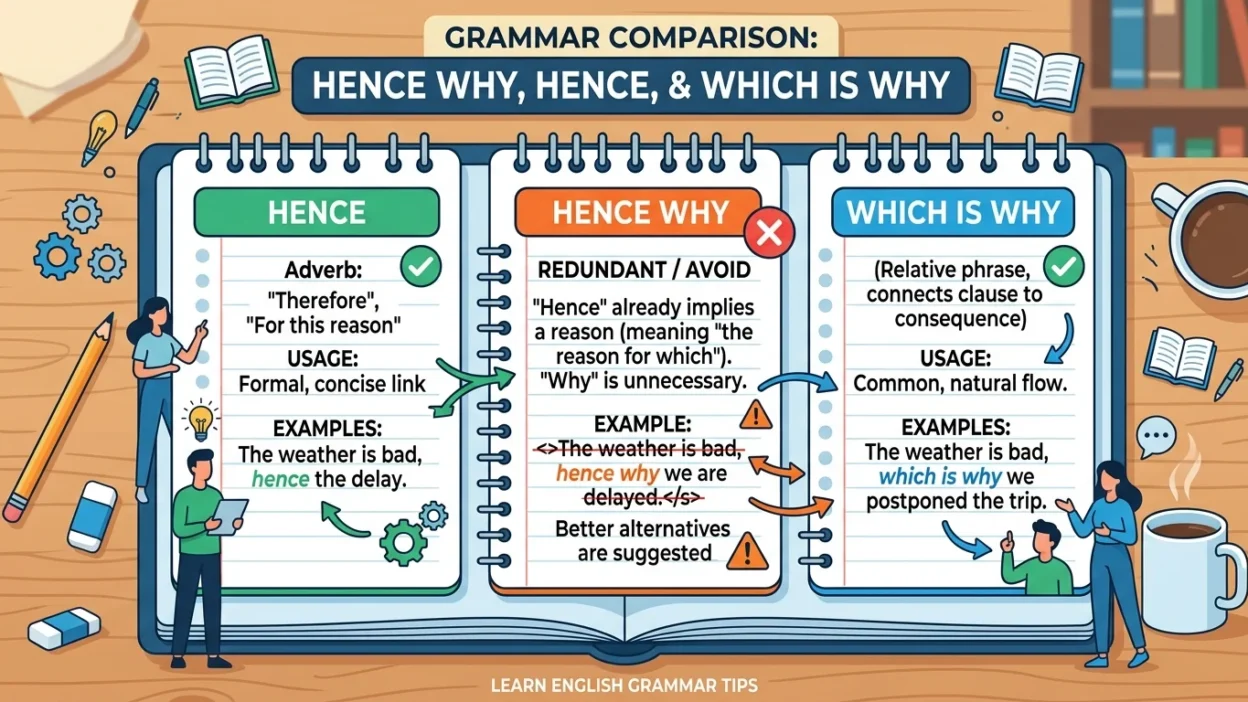
Comparison Table
| Feature | Hence Why | Hence | Which Is Why |
|---|---|---|---|
| Grammatically acceptable | ✅ Yes, but often considered redundant | ✅ Yes | ✅ Yes |
| Best for formal writing | ❌ No | ✅ Yes | ✅ Yes |
| Common in conversation | ✅ Yes | Sometimes | ✅ Yes |
| Recommended by many style guides | ❌ No | ✅ Yes | ✅ Yes |
When to Use Each
Use hence why when:
- Speaking informally.
- Writing casual content.
- Mimicking conversational English.
Use hence when:
- Writing academic papers.
- Preparing business documents.
- Using formal English.
Use which is why when:
- You want a natural and clear sentence.
- Writing for a general audience.
Examples
- He forgot his passport, which is why he missed the flight.
- She studied every day; hence, she passed the exam.
- The shop was closed, hence why we went elsewhere. (Informal)
- It was raining heavily; therefore, the match was postponed.
- He practised regularly, which is why he improved.
- The machine was damaged; hence, production stopped.
- They arrived late, which is why they missed the introduction.
- The project exceeded its budget; therefore, it was reviewed.
- She felt unwell, hence why she stayed home. (Informal)
- The roads were icy; thus, drivers were advised to slow down.
- He ignored the warning, which is why he faced problems.
- The software was outdated; hence, it needed replacing.
Common Mistakes
Many learners make these errors.
- Using hence why in formal essays.
- Assuming hence why is the only correct expression.
- Overusing hence where because or which is why would sound more natural.
Correct:
- She worked hard, which is why she succeeded.
- She worked hard; hence, she succeeded.
Less preferred in formal writing:
- She worked hard, hence why she succeeded.
Memory Trick
Remember this simple rule:
Hence = For this reason.
Because hence already means for this reason, adding why is often unnecessary.
When writing formally, choose hence or which is why.
American vs British English
Both American and British English use hence why in informal contexts.
However, style guides in both varieties generally prefer hence, therefore, or which is why in formal writing.
Similar Words
You may also confuse these linking expressions:
- Hence vs Therefore
- Thus vs Therefore
- Because vs Since
- So vs Therefore
- Consequently vs Hence
- Accordingly vs Thus
- As a result vs Therefore
- For this reason vs Hence
- Which is why vs That’s why
- Therefore vs Thereby
Final Verdict
Hence why is widely understood and commonly used in everyday English, but many grammar experts consider it redundant because hence already expresses the idea of for this reason.
If you’re writing informally, hence why is generally acceptable. For academic, professional, or formal writing, it’s better to use hence, therefore, thus, or which is why.
Remember This
Hence why = Common but often considered redundant. ⚠️
Hence = Best for formal writing. ✅
Which is why = Natural and widely accepted. ✅
FAQs
Is “hence why” grammatically correct?
Yes. It is widely used and understood, but many grammar experts consider it redundant because hence already means for this reason.
Should I avoid “hence why”?
For formal or academic writing, yes. Use hence, therefore, or which is why instead.
Is “hence why” acceptable in conversation?
Yes. It is common in everyday speech and informal writing.
What can I use instead of “hence why”?
You can use hence, therefore, thus, which is why, or that is why.
Is “hence” the same as “therefore”?
Yes. Both mean for this reason or as a result, although hence often sounds slightly more formal.
Do British and American English treat “hence why” differently?
No. In both varieties, it is common informally but often discouraged in formal writing.
Why do some grammar experts dislike “hence why”?
Because hence already means for this reason, adding why repeats the same idea and may be considered unnecessary.
Conclusion
The debate over hence why comes down to style rather than strict grammar. While the phrase is common in everyday English and is easily understood, many editors and grammar experts recommend avoiding it in formal writing because it repeats the idea already contained in hence.
For the clearest and most polished writing, use hence, therefore, or which is why. In casual conversations or informal content, hence why is generally acceptable and unlikely to confuse readers.

Daniel Charles is a dedicated author and dream interpretation enthusiast at DrameyHut. He specializes in analyzing dream symbols and meanings, offering clear and insightful content for readers. His work aims to help individuals understand their subconscious thoughts, gain clarity, and explore the deeper messages hidden within their dreams.