
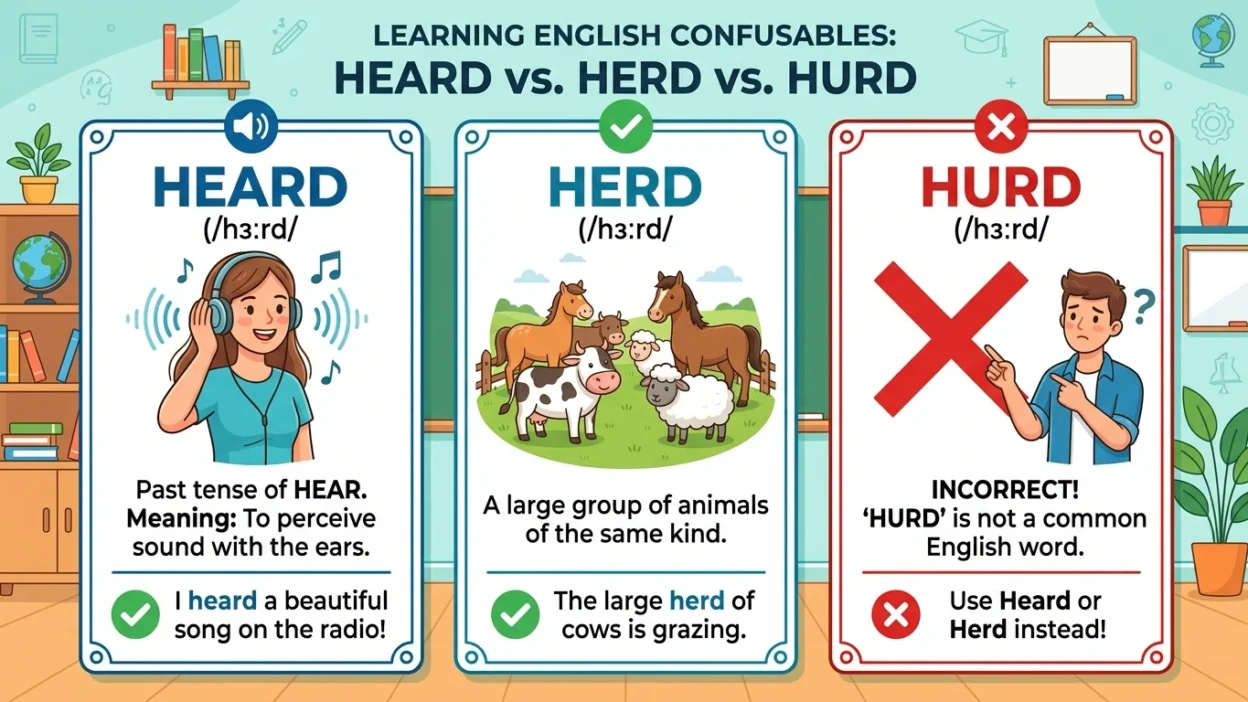
Many English learners confuse heard, herd, and hurd because they are pronounced similarly in many English accents. However, these words have completely different meanings and spellings. Knowing when to use each one will help you avoid common writing mistakes.
Understanding the difference between heard vs herd vs hurd will improve your vocabulary and make your English more accurate. This guide explains the meanings, pronunciation, examples, common mistakes, and an easy memory trick.
Quick Answer
Heard is the past tense of hear and means received a sound. Herd is a noun or verb related to a group of animals or gathering animals together. Hurd is not a standard English word and is usually a misspelling of heard or herd.
Why People Confuse It
The confusion happens because heard and herd are homophones, meaning they sound the same but have different meanings and spellings.
Some people also mistakenly write hurd, even though it is not a standard English word.
Heard
Heard is the past tense and past participle of hear.
Meaning
It means:
- Received or noticed a sound.
- Was told or learned something.
Examples
- I heard the phone ring.
- Have you heard the news?
- She heard someone knocking at the door.
- We heard beautiful music.
- He heard his name being called.
Herd
Herd can be a noun or a verb.
Meaning
As a noun, it means:
- A group of animals that live or move together.
As a verb, it means:
- To gather or move animals or people together.
Examples
- A herd of elephants crossed the road.
- The farmer owns a large herd of cattle.
- Cowboys herded the sheep into the field.
- We saw a herd of deer in the forest.
- The dogs helped herd the sheep.
Hurd
Hurd is not a standard English word.
It is usually a spelling mistake for heard or herd.
Always check the context and choose the correct word.
Comparison Table
| Feature | Heard | Herd | Hurd |
|---|---|---|---|
| Correct standard English | ✅ Yes | ✅ Yes | ❌ No |
| Part of speech | Verb | Noun / Verb | Not a standard word |
| Related to sound | ✅ Yes | ❌ No | ❌ No |
| Related to animals | ❌ No | ✅ Yes | ❌ No |
| Suitable for formal writing | ✅ Yes | ✅ Yes | ❌ No |
When to Use Each
Use heard when:
- Talking about listening or receiving sounds.
- Referring to news or information.
Use herd when:
- Referring to a group of animals.
- Talking about gathering animals or people.
Never use hurd in standard English.
Examples
- I heard the alarm this morning.
- She heard a loud noise outside.
- Have you heard the latest announcement?
- We heard birds singing at sunrise.
- He heard the teacher’s instructions clearly.
- A herd of cows grazed in the field.
- The shepherd herded the sheep safely.
- We spotted a herd of buffalo.
- The ranch has a large herd of horses.
- Farmers often herd cattle using dogs.
- I heard someone calling my name.
- The herd moved across the valley together.
Common Mistakes
Many learners make these errors.
- Writing herd when they mean heard.
- Spelling heard as hurd.
- Using hurd because it sounds like the other two words.
Correct:
- I heard the music.
- We saw a herd of deer.
Incorrect:
- I herd the music.
- We saw a heard of deer.
- I hurd the announcement.
Memory Trick
Remember this simple rule:
Heard = Hear = Sound.
Herd = Group of animals.
Hurd = Not a standard English word.
Think:
I heard a sound.
A herd of sheep.
American vs British English
There is no difference between American and British English.
Both varieties use heard and herd with the same meanings, while hurd is not accepted as a standard English word.
Similar Words
You may also confuse these homophones:
- Hear vs Here
- Their vs There vs They’re
- To vs Too vs Two
- Brake vs Break
- Bare vs Bear
- Allowed vs Aloud
- Weather vs Whether
- Whole vs Hole
- Sale vs Sail
- Pair vs Pear
Final Verdict
The difference between heard, herd, and hurd is simple once you know their meanings. Heard is the past tense of hear and relates to sounds or information. Herd refers to a group of animals or the act of gathering them. Hurd is not a standard English word and should be avoided.
By remembering Heard = Sound and Herd = Animals, you’ll choose the correct spelling every time.
Remember This
Heard = Past tense of hear. ✅
Herd = A group of animals or gathering them. ✅
Hurd = Incorrect spelling. ❌
FAQs
What is the difference between heard and herd?
Heard is the past tense of hear, while herd refers to a group of animals or the act of gathering them.
Is hurd a real word?
No. Hurd is not a standard English word and is usually a misspelling.
Which is correct, I heard or I herd?
I heard is correct because it refers to hearing a sound.
What is a herd?
A herd is a group of animals, such as cows, elephants, or deer, that live or move together.
Are heard and herd pronounced the same?
Yes. In most English accents, heard and herd are homophones.
Do British and American English use these words differently?
No. Both varieties use heard and herd in the same way.
How can I remember the difference?
Remember: heard contains hear, so it relates to sound. Herd refers to animals moving together.
Conclusion
Although heard, herd, and hurd may sound alike, they have very different meanings. Heard is the correct word when talking about sounds or information, while herd refers to a group of animals or the action of gathering them. Hurd is simply a misspelling and should not be used in standard English.
Learning this distinction will help you avoid common homophone errors and improve both your spoken and written English.

Nancy Lisa is a passionate writer and contributor at DrameyHut, focused on uncovering the deeper meanings behind dreams. She creates engaging and insightful content that helps readers interpret their dreams and understand their subconscious thoughts. Her work inspires self-reflection, clarity, and a stronger connection to inner emotions.