Many English learners come across the phrase day well spent in conversations, social media captions, and everyday writing. While it sounds simple, people often wonder if it is grammatically correct, when to use it, and how it differs from similar expressions like well spent day or a day well spent.
Understanding the correct day well spent usage will help you express satisfaction after a productive, enjoyable, or meaningful day. This guide explains the meaning, grammar, examples, common mistakes, and alternatives.
Quick Answer
Day well spent is a correct English expression. It means a day used productively, happily, or meaningfully. The most natural form is a day well spent, although day well spent is also common as a caption or short phrase.
Why People Confuse It
The confusion happens because day well spent is often used without an article in social media captions.
In complete sentences, native speakers usually say a day well spent or it was a day well spent.
Day Well Spent
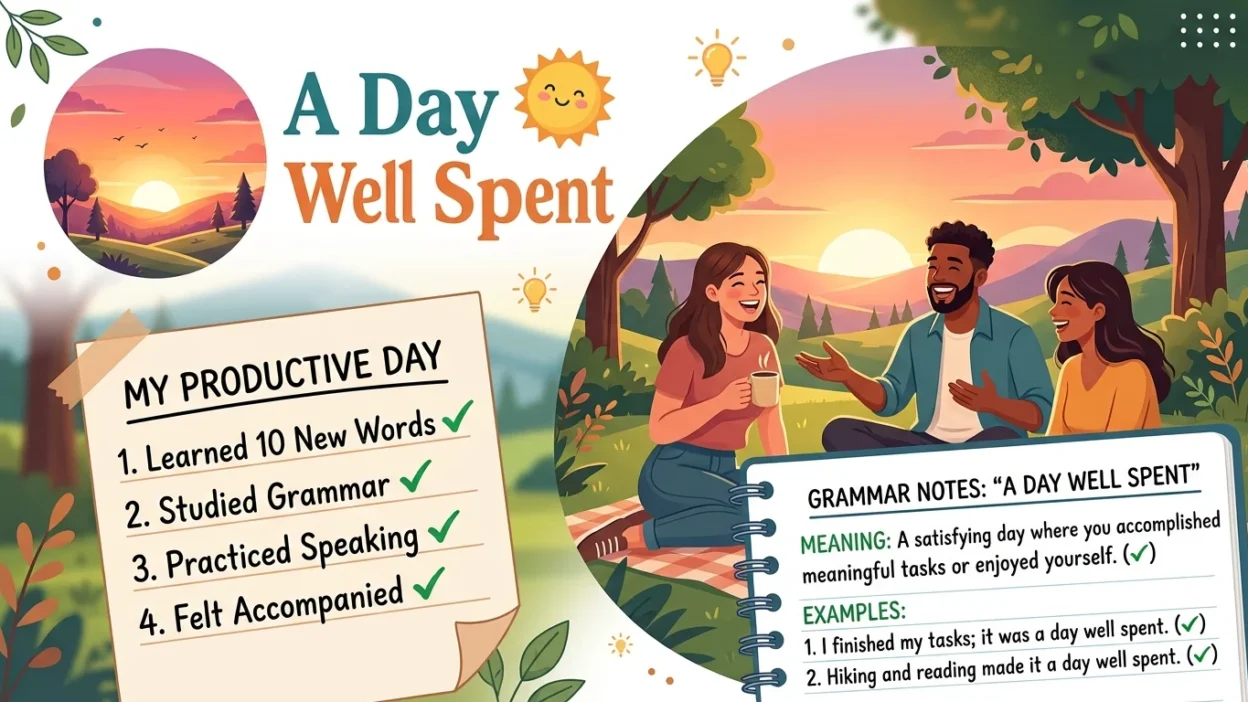
Day well spent is a phrase describing a day that was worthwhile or enjoyable.
Meaning
It refers to a day that was used in a satisfying, productive, or memorable way.
Examples
- A day well spent with family.
- A day well spent exploring the city.
- It was a day well spent learning new skills.
- After the hike, we agreed it was a day well spent.
- Every volunteer felt it was a day well spent.
Well Spent Day
Well spent day is also grammatically correct but is less common than a day well spent.
Meaning
It describes a day that was used wisely or productively.
Examples
- We enjoyed a well spent day at the beach.
- It was a well spent day full of learning.
Most native speakers prefer a day well spent because it sounds more natural.
Comparison Table
| Feature | Day Well Spent | A Day Well Spent | Well-Spent Day |
|---|---|---|---|
| Grammatically correct | ✅ Yes (as a phrase) | ✅ Yes | ✅ Yes |
| Most natural in sentences | ❌ Usually not | ✅ Yes | Sometimes |
| Common as a social media caption | ✅ Yes | ✅ Yes | Less common |
| Common in formal writing | Less common | ✅ Yes | Less common |
When to Use Each
Use day well spent when:
- Writing a short caption.
- Posting on social media.
- Adding a photo description.
Use a day well spent when:
- Writing complete sentences.
- Speaking naturally.
- Writing emails, blogs, or stories.
Use well-spent day only when you want to place the description before the noun.
Examples
- It was a day well spent with my family.
- Today was a day well spent.
- We enjoyed a day well spent outdoors.
- Day well spent with amazing friends.
- Day well spent doing what I love.
- After volunteering, it truly felt like a day well spent.
- Every moment made it a day well spent.
- We ended the trip feeling it was a day well spent.
- Learning something new made it a day well spent.
- Day well spent, memories forever.
- We had a well-spent day at the museum.
- It was truly a day well spent.
Common Mistakes
Many learners make these errors.
- Using day well spend instead of day well spent.
- Forgetting the article a in complete sentences.
- Assuming well spent day is always more natural.
Correct:
- It was a day well spent.
Caption:
- Day well spent.
Incorrect:
- It was day well spent.
- Day well spend.
Memory Trick
Remember this simple rule:
For captions:
Day well spent. ✅
For complete sentences:
It was a day well spent. ✅
American vs British English
There is no difference between American and British English.
Both varieties commonly use a day well spent in speech and writing, while day well spent is popular in captions and informal posts.
Similar Words
You may also use these expressions:
- Time well spent
- Evening well spent
- Weekend well spent
- Productive day
- Memorable day
- Rewarding day
- Meaningful day
- Great day
- Wonderful day
- Fulfilling day
Final Verdict
Day well spent is a correct and popular expression, especially in captions and informal writing. For complete sentences, a day well spent is the most natural and grammatically preferred choice.
If you’re writing a social media post, Day well spent works perfectly. If you’re writing an article, email, or story, choose It was a day well spent for smoother, more natural English.
Remember This
Day well spent ✅ Best for captions.
A day well spent ✅ Best for complete sentences.
Day well spend ❌ Incorrect.
FAQs
Is day well spent grammatically correct?
Yes. It is correct as a phrase or caption. In a full sentence, a day well spent is more natural.
Which is correct, day well spent or a day well spent?
Both are correct, but a day well spent is preferred in complete sentences.
Can I use day well spent as an Instagram caption?
Yes. Day well spent is a very common and natural social media caption.
Is well-spent day correct?
Yes, but it is less common than a day well spent.
What does day well spent mean?
It means a day that was enjoyable, productive, meaningful, or worthwhile.
Is there a difference between British and American English?
No. Both varieties use the expression in the same way.
What is another way to say day well spent?
You can say time well spent, a productive day, a rewarding day, or a memorable day.
Conclusion
The phrase day well spent is widely used to express satisfaction after a meaningful, enjoyable, or productive day. While it works well as a short caption, the more natural choice in full sentences is a day well spent.
Whether you’re sharing travel photos, reflecting on a successful day, or describing a memorable experience, using the correct form will make your English sound more fluent and polished.

Daniel Charles is a dedicated author and dream interpretation enthusiast at DrameyHut. He specializes in analyzing dream symbols and meanings, offering clear and insightful content for readers. His work aims to help individuals understand their subconscious thoughts, gain clarity, and explore the deeper messages hidden within their dreams.