“If she was” and “if she were” can both be correct, but they are used for different situations. The main difference is whether you are talking about a real or possible situation in the past or an imaginary, hypothetical, or unlikely situation.
The most important rule is simple:
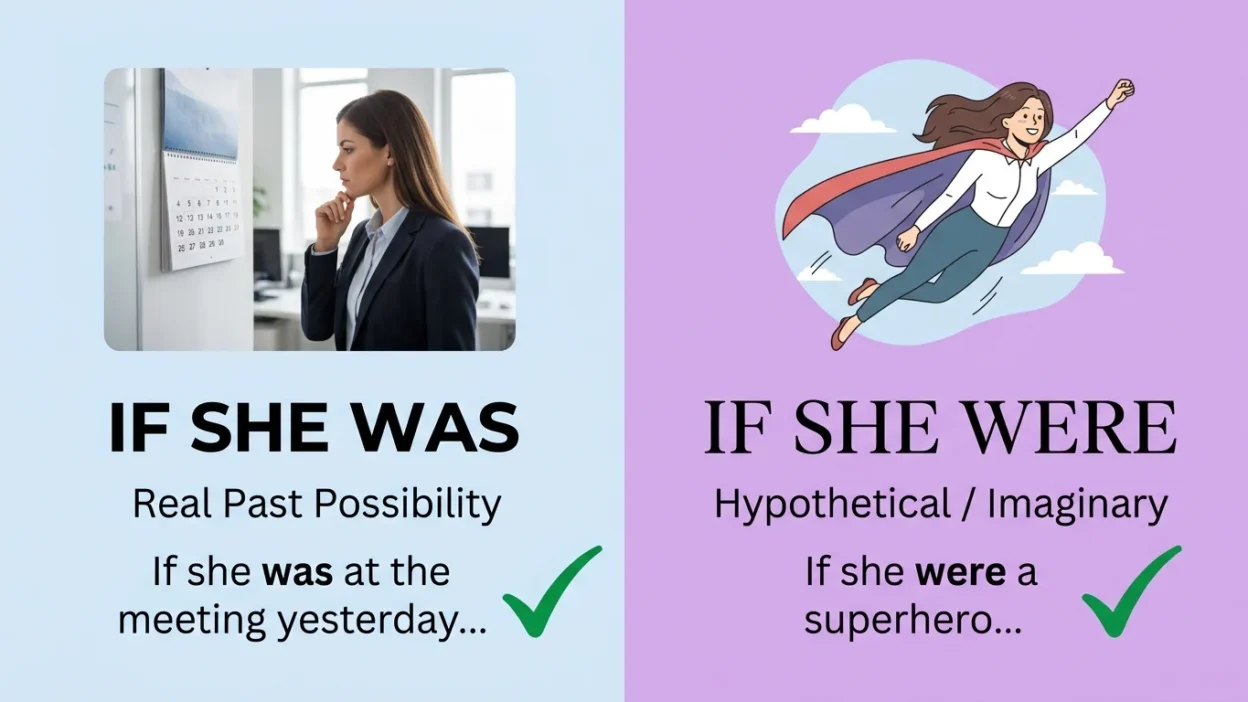
If she was = a real or possible past situation
If she were = a hypothetical or unreal situation
Quick Answer
Use “if she was” when you are discussing something that may actually have happened in the past.
If she was tired, she probably went home.
Use “if she were” for an imaginary, hypothetical, or unlikely situation.
If she were here, she would help us.
“If she were” is traditionally called the subjunctive form.
If She Was
“If she was” is generally used when the condition refers to a real possibility or an actual past situation.
Examples
If she was at the party, I didn’t see her.
The speaker does not know whether she was there, but being there is a real possibility.
If she was tired, she probably went to bed early.
It is possible that she was tired.
If she was upset yesterday, she didn’t show it.
The speaker is considering something that may actually have happened.
Pattern
If + subject + was + past situation
If she was sick, she stayed home.
If she was angry, I didn’t notice.
If She Were
“If she were” is used for a hypothetical, imaginary, or contrary-to-fact situation.
Examples
If she were here, she would help us.
She is not here, or the speaker is imagining a situation in which she is here.
If she were my boss, I would be nervous.
The speaker is imagining her being their boss.
If she were taller, she could reach the shelf.
The speaker is suggesting a hypothetical condition.
The Subjunctive “Were”
In traditional English grammar, were is used instead of was in hypothetical conditions with I, he, she, and it.
Compare:
If she were here, we could ask her.
If I were you, I would apologize.
If he were more careful, he wouldn’t make so many mistakes.
This is known as the irrealis subjunctive or simply the subjunctive mood.
The especially common expression is:
If I were you…
Not:
If I was you…
“If I were you” is the standard form in careful or formal English.
Comparison Table
| Expression | Typical Meaning | Example |
|---|---|---|
| If she was | Possible or real past situation | If she was tired, she went home. |
| If she were | Hypothetical or unreal situation | If she were here, she would help. |
| If I was | Possible past situation | If I was rude, I’m sorry. |
| If I were | Hypothetical situation | If I were you, I’d leave. |
Compare These Two Sentences
If she was here
If she was here, I didn’t see her.
This means you are unsure whether she was actually there.
Her being there is a possibility in the past.
If she were here
If she were here, she would help us.
This presents her presence as hypothetical or contrary to fact.
The implied meaning is often that she isn’t here.
Another Important Difference
The difference becomes particularly clear when the main clause uses would.
If she were here, she would help us.
This is a classic hypothetical conditional.
But you can also use was when talking about a possible past condition:
If she was there, she would have seen what happened.
Here, the speaker is considering whether she actually was there.
Common Mistakes
“If she was here, she would help us”
This sentence is not always wrong. In informal English, was is sometimes used instead of were for hypothetical situations.
However, in traditional and formal English:
✅ If she were here, she would help us.
is the preferred form when the situation is hypothetical or contrary to fact.
“If she were at the party yesterday”
If you’re simply uncertain whether she actually attended a past event, was is generally more appropriate:
If she was at the party yesterday, I didn’t see her. ✅
Using were would make the situation sound more hypothetical or detached from reality.
Memory Trick
Ask yourself:
Did it possibly happen? → WAS
Am I imagining it? → WERE
For example:
If she was sick, she stayed home.
Maybe she really was sick.
If she were sick, she would stay home.
You’re imagining a hypothetical situation.
American vs British English
Both American and British English traditionally use were for hypothetical or contrary-to-fact conditions:
If she were here…
However, was is increasingly heard in informal speech, particularly in hypothetical constructions.
For formal writing, academic writing, and careful English, were remains the safest choice for clearly hypothetical situations.
Quick Examples
Real or possible:
If she was angry, she didn’t show it.
Hypothetical:
If she were angry, she would tell us.
Real or possible past event:
If she was at the meeting, I didn’t notice her.
Imaginary situation:
If she were at the meeting, she would probably disagree.
Advice:
If I were you, I would wait.
Final Verdict
The basic distinction is:
If she was → a real or possible situation, especially in the past.
If she were → an imaginary, hypothetical, or contrary-to-fact situation.
So:
If she was tired, she probably went home. ✅
If she were here, she would help us. ✅
And for the famous expression:
If I were you, I would do it. ✅
Easy Rule to Remember
Was = possibility
Were = hypothetical
“If I were you” = standard fixed pattern
Conclusion
The difference between “if she was” and “if she were” depends mainly on whether you are talking about a possible real situation or a hypothetical situation. Use “if she was” when referring to something that may have actually happened, especially in the past. Use “if she were” when imagining an unreal, unlikely, or hypothetical situation.
A simple way to remember the difference is “was” for possibility and “were” for hypothetical situations. For example, “If she was tired, she went home” suggests that she may really have been tired, while “If she were here, she would help us” describes an imagined situation. For formal and careful English, “if she were” is the preferred form for hypothetical conditions.

Daniel Charles is a dedicated author and dream interpretation enthusiast at DrameyHut. He specializes in analyzing dream symbols and meanings, offering clear and insightful content for readers. His work aims to help individuals understand their subconscious thoughts, gain clarity, and explore the deeper messages hidden within their dreams.