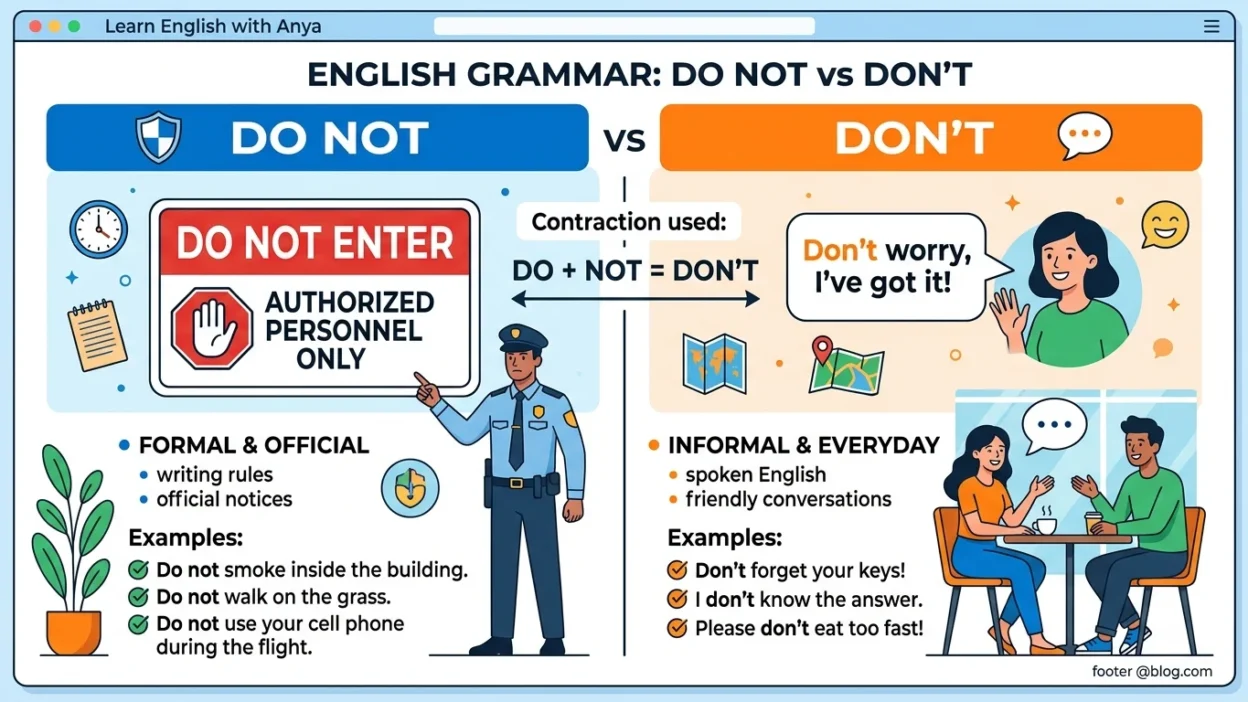
“Do not” and “don’t” have the same basic meaning. Both are used to make a negative statement or command. The main difference is formality and emphasis.
Do not is the full form and sounds more formal, direct, or emphatic. Don’t is the contraction and is more common in everyday conversation and informal writing.
Quick Answer
Do not = formal or emphatic
Don’t = informal and conversational
For example:
Do not touch the equipment.
Don’t touch the equipment.
Both are grammatically correct and mean the same thing, but “do not” sounds more formal and forceful.
Do Not
Do not is the full form of the negative auxiliary do.
It is commonly used in:
- Formal writing
- Official instructions
- Warnings
- Rules and regulations
- Academic writing
- Professional communication
- Strong commands
Examples
Do not enter this room.
Do not share your password.
Do not use your phone during the exam.
Do not forget to submit the form.
Please do not disturb the meeting.
Using do not can make a statement sound more serious or authoritative.
Don’t
Don’t is the contraction of do not.
It is extremely common in everyday English.
Examples
Don’t touch that.
Don’t worry.
Don’t be late.
Don’t forget your keys.
Don’t tell anyone.
In casual conversation, don’t is generally more natural than do not.
Comparison Table
| Expression | Meaning | Tone | Example |
|---|---|---|---|
| Do not | Negative command or statement | Formal, direct, emphatic | Do not enter. |
| Don’t | Negative command or statement | Informal, conversational | Don’t enter. |
When to Use “Do Not”
Use do not when you want your writing to sound formal, official, or particularly emphatic.
Signs and Warnings
Do not touch.
Do not enter.
Do not park here.
Formal Writing
Employees do not need to submit additional documents.
These results do not support the hypothesis.
Emphasis
Sometimes do not is deliberately used instead of don’t to emphasize the negative.
Do not tell anyone about this.
This can sound much stronger than:
Don’t tell anyone about this.
When to Use “Don’t”
Use don’t when writing or speaking naturally and conversationally.
Everyday Conversation
I don’t know.
I don’t understand.
Don’t worry.
Don’t forget.
Informal Messages
Don’t forget to call me.
I don’t think that’s right.
Don’t be late.
The contraction makes the language sound more relaxed and natural.
Do Not vs Don’t in Commands
Both forms can be used for negative commands.
Do not touch the screen.
Don’t touch the screen.
The difference is mainly tone.
Do not touch the screen.
More formal or authoritative.
Don’t touch the screen.
More conversational.
Do Not vs Don’t in Statements
Both can also be used in ordinary negative statements.
I do not understand.
I don’t understand.
The first sounds more formal or emphatic.
The second is much more natural in everyday conversation.
Compare:
I do not agree with this decision.
This can sound formal, serious, or strongly emphatic.
I don’t agree with this decision.
This sounds more conversational.
Common Mistakes
Writing “dont”
❌ I dont know.
✅ I don’t know.
The contraction requires an apostrophe because don’t is short for do not.
Using “do not” when the tone is too formal
In casual conversation:
I do not know what you’re talking about.
This is grammatically correct but can sound unusually formal.
More natural:
I don’t know what you’re talking about.
Confusing “don’t” with “doesn’t”
Use don’t with I, you, we, and they.
I don’t know.
They don’t agree.
Use doesn’t with he, she, and it.
She doesn’t know.
He doesn’t agree.
Do Not vs Don’t for Emphasis
One important point is that do not can be used for emphasis even in informal speech.
For example:
I do not want to go.
This can strongly emphasize the speaker’s refusal.
Compare:
I don’t want to go.
This is neutral.
I do not want to go.
This can sound much more forceful.
American vs British English
Both do not and don’t are standard in American and British English.
There is no major difference in meaning between the two varieties.
The main distinction is style and context.
Quick Examples
Formal:
Please do not share this information.
Casual:
Please don’t share this information.
Strong emphasis:
Do not touch that!
Everyday speech:
Don’t touch that!
Formal statement:
I do not agree with the proposal.
Conversational statement:
I don’t agree with the proposal.
Final Verdict
“Do not” and “don’t” mean the same thing, but they create different tones.
Use do not for formal writing, official instructions, warnings, or emphasis.
Use don’t for everyday conversation, informal writing, and natural conversational English.
The best simple rule is:
Do not = formal or emphatic
Don’t = casual and conversational
So both are correct:
Do not worry. ✅
Don’t worry. ✅
The second is usually more natural in everyday conversation, while the first can sound more formal or emphatic.
FAQs
Is “do not” the same as “don’t”?
Yes. Don’t is simply the contraction of do not, so they have the same basic meaning.
Is “do not” more formal than “don’t”?
Yes. Do not generally sounds more formal, direct, or emphatic, while don’t is more conversational.
Is “don’t” grammatically correct?
Yes. Don’t is a standard contraction of do not and is completely correct in appropriate contexts.
Should I use “do not” or “don’t” in formal writing?
Do not is generally preferable in formal or official writing, although contractions are not automatically grammatically incorrect in all formal contexts.
Which is better for everyday conversation?
Don’t is usually more natural.
I don’t know.
Don’t worry.
Does “do not” add emphasis?
It can. Saying “I do not agree” can sound stronger or more deliberate than “I don’t agree.”
Conclusion
Do not and don’t are grammatically equivalent, but their tone is different. Do not is generally used for formal situations, official instructions, warnings, and emphasis, while don’t is the natural choice for most everyday conversations and informal writing.
Remember the simple rule: “do not” sounds formal or emphatic, while “don’t” sounds conversational. Choose the form that matches the tone you want.

Daniel Charles is a dedicated author and dream interpretation enthusiast at DrameyHut. He specializes in analyzing dream symbols and meanings, offering clear and insightful content for readers. His work aims to help individuals understand their subconscious thoughts, gain clarity, and explore the deeper messages hidden within their dreams.