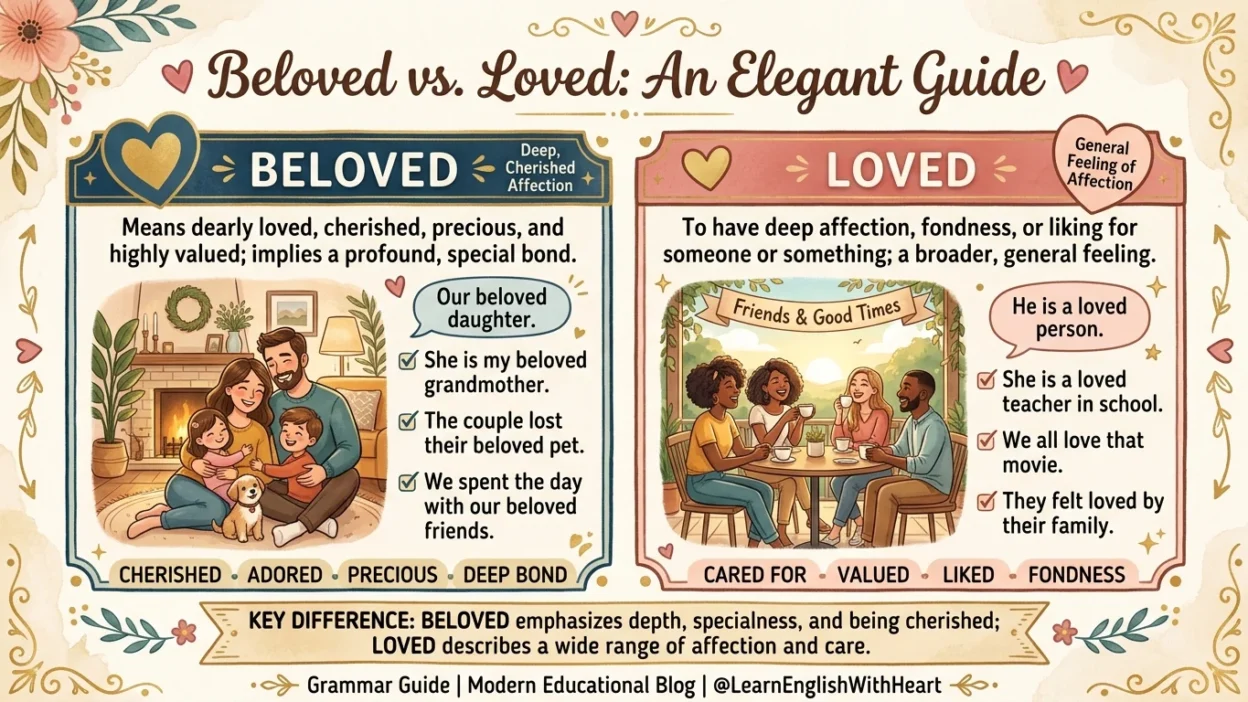
Beloved and loved both describe someone or something that is deeply cared for, but they are not always interchangeable. The main difference is degree, tone, and usage.
Loved is the ordinary past tense and past participle of love. Beloved means deeply loved, greatly cherished, or dearly loved and often sounds warmer, more emotional, or more literary.
Quick Answer
Loved means someone received love or was cared about.
Beloved means someone or something was deeply and dearly loved.
She was loved by her family.
She was beloved by her family.
Both are correct, but beloved expresses a stronger sense of affection and cherished status.
Loved
Loved is the past tense and past participle of love.
It is the normal, everyday word used to describe affection or strong positive feelings.
Examples
- Her parents loved her very much.
- He loved his wife deeply.
- The children loved the movie.
- She felt loved by her family.
- He was loved by everyone who knew him.
Loved can describe romantic love, family affection, friendship, or enjoyment.
I loved the book.
Here, loved simply means you liked or enjoyed the book very much.
Beloved
Beloved means deeply loved, dearly loved, or greatly cherished.
It often carries a stronger emotional quality than loved.
Examples
- She was a beloved mother and grandmother.
- He was a beloved member of the community.
- The town said goodbye to its beloved teacher.
- She returned to her beloved hometown.
- The actor was beloved by millions of fans.
Beloved is particularly common in descriptions of people who are greatly admired and cherished by many.
Comparison Table
| Word | Meaning | Tone | Example |
|---|---|---|---|
| Loved | Received love or affection | Neutral, everyday | She was loved by her family. |
| Beloved | Deeply or dearly loved | Warm, emotional, sometimes literary | She was a beloved member of the community. |
The Main Difference
The easiest way to understand the distinction is:
Loved = cared for
Beloved = deeply cherished
Compare:
He was loved by his friends.
This simply tells us that his friends cared about him.
He was beloved by his friends.
This suggests that he was especially cherished and held in great affection.
The difference is not always a strict difference in degree. Context and tone matter.
Beloved Is Often Used Before a Noun
Beloved is very common as an adjective placed directly before a noun.
Her beloved husband
His beloved dog
Our beloved teacher
The city’s beloved team
A beloved character
This construction often expresses strong emotional attachment.
Beloved Can Also Come After a Verb
Beloved can also function as a past participle.
She was beloved by her family.
He became beloved throughout the country.
The character is beloved by fans.
However, this use tends to sound more formal or literary than simply saying loved.
Loved vs Beloved in Different Situations
Romantic Relationships
Both can be used:
She was deeply loved by her husband.
She was beloved by her husband.
The second sounds more poetic or emotionally expressive.
Family
He was loved by his children.
He was a beloved father.
The second is especially natural when describing someone’s character or legacy.
Public Figures
Beloved is particularly common when talking about someone admired by a large group of people.
The beloved actor died at the age of 80.
She was a beloved leader.
Objects and Places
Beloved can describe things that someone feels strong affection for.
My beloved hometown
Her beloved childhood home
His beloved old car
Loved is also possible, but often sounds more ordinary:
This is a car I really loved.
Common Mistakes
Thinking beloved means only “dead”
No. Beloved does not necessarily mean that someone has died.
She is a beloved teacher.
This means students and others deeply cherish her. She can be alive.
However, beloved is frequently used in memorial contexts:
He was a beloved father who will be deeply missed.
Assuming beloved always means romantic love
Not necessarily.
You can have:
- A beloved parent
- A beloved friend
- A beloved teacher
- A beloved pet
- A beloved hometown
- A beloved character
It simply indicates deep affection or cherished status.
Using “beloved” when ordinary “loved” sounds more natural
In casual conversation, loved is often the better choice.
I loved that movie. ✅
I beloved that movie. ❌
Beloved is not the normal past tense of love.
Important Grammar Point
Do not use beloved as a replacement for loved in every sentence.
❌ I beloved the movie.
✅ I loved the movie.
But:
✅ My beloved movie
Here, beloved is an adjective meaning something that is dearly loved.
Memory Trick
Think:
Loved = received love
Beloved = deeply cherished
And remember:
Love → loved
Beloved = adjective
So:
I loved her. ✅
She was my beloved friend. ✅
American vs British English
Both loved and beloved are standard in American and British English.
The difference is mainly one of tone and usage, not regional grammar.
Loved is more common in ordinary conversation.
Beloved is more emotional, affectionate, formal, or literary.
Similar Words
Similar to Loved
- Cared for
- Adored
- Liked
- Appreciated
- Cherished
Similar to Beloved
- Dear
- Dearly loved
- Cherished
- Adored
- Treasured
- Precious
- Much loved
Final Verdict
Loved is the normal form of the verb love and means that someone or something received love or affection.
Beloved means deeply or dearly loved and is usually more emotional and expressive.
She was loved by her family. ✅
She was a beloved member of the family. ✅
The easiest way to remember it is:
Loved = received love
Beloved = deeply cherished
Remember This
Loved → ordinary expression of affection ✅
Beloved → deeply cherished or dearly loved ✅
I loved the movie. ✅
She is a beloved teacher. ✅
He was loved by his parents. ✅
He was a beloved father. ✅
FAQs
What is the difference between beloved and loved?
Loved simply means receiving love or affection. Beloved means deeply or dearly loved and usually carries a warmer, stronger, or more emotional tone.
Does beloved mean loved very much?
Generally, yes. Beloved describes someone or something that is deeply cherished or dearly loved.
Is beloved only used for someone who has died?
No. A living person can absolutely be beloved.
She is a beloved teacher.
However, the word is also frequently used when speaking about someone who has died.
Can beloved be used for things?
Yes. You can describe a place, object, animal, character, or idea as beloved.
His beloved hometown
Her beloved dog
Is “I beloved you” correct?
No.
❌ I beloved you.
✅ I loved you.
Beloved is not the ordinary past tense of love.
Is beloved more formal than loved?
Usually, yes. Beloved often sounds more emotional, literary, ceremonial, or affectionate than loved.
Is “beloved” a verb?
In modern standard English, beloved is primarily used as an adjective or as the past participle in constructions such as “was beloved by many.” The normal past tense of love is loved.
Conclusion
Although beloved and loved are closely related, they create different impressions. Loved is the normal, everyday word for receiving affection, while beloved suggests that someone or something is deeply cherished and held in special affection.
When you want a simple, natural expression, use loved. When you want to emphasize deep affection, admiration, or emotional importance, beloved is often the better choice.

Christopher Thomas is a passionate writer and dream researcher dedicated to exploring the meanings behind dreams. As an author at DrameyHut, he creates insightful and easy-to-understand interpretations that help readers connect with their subconscious mind. His work focuses on guiding individuals toward self-discovery, clarity, and a deeper understanding of their inner thoughts.