
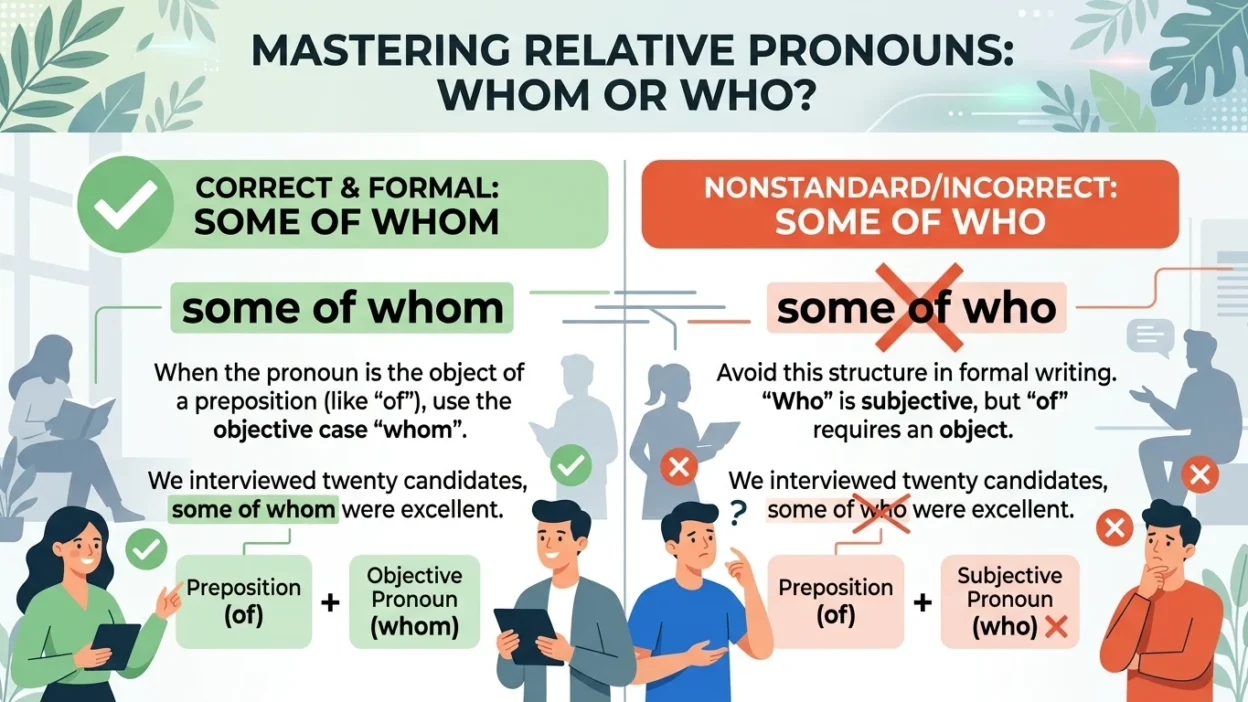
Choosing between “some of whom” and “some of who” can be confusing, especially because “who” is much more common in everyday English. The two expressions look almost identical, but only one is traditionally considered grammatically correct when it follows a preposition or functions as an object.
The correct expression is generally “some of whom.” The word whom is used because it is the object of the preposition of. However, “some of who” can occasionally appear in informal or nonstandard English, but it is not the preferred choice in careful writing.
In this guide, we will explain some of whom vs some of who, the grammar behind the difference, examples, common mistakes, useful alternatives, and an easy way to remember which form to use.
Quick Answer: Some of Whom vs Some of Who
“Some of whom” is the standard grammatically correct expression when referring to people. After the preposition of, use the object pronoun whom, not the subject pronoun who.
Correct:
I met several students, some of whom were from Canada.
Usually incorrect in formal English:
I met several students, some of who were from Canada.
Easy rule: When you can replace the word with him/her/them, use whom.
Why People Confuse “Some of Whom” and “Some of Who”
The confusion happens because who is much more common than whom in modern English.
In everyday conversation, many native speakers use who in situations where traditional grammar would prescribe whom.
For example:
Who did you invite?
Traditionally, whom would be preferred:
Whom did you invite?
However, “who” has become extremely common in informal English.
With the expression “some of ___,” the grammatical structure is clearer because of is a preposition.
For example:
Some of them
Therefore:
Some of whom
is the standard relative pronoun structure.
Some of Whom
“Some of whom” is the standard form used when referring to a group of people.
It usually appears in a relative clause and means “some of those people.”
For example:
I interviewed ten candidates, some of whom had extensive experience.
This means:
I interviewed ten candidates, and some of those candidates had extensive experience.
The word whom represents the people being referred to and functions as the object of of.
Examples of “Some of Whom”
She has several friends, some of whom live abroad.
We invited twenty guests, some of whom arrived early.
He works with many doctors, some of whom specialize in cardiology.
The company hired several employees, some of whom had previous experience.
I read several books, some of which were extremely helpful.
Notice that whom is used for people, while which is used for things.
Some of Who
“Some of who” is generally not considered the standard grammatical construction in formal English.
For example:
I met several students, some of who were from France.
This sentence is commonly understood, but traditional grammar recommends:
I met several students, some of whom were from France.
The problem is that who is a subject pronoun, while whom is the object form.
Since of is a preposition, the traditional grammatical structure requires its object:
of + whom
rather than:
of + who
In informal speech, however, people sometimes use “who” more broadly because whom is becoming less common in everyday English.
Some of Whom vs Some of Who: Comparison Table
| Expression | Standard Grammar | Usage | Example |
|---|---|---|---|
| Some of whom | Correct | Formal and standard writing | I met several people, some of whom were teachers. |
| Some of who | Nonstandard in this structure | Informal/nonstandard usage | I met several people, some of who were teachers. |
The safest choice is “some of whom.”
When to Use “Some of Whom”
Use “some of whom” when you are referring to some members of a previously mentioned group of people.
The structure is:
noun + , some of whom + verb
For example:
She has five brothers, some of whom live overseas.
The noun brothers establishes the group. Some of whom then refers to some members of that group.
Another example:
We interviewed several applicants, some of whom had impressive qualifications.
Here, some of whom refers back to applicants.
This construction is especially useful in formal writing, academic writing, reports, journalism, and professional communication.
Examples of “Some of Whom”
Here are more examples:
- I invited several colleagues, some of whom could not attend.
- She knows many writers, some of whom have won awards.
- We met several tourists, some of whom were visiting for the first time.
- The school has many teachers, some of whom have worked there for decades.
- He interviewed several candidates, some of whom had excellent qualifications.
- The company employs hundreds of people, some of whom work remotely.
- I spoke with several customers, some of whom had experienced the same problem.
- They invited many guests, some of whom stayed until midnight.
- She has worked with several organizations, some of whom offered her new opportunities.
- The conference attracted many researchers, some of whom presented their latest findings.
- We contacted several experts, some of whom agreed to participate.
- He has met many politicians, some of whom he considers close friends.
How to Know Whether to Use Who or Whom
The easiest method is to determine whether the pronoun functions as a subject or an object.
Use “who” for the subject
Who called you?
Here, who performed the action of calling.
You can think:
He called.
So who is correct.
Use “whom” for the object
Whom did you call?
Here, the person received the action.
You can think:
I called him.
Because him is the object form, whom is traditionally correct.
The same test works with some of whom.
Some of whom
can be understood as:
Some of them
Because them is an object pronoun, whom is the traditional grammatical choice.
The “Him/Her/They” Test
A quick memory trick is the him/her/them test.
If the answer would be he/she/they, use who.
If the answer would be him/her/them, use whom.
For example:
I met several people, some of whom were teachers.
Ask:
Some of who?
Replace it with a personal pronoun:
Some of them were teachers.
You would not say:
Some of they were teachers.
Therefore, whom is the correct traditional form.
Common Mistakes
Mistake 1: Writing “some of who”
Incorrect in standard formal English:
We interviewed ten people, some of who had experience.
Preferred:
We interviewed ten people, some of whom had experience.
Mistake 2: Thinking “who” is always correct for people
“Who” is the subject form, while “whom” is traditionally the object form.
Although modern English often uses “who” in place of “whom,” formal writing still commonly maintains the distinction.
Mistake 3: Avoiding “whom” because it sounds formal
Some people avoid “whom” because it can sound formal or old-fashioned.
However, “some of whom” is a very common and natural construction in formal and professional writing.
For example:
The organization supports many charities, some of which provide assistance to children.
and:
The organization works with many volunteers, some of whom provide assistance to children.
Both constructions are perfectly natural.
Mistake 4: Confusing “some of whom” with “some who”
These structures are different.
Some who attended the meeting left early.
Here, who is the subject of attended.
But:
Some of whom attended the meeting left early.
Here, whom follows of.
“Some Who” vs “Some of Whom”
This distinction is important.
Some who
“Some who” means some people who perform an action.
Some who attended the meeting left early.
Here, who is the subject of attended.
Some of whom
“Some of whom” means some members of a previously mentioned group.
We invited twenty people, some of whom attended the meeting.
Here, whom follows of.
Compare:
Some who attended the meeting left early.
with:
We invited twenty people, some of whom attended the meeting.
Both are correct, but they have different grammatical structures.
“Many of Whom” and Similar Expressions
The same rule applies to other expressions involving of.
You will commonly see:
many of whom
several of whom
most of whom
few of whom
all of whom
none of whom
For example:
She has interviewed many people, most of whom were very helpful.
We invited several guests, all of whom arrived on time.
He has worked with dozens of employees, many of whom became close friends.
These expressions are standard and widely used.
American vs British English
The distinction between who and whom exists in both American and British English.
However, both varieties have experienced a gradual decline in the everyday use of whom.
In casual conversation, native speakers often use who where traditional grammar would use whom.
Nevertheless, “some of whom” remains a standard and widely accepted construction in formal writing in both American and British English.
For professional, academic, or carefully edited writing, some of whom is the safest choice.
Similar Expressions
If you want to avoid using whom, you can sometimes rewrite the sentence.
Instead of:
I met several people, some of whom were doctors.
You could write:
I met several people, and some of them were doctors.
Both sentences are correct.
Another option is:
I met several people. Some of them were doctors.
These alternatives are particularly useful if you are writing for a casual audience and want simpler language.
However, “some of whom” is concise and elegant, especially in formal writing.
Is “Some of Whom” Too Formal?
No. “Some of whom” is formal or neutral, but it is not unnecessarily formal.
It is a standard grammatical construction and is common in professional and academic writing.
For example:
The study included 200 participants, some of whom had previously participated in similar research.
This sounds completely natural in academic writing.
In casual conversation, however, people may be more likely to say:
We talked to a bunch of people, and some of them had done the same thing.
The choice depends on your audience and writing style.
Final Verdict
“Some of whom” is the standard and preferred expression.
Use it when referring to some people from a previously mentioned group.
Correct: We interviewed several candidates, some of whom had extensive experience.
“Some of who” is generally considered nonstandard in this construction because who is the subject form, while whom is the traditional object form required after the preposition of.
The easiest way to remember the difference is to replace the expression with some of them. If “them” works, whom is the traditional choice.
FAQs
Is “some of whom” correct?
Yes. “Some of whom” is grammatically correct and is the standard form in formal and carefully edited English.
Is “some of who” grammatically correct?
“Some of who” is generally considered nonstandard in formal English. The preferred form is “some of whom.”
Why is it “some of whom” and not “some of who”?
Because whom is traditionally the object form of who, and it follows the preposition of. The phrase corresponds to “some of them.”
Can I use “some of whom” in academic writing?
Yes. “Some of whom” is particularly common and appropriate in academic, professional, formal, and carefully edited writing.
What is the difference between “some who” and “some of whom”?
“Some who” introduces people who perform an action, while “some of whom” refers back to members of a previously mentioned group.
For example:
Some who attended left early.
We invited several people, some of whom left early.
Is “whom” still used in modern English?
Yes. Although “whom” is less common in everyday speech than “who,” it remains widely used in formal writing and in established expressions such as “some of whom,” “many of whom,” and “all of whom.”
What is an easy way to remember “some of whom”?
Replace whom with them. If you would say “some of them,” then “some of whom” is the traditional grammatical form.
Conclusion
The difference between “some of whom” and “some of who” comes down to the traditional distinction between who and whom. Since whom follows the preposition of and represents the object, “some of whom” is the standard construction.
Although “who” is increasingly used instead of “whom” in everyday English, “some of whom” remains the safest and most polished choice for formal, academic, and professional writing. If you are ever unsure, remember the simple substitution test: some of them → some of whom.
Remember This
Some of whom = the standard form.
Use whom after of when referring to people in this construction.
We invited several people, some of whom attended.
Think:
some of them → some of whom
Avoid “some of who” in formal and carefully edited writing.

Christopher Thomas is a passionate writer and dream researcher dedicated to exploring the meanings behind dreams. As an author at DrameyHut, he creates insightful and easy-to-understand interpretations that help readers connect with their subconscious mind. His work focuses on guiding individuals toward self-discovery, clarity, and a deeper understanding of their inner thoughts.