“In which” and “where” are often interchangeable when talking about a place, location, situation, or context. This can make the choice confusing, especially in formal writing where small grammatical differences matter. Although both can introduce a relative clause, they are not always used in exactly the same way.
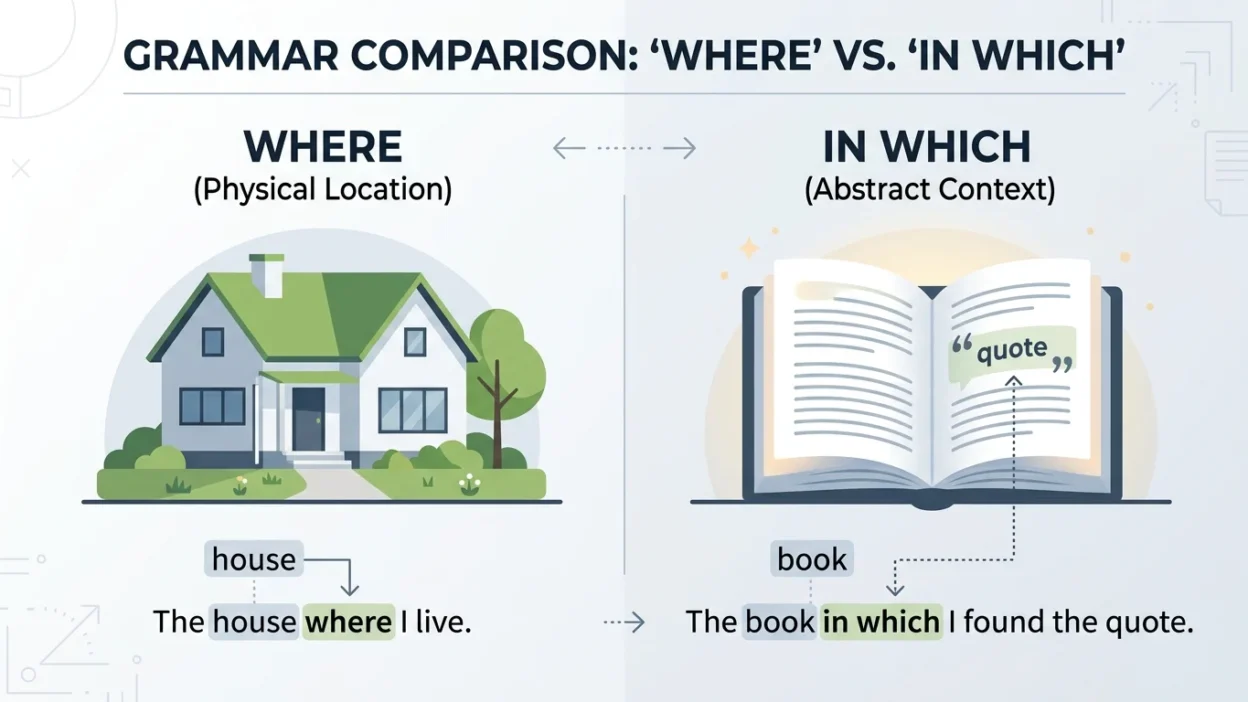
The easiest way to understand the difference is to look at what each expression refers to. “Where” is primarily used to refer to a place or location, while “in which” means “in which place,” “in which situation,” or “within which.”
“Where” is usually shorter and more natural in everyday English, whereas “in which” often sounds more formal and is particularly common in academic, legal, technical, and professional writing.
Quick Answer
“Where” and “in which” can both refer to a place or situation, but they are not identical. “Where” is more natural and conversational, while “in which” is generally more formal. For physical locations, both can often be used: “the house where I grew up” and “the house in which I grew up.”
Why Do People Confuse “In Which” and “Where”?
The confusion comes from the fact that both expressions can introduce a relative clause describing a place.
Compare:
This is the house where I grew up.
This is the house in which I grew up.
Both sentences are grammatically correct and have essentially the same meaning.
The main difference is style.
“Where” is simpler and more natural in everyday English.
“In which” is more formal and follows the structure of a preposition plus a relative pronoun.
There are also situations where “in which” can refer to something that is not a physical place, while “where” may sound less appropriate or more conversational.
Where
“Where” is commonly used as a relative adverb referring to a place or location.
For example:
This is the restaurant where we had dinner.
Here, “where” refers to the restaurant.
It can replace the more formal:
This is the restaurant in which we had dinner.
“Where” is very common in everyday English because it is concise and natural.
Examples of “Where”
- This is the house where I grew up.
- I remember the school where we first met.
- That is the restaurant where we had dinner.
- Do you know where she lives?
- This is the city where my parents were born.
- I found the place where we left the car.
- The hotel where we stayed was beautiful.
- She returned to the village where she was born.
- That is the office where he works.
- I visited the museum where the exhibition was held.
In Which
“In which” consists of the preposition “in” followed by the relative pronoun “which.”
It can refer to a place, situation, circumstance, system, process, or other context.
For example:
This is the house in which I grew up.
It has essentially the same meaning as:
This is the house where I grew up.
However, “in which” generally sounds more formal.
Examples of “In Which”
- This is the house in which I grew up.
- The building in which she works is very old.
- The city in which he was born has changed considerably.
- The room in which the meeting took place was small.
- The company in which she works has expanded rapidly.
- The situation in which we find ourselves is difficult.
- The environment in which children learn can affect their development.
- The system in which the data is stored requires updating.
- The circumstances in which the decision was made were unusual.
- The process in which the materials are converted requires careful monitoring.
Notice that “in which” does not have to refer to a physical place.
For example:
The situation in which we find ourselves is complicated.
Here, “situation” is not a physical location. “In which” means something like “in that situation.”
In Which vs Where: Comparison Table
| Feature | Where | In Which |
|---|---|---|
| Basic meaning | Refers to a place or location | Means in which place, situation, or context |
| Style | Neutral and conversational | More formal |
| Common in speech | Very common | Less common |
| Common in formal writing | Yes | Very common |
| Refers to physical places | Yes | Yes |
| Refers to situations | Sometimes | Very common |
| Refers to abstract contexts | Possible in some contexts | Often more precise |
| Example | The house where I live | The house in which I live |
When Can “Where” and “In Which” Be Interchanged?
They can often be interchanged when “where” refers to a physical place and “in which” has the literal meaning of being inside that place.
For example:
The room where we met was quiet.
The room in which we met was quiet.
Both are correct.
Another example:
The country where she was born is beautiful.
The country in which she was born is beautiful.
Again, both are grammatically correct.
The choice mainly depends on style and formality.
When Should You Use “Where”?
Use “where” when you want natural, concise English, especially in everyday conversation.
For example:
This is the place where we met.
This sounds very natural.
“Where” is also useful when you want your sentence to be easy to read.
Compare:
The restaurant where we had dinner was crowded.
with:
The restaurant in which we had dinner was crowded.
The first version is more conversational and usually feels less heavy.
When Should You Use “In Which”?
Use “in which” when you want a more formal or precise style.
It is especially common in:
- academic writing
- legal writing
- technical writing
- formal reports
- research papers
- professional documents
For example:
The study examined the conditions in which the participants performed the task.
This sounds appropriate in academic writing.
You could say:
The study examined the conditions where the participants performed the task.
This may be understandable, but “in which” is more precise and formal in this context.
“Where” Is Not Always a Replacement for “In Which”
This is an important point.
Although “where” and “in which” can sometimes be interchangeable, you should not assume that where can replace every occurrence of in which.
Consider:
The circumstances in which the decision was made were unusual.
“In which” clearly connects the decision to the circumstances.
Using “where” here:
The circumstances where the decision was made were unusual.
This is sometimes heard, especially in informal speech, but many editors would prefer “in which” because “circumstances” is an abstract noun rather than a physical location.
A more natural alternative would be:
The circumstances under which the decision was made were unusual.
Where vs In Which With Abstract Nouns
“In which” is particularly useful with abstract nouns.
For example:
The situation in which they found themselves was difficult.
The circumstances in which the agreement was reached were unusual.
The context in which the statement was made is important.
In these examples, the nouns are not physical places.
“Where” can sometimes be used metaphorically with abstract nouns, but “in which” often provides greater grammatical precision in formal writing.
In Which vs Where in Academic Writing
Academic writing often favors “in which” because it can make relationships between ideas more explicit.
For example:
This study examines the environment in which children develop language skills.
This is formal and precise.
In a less formal context, you might say:
This study examines where children develop language skills.
But that sentence can change the meaning. It may now sound as though the study is asking what location children develop language skills in, rather than describing the broader environment or circumstances.
Therefore, replacing “in which” with “where” can sometimes change the emphasis.
Common Mistakes
1. Thinking “In Which” Is Always Better
“In which” is not automatically better or more correct.
For example:
This is the restaurant where we ate.
is completely correct.
You do not need to use “in which” simply because you are writing formally.
2. Thinking “Where” Is Always Informal
“Where” is not incorrect or overly casual in formal writing.
For example:
The study describes the region where the samples were collected.
This can be perfectly acceptable.
3. Using “In Where”
Avoid combining the two expressions.
Incorrect:
This is the house in where I grew up.
Correct:
This is the house where I grew up.
or:
This is the house in which I grew up.
“Where” already carries the location relationship in this construction.
4. Using “In Which” Without the Correct Preposition
The preposition can change depending on the intended relationship.
For example:
The conditions under which the experiment was conducted were controlled.
Not:
The conditions in which the experiment was conducted were controlled.
“In which” is not a universal replacement for every preposition plus “which.”
Other possibilities include:
at which
The meeting at which we discussed the issue was productive.
on which
The day on which we met was memorable.
by which
The method by which the data was collected was reliable.
under which
The conditions under which the agreement was made were unusual.
In Which vs Which
“In which” and “which” are not always interchangeable.
Compare:
The house in which I live is old.
The house which I live is old.
The second sentence is not standard because “live” requires the location relationship.
You can instead say:
The house which I bought is old.
Here, “which” is the object of “bought.”
The preposition matters.
A Simple Rule to Remember
Use this rule:
Where = place or location.
In which = in that place, situation, or context.
For a physical location:
The house where I live.
The house in which I live.
Both are correct.
For an abstract situation:
The situation in which we found ourselves.
This is often more precise than using “where.”
American vs British English
There is no major difference between American and British English regarding “where” and “in which.”
Both varieties use “where” in everyday speech and “in which” in formal and written contexts.
For example:
American English:
The company where she works is expanding.
British English:
The company where she works is expanding.
Both are standard.
Similar Expressions
Depending on context, several other structures can express similar meanings.
In Which
The environment in which the experiment took place was controlled.
Where
The environment where the experiment took place was controlled.
In Which Context
The context in which the statement was made is important.
Within Which
“Within which” emphasizes something contained inside a particular boundary, system, or period.
The period within which the application must be submitted is thirty days.
At Which
Used when the relationship involves a specific point, event, or occasion.
The meeting at which the decision was made lasted two hours.
Under Which
Used for conditions, rules, or circumstances.
The conditions under which the agreement was signed were unusual.
Final Verdict
“Where” and “in which” can both refer to places, but “where” is generally simpler and more conversational, while “in which” is more formal and can refer to situations, circumstances, and abstract contexts.
For physical locations, both can often be used interchangeably:
The house where I grew up.
The house in which I grew up.
When discussing an abstract situation, “in which” is often more precise:
The situation in which we found ourselves was difficult.
The most useful rule is to remember that “where” focuses on a place or location, while “in which” can express the idea of being within a place, situation, or context.
Frequently Asked Questions
Is “in which” the same as “where”?
Not always, but they can have the same meaning when referring to a physical location. “In which” is generally more formal.
Which is more formal, “where” or “in which”?
“In which” generally sounds more formal and is common in academic, legal, technical, and professional writing.
Can I use “where” instead of “in which”?
Often, yes, when referring to a physical place.
The house where I live.
The house in which I live.
However, “where” is not always a suitable replacement when “in which” refers to an abstract situation or context.
Is “in where” correct?
Usually no. Use either “where” or “in which,” not “in where.”
Can “in which” refer to a person?
Usually, no. “In which” normally refers to things, places, situations, or contexts. For people, “in whom” may be appropriate depending on the sentence.
Is “where” always used for physical places?
Not necessarily. “Where” can sometimes be used metaphorically for situations or conditions, especially in informal English. However, “in which” may be more precise in formal writing.
Which sounds more natural in conversation?
“Where” usually sounds more natural and conversational.
This is the place where we met.
Which should I use in academic writing?
Both can be correct. Use “in which” when it clearly expresses a relationship involving a situation, context, condition, or formal setting. Do not replace “where” simply to make your writing sound more academic.
Conclusion
“In which” and “where” are closely related structures, and both can be used to describe locations. In many sentences involving physical places, they are interchangeable. “Where” is usually shorter, simpler, and more natural in everyday English, while “in which” has a more formal tone.
The important difference appears when the noun is abstract. “In which” can naturally refer to a situation, circumstance, environment, context, or system. In these cases, replacing it with “where” may sound less precise or may slightly change the meaning. Understanding this distinction will help you choose the expression that fits both your meaning and your level of formality.
Remember This
Where = place or location.
In which = in that place, situation, or context.
For a physical place, both can work:
The city where I was born.
The city in which I was born.
For an abstract context, “in which” is often the clearer choice:
The situation in which we found ourselves was complicated.

Daniel Charles is a dedicated author and dream interpretation enthusiast at DrameyHut. He specializes in analyzing dream symbols and meanings, offering clear and insightful content for readers. His work aims to help individuals understand their subconscious thoughts, gain clarity, and explore the deeper messages hidden within their dreams.