
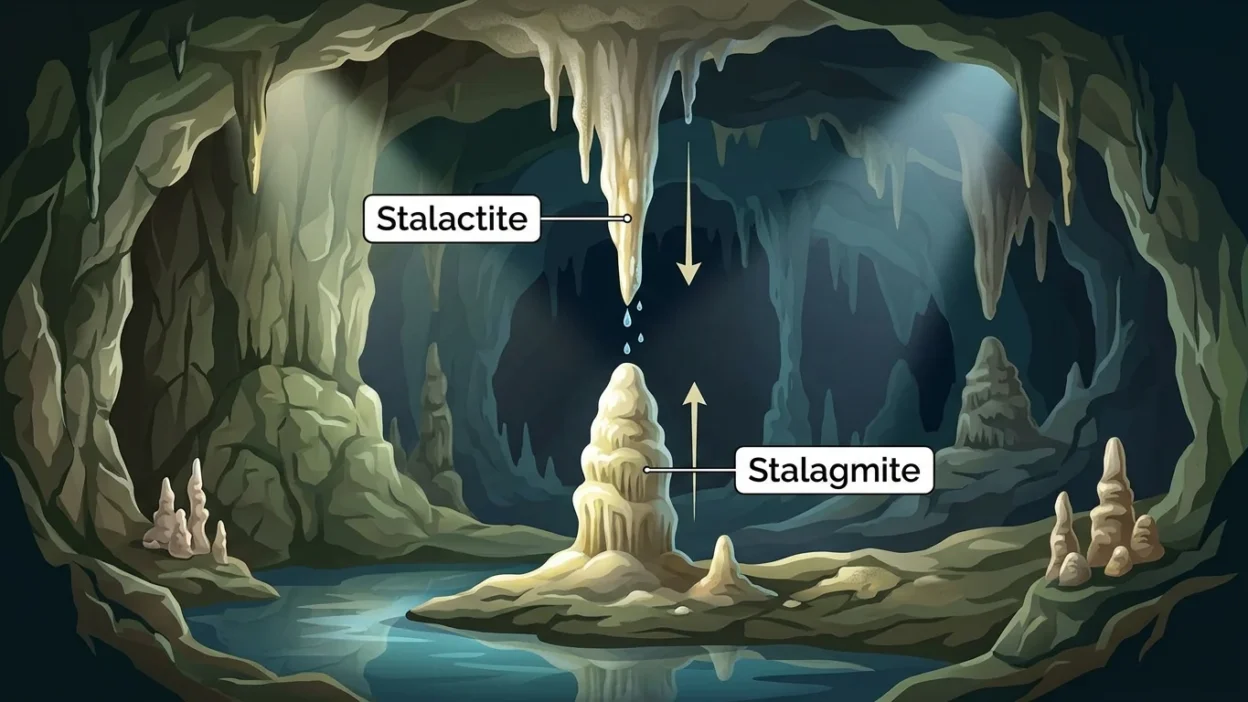
If you have ever wondered whether a cave formation is called a stalactite or a stalagmite, you are not alone. These two geological terms look and sound remarkably similar, and both describe mineral deposits that form inside caves. The main difference is surprisingly simple: stalactites hang from the ceiling, while stalagmites rise from the ground.
Knowing the difference becomes much easier when you connect each word with a simple memory trick. Stalactites grow downward from cave ceilings, while stalagmites grow upward from cave floors. Both usually form over long periods as mineral rich water deposits material onto the cave surface.
In this guide, you will learn the exact meanings of stalactite and stalagmite, how they form, how they differ, common examples, pronunciation, and an easy trick that will help you remember which is which.
Quick Answer
A stalactite is a mineral formation that hangs down from the ceiling of a cave. A stalagmite is a mineral formation that rises from the floor of a cave. Remember: stalactites hold tight to the ceiling, while stalagmites might reach the ceiling.
Why Do People Confuse Stalactite and Stalagmite?
The two words are easy to confuse because they are almost identical in spelling and pronunciation.
Both describe formations created by mineral deposits in caves, and both can be made primarily of calcium carbonate when they form in limestone caves.
The important difference is their direction of growth.
Stalactite: grows downward from the ceiling.
Stalagmite: grows upward from the floor.
They can eventually grow toward one another. If a stalactite and stalagmite eventually connect, they can form a column or pillar extending from the cave floor to the ceiling.
What Is a Stalactite?
A stalactite is a mineral deposit that hangs from the ceiling of a cave.
As mineral rich water moves through cracks in rock and reaches the cave ceiling, it can leave behind small amounts of dissolved minerals. Over a long period, these deposits can accumulate and form a hanging structure.
Simple Definition
Stalactite = a cave formation that hangs from the ceiling.
Examples
- The cave ceiling was covered with long stalactites.
- We carefully walked beneath a large stalactite.
- Water slowly dripped from the stalactite.
- The guide pointed to a thin stalactite above us.
- Some stalactites take thousands of years to develop.
- The cave contained hundreds of delicate stalactites.
- A large stalactite hung above the visitors.
- The scientists studied how the stalactite formed.
- The stalactites created unusual shapes across the cave ceiling.
- The tour guide warned us not to touch the stalactites.
What Is a Stalagmite?
A stalagmite is a mineral deposit that rises from the floor of a cave.
When mineral rich water drips from the cave ceiling onto the floor, it can leave mineral deposits behind. Over time, these deposits can build upward and create a stalagmite.
Simple Definition
Stalagmite = a cave formation that rises from the floor.
Examples
- A tall stalagmite stood in the middle of the cave.
- The guide showed us a huge stalagmite.
- Water dripped onto the top of the stalagmite.
- The cave floor contained several small stalagmites.
- Scientists measured the growth of the stalagmite.
- We saw a beautiful stalagmite near the cave entrance.
- The stalagmites formed unusual shapes on the cave floor.
- One stalagmite was nearly as tall as a person.
- The formation of stalagmites can take a very long time.
- Visitors were asked not to touch the stalagmites.
Stalactite vs Stalagmite Comparison Table
| Feature | Stalactite | Stalagmite |
|---|---|---|
| Location | Cave ceiling | Cave floor |
| Direction | Grows downward | Grows upward |
| Appearance | Hangs down | Rises up |
| Formation | Mineral deposits from water on the ceiling | Mineral deposits from water dripping onto the floor |
| Memory clue | Holds tight to the ceiling | Might reach the ceiling |
| Can they connect? | Yes | Yes |
| Common setting | Caves | Caves |
Stalactite vs Stalagmite: The Main Difference
The easiest way to understand the difference is to focus on where the formation starts.
A stalactite starts at the ceiling and grows downward.
A stalagmite starts at the floor and grows upward.
Think of the cave as having two surfaces:
Ceiling → stalactite ↓
Floor → stalagmite ↑
This simple visual relationship makes the distinction much easier to remember.
How Do Stalactites and Stalagmites Form?
Both formations generally develop through the movement of mineral rich water.
Rainwater can absorb carbon dioxide as it moves through soil and rock. In limestone regions, the water can dissolve small amounts of calcium carbonate from the rock.
When the water reaches a cave, changes in conditions can cause some of the dissolved material to be deposited.
For a stalactite, mineral deposits accumulate on the cave ceiling.
For a stalagmite, water drips onto the cave floor and leaves mineral deposits there.
Repeated deposition over long periods gradually produces the recognizable formations.
Can a Stalactite Become a Stalagmite?
A stalactite does not normally transform into a stalagmite.
Instead, a stalactite grows downward from the ceiling while a stalagmite grows upward from the floor.
If both continue growing toward each other, they may eventually meet and form a continuous mineral column.
This process can take a very long time and depends on factors such as water supply, mineral availability, temperature, and cave conditions.
What Happens When They Meet?
When a stalactite and stalagmite grow together and connect, they can form a column or pillar.
You can visualize the process like this:
Stalactite ↓
Stalagmite ↑
Together = column
This is one reason caves can contain impressive pillars that appear to connect the ceiling and floor.
Common Mistakes
1. Thinking Stalactites Grow Upward
This is the most common mistake.
Remember that a stalactite hangs from the ceiling.
2. Thinking Stalagmites Hang From the Ceiling
A stalagmite grows from the floor upward.
3. Thinking They Are Different Types of Rock
They are not simply two unrelated rock types. The terms describe the position and growth direction of mineral deposits in caves.
4. Assuming Every Cave Formation Is a Stalactite or Stalagmite
Caves can contain many other formations, including flowstones, columns, draperies, and other mineral deposits.
5. Forgetting Which One Starts at the Floor
If you remember only one thing, remember:
Stalagmite starts on the ground.
Easy Memory Trick
The most famous memory trick is:
Stalactites hold tight to the ceiling.
The word stalactite contains the letter C, which you can associate with ceiling.
Another useful trick is:
Stalagmites might reach the ceiling.
A stalagmite starts on the ground and grows upward, so it might eventually reach the ceiling.
The Short Version
Stalactite = Ceiling
Stalagmite = Ground
Or:
Stalactites come down. Stalagmites go up.
Stalactite vs Stalagmite Pronunciation
Both words are commonly pronounced with four syllables.
Stalactite: stuh LAK tite
Stalagmite: stuh LAG mite
The middle consonant sound helps distinguish them when spoken, but the spelling is still easy to mix up.
American vs British English
There is no major American versus British spelling difference between stalactite and stalagmite.
Both forms are standard in American and British English.
The definitions are also the same:
Stalactite: a formation hanging from a cave ceiling.
Stalagmite: a formation rising from a cave floor.
So unlike words such as traveling and travelling, this is not a regional spelling issue.
Stalactite vs Stalagmite vs Column
These terms describe related cave formations, but they are not interchangeable.
A stalactite grows from the ceiling downward.
A stalagmite grows from the floor upward.
A column can form when a stalactite and stalagmite eventually connect.
| Formation | Where It Grows |
|---|---|
| Stalactite | Ceiling downward |
| Stalagmite | Floor upward |
| Column | Connects floor and ceiling |
Similar Cave Formation Words
If you are interested in cave geology, you may also encounter these terms:
Flowstone: A sheet like mineral deposit formed when mineral rich water flows over cave surfaces.
Column: A formation created when a stalactite and stalagmite connect.
Drapery: A thin, curtain like mineral formation hanging from an inclined cave surface.
Cave pearl: A rounded mineral formation that develops around a nucleus in pools of water.
These formations are related to mineral deposition but are not the same thing as stalactites and stalagmites.
Examples in Everyday Writing
Here are some natural examples showing both words together:
- The cave was filled with stalactites and stalagmites.
- The guide explained the difference between a stalactite and a stalagmite.
- The stalactite hung from the ceiling while the stalagmite rose from the floor.
- Some caves contain enormous stalactites and stalagmites.
- The formation of stalactites and stalagmites can take thousands of years.
- We photographed the stalactites above us and the stalagmites below us.
- The cave’s stalactites and stalagmites created a dramatic landscape.
- A stalactite and stalagmite were growing toward each other.
- The museum displayed a sample of a stalagmite.
- The cave ceiling was covered with delicate stalactites.
FAQs
What is the difference between a stalactite and a stalagmite?
A stalactite hangs from the ceiling of a cave and grows downward. A stalagmite rises from the floor and grows upward.
Which one grows from the ceiling?
A stalactite grows from the ceiling.
Which one grows from the ground?
A stalagmite grows from the cave floor.
Do stalactites grow up or down?
Stalactites grow downward from the cave ceiling.
Do stalagmites grow up or down?
Stalagmites grow upward from the cave floor.
Can stalactites and stalagmites touch?
Yes. If they continue growing toward each other, they can eventually connect and form a column.
Are stalactites and stalagmites rocks?
They are mineral deposits or cave formations that commonly form through mineral deposition in caves. In limestone caves, calcium carbonate is often an important component.
What is the easiest way to remember stalactite and stalagmite?
Remember stalactite = ceiling and stalagmite = ground. You can also remember “stalactites hold tight to the ceiling” and “stalagmites might reach the ceiling.”
Final Verdict
Stalactite and stalagmite are both cave formations, but they grow in opposite directions.
A stalactite hangs from the ceiling, while a stalagmite rises from the floor.
The easiest memory trick is:
Stalactite = ceiling.
Stalagmite = ground.
Once you connect the words with their locations, you will have little reason to confuse them again.
Conclusion
The difference between stalactite and stalagmite is simple once you focus on direction. Stalactites form on cave ceilings and grow downward, while stalagmites form on cave floors and grow upward. Both can develop gradually as mineral rich water deposits material inside a cave.
If you struggle to remember which is which, use the classic memory tricks. Stalactites hold tight to the ceiling, while stalagmites might reach the ceiling. With that distinction in mind, these two commonly confused geological terms become much easier to understand and use correctly.
Remember This
Stalactite = ceiling = grows down.
Stalagmite = ground = grows up.
Think C for ceiling when you remember stalactite.

Nancy Lisa is a passionate writer and contributor at DrameyHut, focused on uncovering the deeper meanings behind dreams. She creates engaging and insightful content that helps readers interpret their dreams and understand their subconscious thoughts. Her work inspires self-reflection, clarity, and a stronger connection to inner emotions.