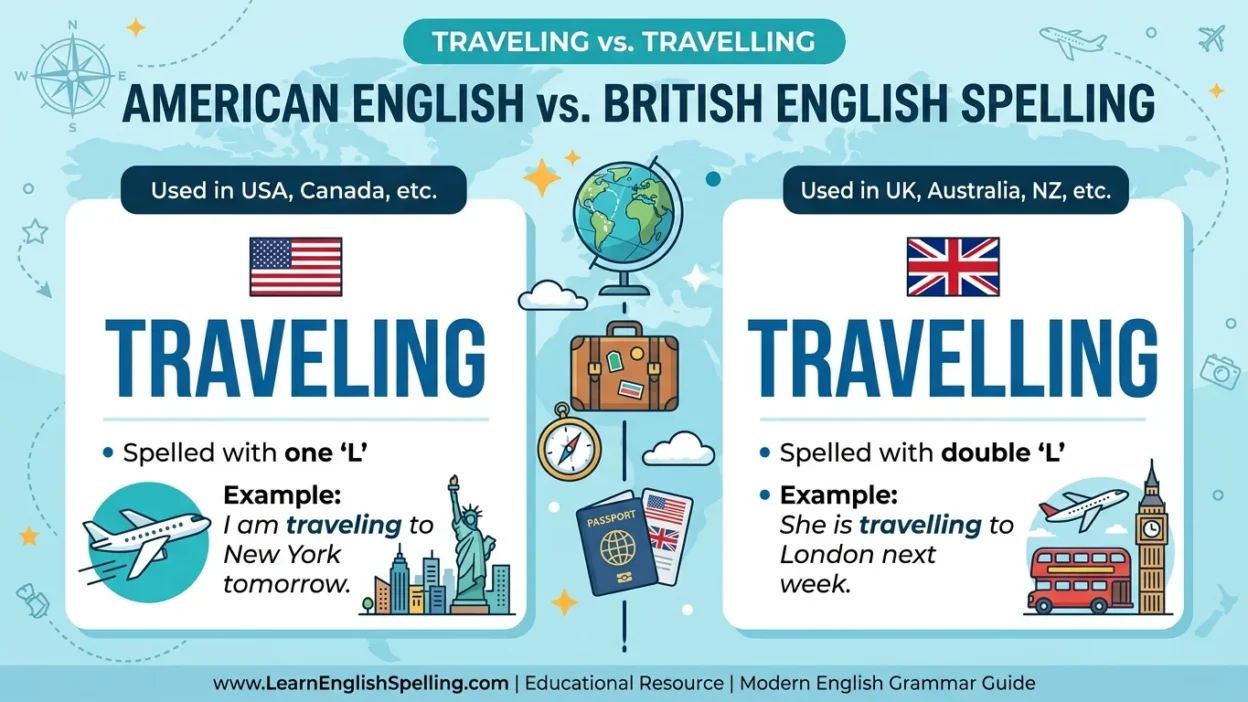
Traveling and travelling have the same meaning, but their spelling depends mainly on the variety of English you are using. Both forms are correct, so the choice is not about grammar. It is about regional spelling conventions.
If you use American English, traveling is the standard spelling. If you use British English, travelling is the standard form. The same difference appears in words such as traveled and travelled, traveler and traveller, and traveling and travelling.
Understanding this small spelling difference can help you write consistently, especially in school, professional, academic, and online writing. In this guide, we will explain the difference between traveling and travelling, show you how each form is used, and give you simple examples to remember the rule.
Quick Answer
Traveling is the standard American English spelling, while travelling is the standard British English spelling. Both mean the same thing and are grammatically correct. Use traveling for American English and travelling for British English.
Why Do People Confuse Traveling and Travelling?
The confusion comes from different spelling rules for words ending in a vowel followed by a consonant when adding ing.
The word travel becomes:
American English: traveling
British English: travelling
American English generally keeps one l in traveling, while British English traditionally doubles the l before adding ing.
The pronunciation and meaning remain the same.
Traveling
Traveling is the standard spelling in American English.
It is the present participle of travel and can also function as a gerund.
Examples
- I am traveling to New York next week.
- She enjoys traveling around the world.
- He is traveling for work this month.
- We spent the summer traveling through Europe.
- Traveling alone can be an exciting experience.
- They are traveling by train.
- I love traveling to new places.
- She has been traveling since June.
- He is traveling with his family.
- Traveling teaches you about different cultures.
In American English, you will also see related forms such as traveled and traveler.
Travelling
Travelling is the standard spelling in British English and many other varieties of English influenced by British spelling.
It has exactly the same meaning as traveling.
Examples
- I am travelling to London next week.
- She enjoys travelling around Europe.
- He is travelling for work.
- We spent the summer travelling through France.
- Travelling can be a wonderful way to learn.
- They are travelling by train.
- I love travelling to new places.
- She has been travelling since May.
- He is travelling with his friends.
- Travelling abroad can broaden your perspective.
In British English, you will also commonly see travelled and traveller.
Traveling vs Travelling Comparison Table
| Feature | Traveling | Travelling |
|---|---|---|
| Meaning | Moving from one place to another | Moving from one place to another |
| Standard variety | American English | British English |
| Spelling | One L | Two Ls |
| Pronunciation | Same | Same |
| Grammar | Correct | Correct |
| Past form | traveled | travelled |
| Noun for person | traveler | traveller |
| Used in British English | Less common | Standard |
| Used in American English | Standard | Less common |
When to Use Traveling
Use traveling when you are writing in American English.
This spelling is common in the United States and is also widely seen in international digital content because of the global influence of American English.
Examples
American English:
I am traveling to California tomorrow.
She enjoys traveling alone.
He traveled across the country last year.
If your document follows American spelling throughout, use traveling consistently.
When to Use Travelling
Use travelling when you are writing in British English.
This spelling is standard in the United Kingdom and is also commonly used in countries and regions that traditionally follow British English conventions.
Examples
British English:
I am travelling to Scotland tomorrow.
She enjoys travelling alone.
He travelled across the country last year.
The important thing is consistency. Do not switch between American and British spelling without a reason.
Why Does Traveling Have One L but Travelling Has Two?
This difference comes from spelling conventions.
American English often follows a simpler pattern with words like traveling, while British English traditionally doubles the final consonant in travelling.
Compare:
| American English | British English |
|---|---|
| traveling | travelling |
| traveled | travelled |
| traveler | traveller |
There are other spelling differences between American and British English, but this particular difference is especially noticeable because both forms remain very common.
Is Traveling or Travelling More Correct?
Neither is universally more correct.
Both spellings are correct in their respective varieties of English.
If you are following American English, choose traveling.
If you are following British English, choose travelling.
The most important rule is to maintain consistency within the same piece of writing.
Common Mistakes
1. Treating Travelling as Incorrect
Travelling is not a misspelling. It is the standard British spelling.
2. Treating Traveling as Incorrect
Traveling is not incorrect either. It is the standard American spelling.
3. Mixing Spelling Styles
Using traveling in one paragraph and travelling in another can make your writing look inconsistent.
Choose the spelling style that matches your intended variety of English.
4. Confusing Meaning
The two spellings do not have different meanings.
Traveling = travelling
The difference is spelling, not meaning.
Traveling vs Travelling in American and British English
This is primarily a regional spelling difference.
American English
American English uses:
traveling
traveled
traveler
British English
British English uses:
travelling
travelled
traveller
The same distinction can appear in other words derived from travel.
Traveling vs Travelling Pronunciation
Both words are pronounced the same way.
A simple pronunciation guide is:
traveling: TRAV uh ling
travelling: TRAV uh ling
The extra l in the British spelling does not create an extra syllable.
Traveling vs Travelling in Other English Speaking Countries
British style spelling is common in many countries that traditionally use British English, including the United Kingdom and several Commonwealth countries.
American English is particularly common in the United States.
However, English usage can vary by country, institution, publication, and style guide. When writing for a particular audience, follow the spelling convention expected by that audience.
Similar Words
The same American and British spelling pattern appears in several related words.
| American English | British English |
|---|---|
| traveling | travelling |
| traveled | travelled |
| traveler | traveller |
The meanings remain the same.
Memory Trick
Remember:
One L = American English
Two Ls = British English
You can think of traveling as the shorter American spelling and travelling as the traditional British spelling.
The key is not to memorize which one is “right.” Remember that both are right, depending on the English variety.
FAQs
Is traveling or travelling correct?
Both are correct. Traveling is standard American English, while travelling is standard British English.
Is travelling British or American?
Travelling is the standard British English spelling.
Is traveling American English?
Yes. Traveling is the standard American English spelling.
Do traveling and travelling mean the same thing?
Yes. They have exactly the same meaning. The difference is spelling.
Which spelling should I use in an American English article?
Use traveling.
Which spelling should I use in British English?
Use travelling.
Is traveled or travelled correct?
Both are correct. Traveled is standard American English, while travelled is standard British English.
Is traveler or traveller correct?
Both are correct. Traveler is standard American English, while traveller is standard British English.
Final Verdict
Traveling and travelling are both correct spellings of the same word.
Use traveling in American English and travelling in British English. The difference does not affect meaning or pronunciation.
The same pattern applies to traveled/travelled and traveler/traveller. When choosing between the two, simply follow the spelling convention of your intended audience and remain consistent.
Conclusion
The difference between traveling and travelling is a spelling difference rather than a difference in meaning or grammar. American English normally uses traveling, while British English normally uses travelling.
Once you know the regional spelling rule, the choice becomes easy. If your writing follows American English, use one L. If it follows British English, use two Ls. Both forms are widely recognized and completely correct in their appropriate variety of English.
Remember This
Traveling = American English
Travelling = British English
Same meaning, same pronunciation, different spelling convention.

Christopher Thomas is a passionate writer and dream researcher dedicated to exploring the meanings behind dreams. As an author at DrameyHut, he creates insightful and easy-to-understand interpretations that help readers connect with their subconscious mind. His work focuses on guiding individuals toward self-discovery, clarity, and a deeper understanding of their inner thoughts.