Spelling mistakes are common in English, especially when words sound exactly as we expect them to. One of the most frequent errors is writing messege instead of message.
If you’re sending an email, writing a text, posting on social media, or completing school or work assignments, using the correct spelling is important for clear and professional communication.
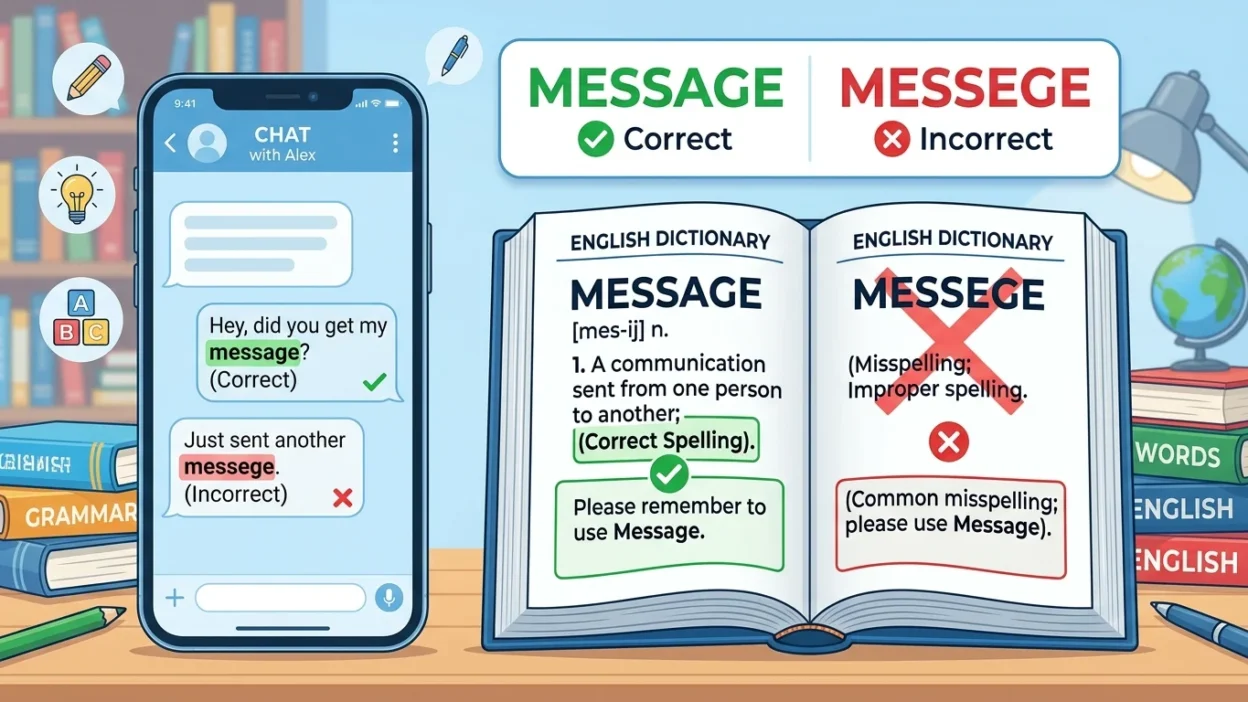
If you’ve ever wondered whether message or messege is correct, the answer is simple. Message is the only correct English spelling. Messege is a common misspelling and should never be used in formal or informal writing.
This guide explains the difference, why people make the mistake, and how to remember the correct spelling forever.
Quick Answer
Message is the correct spelling. It means a piece of written, spoken, or digital communication sent from one person to another. Messege is an incorrect spelling and is not recognized as a standard English word. Always use message in your writing.
Why People Confuse It
Many people accidentally write messege because:
- The word is pronounced quickly in everyday speech.
- English spelling does not always match pronunciation.
- The letters a and e are easy to mix up.
- Typing errors happen frequently on phones and keyboards.
- Spellings of similar words can create confusion.
Fortunately, remembering the correct spelling is easy with a simple trick.
First Word: Message
Message is a noun and sometimes a verb that refers to information sent from one person to another.
It can refer to:
- A text message
- An email
- A spoken communication
- A voicemail
- A social media message
- An important idea or lesson
Example Sentences
- I sent you a message this morning.
- Did you receive my message?
- The teacher shared an inspiring message with the class.
- Please leave a message after the beep.
- Her speech carried a powerful message of hope.
In every example, message refers to communication or information.
Second Word: Messege
Messege is not a correct English word.
It is simply a spelling mistake that appears because of typing errors or confusion about vowel placement.
Incorrect Examples
- I received your messege.
- Please send me a messege later.
- Thank you for your messege.
Each sentence should use message instead.
Message vs Messege Comparison Table
| Feature | Message | Messege |
| | | |
| Spelling | Correct | Incorrect |
| English Word | Yes | No |
| Dictionary Entry | Yes | No |
| Appropriate in Writing | Yes | No |
| Example | Send me a message. | Send me a messege. ✘ |
When to Use Each
Use message whenever you are talking about communication.
Examples include:
- Text message
- Email message
- Voice message
- Error message
- Welcome message
- Secret message
- Inspirational message
Never use messege because it is a spelling error.
Examples
Here are several examples showing the correct usage.
- I received your message this afternoon.
- Please reply to my message when you have time.
- She sent a birthday message to her friend.
- His speech delivered an important message.
- The app displayed an error message.
- Thank you for your thoughtful message.
- I accidentally deleted the message.
- Can you forward the message to the team?
- The welcome message appeared on the screen.
- She left a voice message while I was away.
- Every message should be polite and clear.
- The motivational message inspired everyone.
Common Mistakes
Incorrect:
- I got your messege.
Correct:
- I got your message.
Incorrect:
- Send me a messege tomorrow.
Correct:
- Send me a message tomorrow.
Incorrect:
- Thank you for the beautiful messege.
Correct:
- Thank you for the beautiful message.
Always remember that messege is not a valid English spelling.
Memory Trick
A simple trick makes the spelling easy to remember.
Think of the word:
Message = Mess + Age
The word contains age, not ege.
Another helpful reminder is that every messaging app, email service, and dictionary spells it message.
If you see messege, you know it is incorrect.
American vs British English
Both American English and British English use the exact same spelling.
The correct spelling is:
Message
There are no regional spelling differences.
Messege is incorrect in every English-speaking country.
Similar Words
Here are other commonly misspelled or confused English words.
- Receive and Recieve
- Separate and Seperate
- Message and Messege
- Believe and Beleive
- Tomorrow and Tommorow
- Performed and Preformed
- Faring and Fairing
- Affect and Effect
- Lose and Loose
- Principal and Principle
Learning these common spelling mistakes will improve your writing accuracy.
Final Verdict
The answer is simple.
Message is the correct spelling.
Messege is a spelling mistake and should never be used.
Whenever you write an email, text, letter, or online post, always choose message to ensure your writing looks professional and correct.
Frequently Asked Questions
Is message or messege correct?
Message is the correct spelling. Messege is incorrect.
Is messege an English word?
No. Messege does not appear in standard English dictionaries.
Why do people spell message as messege?
The mistake usually happens because of pronunciation, typing errors, or confusion about the vowels.
How do you spell text message?
The correct spelling is text message.
Is message spelled the same in American and British English?
Yes. Both varieties use the spelling message.
How can I remember the correct spelling?
Remember that message ends with age, not ege.
Is message a noun or a verb?
It is primarily a noun, but it can also be used as a verb, especially in modern English, meaning to send someone a message.
Remember This
Message is always correct.
Messege is always incorrect.
Whenever you write about communication, emails, texts, or notifications, use message.
Conclusion
The difference between message vs messege is straightforward because only one spelling is correct. Message is the standard English word used for written, spoken, or digital communication, while messege is simply a common spelling mistake. Using the correct spelling helps your writing appear more polished, credible, and professional.
If you’re ever uncertain, remember that message ends with age. If you’re sending a text, replying to an email, or writing an important document, choosing the correct spelling will ensure your communication is clear and errorfree.

Nancy Lisa is a passionate writer and contributor at DrameyHut, focused on uncovering the deeper meanings behind dreams. She creates engaging and insightful content that helps readers interpret their dreams and understand their subconscious thoughts. Her work inspires self-reflection, clarity, and a stronger connection to inner emotions.