
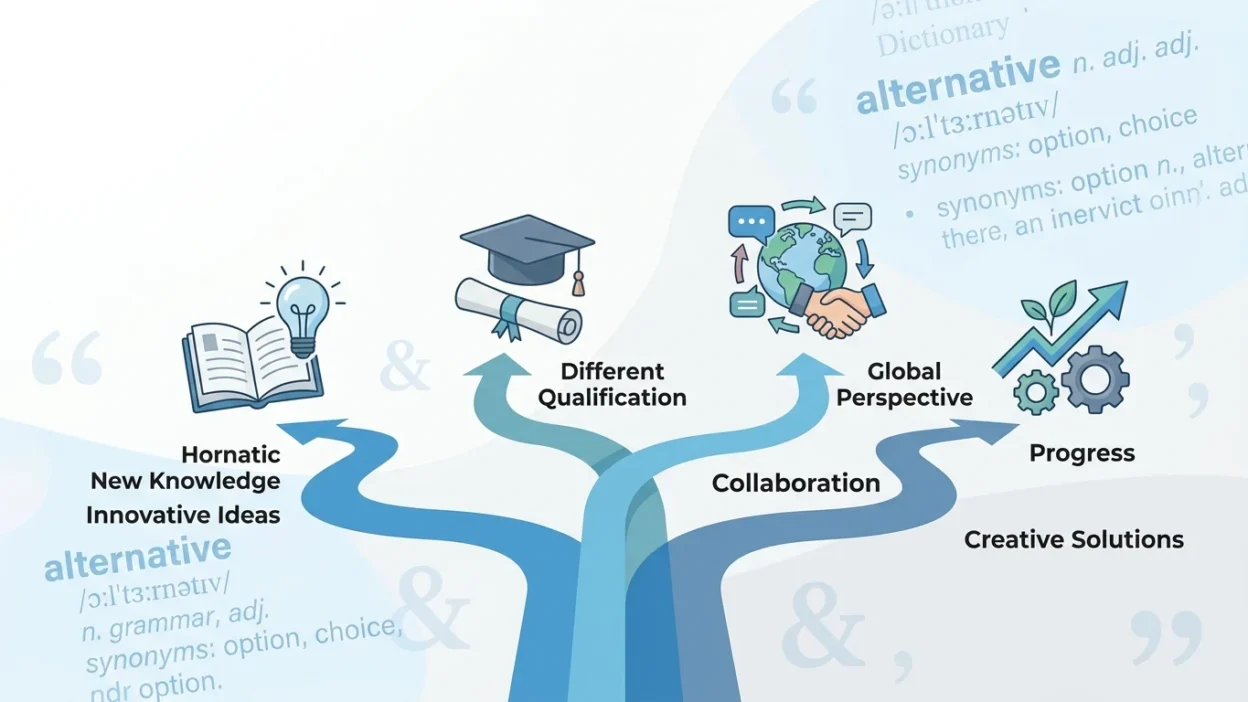
When you want to talk about another choice, option, method, or possibility, the word alternative is one of the most useful words in English. You might say, “We need an alternative plan,” “Is there an alternative to this method?” or “She chose an alternative solution.
” Although the meaning seems simple, many English learners are unsure about how to use alternative correctly, especially when choosing between alternative, option, choice, substitute, replacement, and another.
Understanding the exact meaning of alternative can make your English sound more natural and precise. It can be used as both a noun and an adjective, and its meaning can change slightly depending on the sentence. In this guide, you will learn how to use alternative correctly, when to use similar words, and which expressions are most natural in everyday American and British English.
Quick Answer
Alternative means another choice, possibility, or method that can be used instead of the original one. For example, “We need an alternative plan” means we need another plan. Similar words include option, choice, substitute, replacement, and another possibility.
Why People Confuse It
People often confuse alternative with words such as option, choice, substitute, and replacement because these words can all refer to something different from the original.
However, they are not always interchangeable.
For example:
We need an alternative solution.
This means another solution that could be used instead.
You could also say:
We have several options.
Here, options are the different possibilities available.
The distinction becomes even clearer when you compare alternative with substitute. A substitute usually takes the place of something specific, while an alternative is another possible choice or approach.
Another source of confusion is grammar. Alternative can function as both a noun and an adjective.
As a noun:
There is no alternative.
As an adjective:
We need an alternative approach.
Knowing how the word functions in a sentence will help you use it naturally.
First Word: Alternative
The word alternative generally refers to another possibility, choice, or method that can be considered instead of something else.
Alternative as a noun
As a noun, alternative means another choice or possibility.
Examples:
We need to find an alternative.
Is there an alternative to this plan?
The alternative was to stay home.
A common structure is:
an alternative to + noun
For example:
We need an alternative to traditional energy.
Another common structure is:
alternative to + gerund
Is there an alternative to driving?
Alternative as an adjective
As an adjective, alternative describes something that is different from the usual or original choice.
Examples:
We are looking for an alternative method.
She found an alternative solution.
They chose alternative accommodation.
In some contexts, alternative can also describe something outside the conventional mainstream.
For example:
He listens to alternative music.
Second Word: Option
Option means one of several things that you can choose.
It is often the most natural word when talking about available choices.
Examples:
We have three options.
This is the best option for us.
You can choose either option.
The key difference is that option focuses on a choice that is available, while alternative often emphasizes another possibility instead of something already considered.
Compare:
We have three options.
This simply tells us that three choices are available.
We need an alternative to our current plan.
This suggests that the current plan is not suitable or that another possibility is being considered.
Comparison Table
| Word | Main Meaning | Typical Use | Example |
|---|---|---|---|
| Alternative | Another possibility or method | Something used instead | We need an alternative plan. |
| Option | A choice that is available | Choosing between possibilities | This is our best option. |
| Choice | The act or result of choosing | Decisions and preferences | That was a difficult choice. |
| Substitute | Something used in place of another | Replacing something temporarily or practically | Yogurt can be a substitute for cream. |
| Replacement | Something that takes the place of another | Replacing an existing person or thing | We need a replacement part. |
| Another | One more or a different one | General everyday usage | Let’s try another method. |
| Backup | A secondary choice prepared in case the first fails | Plans and contingencies | We need a backup plan. |
When to Use Each
Choosing the right word depends on what you mean.
Use alternative for another possibility
Use alternative when you want to present another method, solution, plan, or possibility.
We need an alternative approach.
Is there an alternative solution?
Use option for an available choice
Use option when several possibilities are available.
You have two options.
Which option do you prefer?
Use choice for a decision
Use choice when focusing on the act or result of choosing.
It was a difficult choice.
You made the right choice.
Use substitute for something used instead
Use substitute when one thing is used in place of another.
Honey can be used as a substitute for sugar.
Use replacement for something that takes the place of another
Use replacement when the original thing is being replaced.
We ordered a replacement keyboard.
Use another for general everyday situations
Another is much more general and often sounds more natural in casual conversation.
Let’s try another restaurant.
Can I have another cup of coffee?
Examples
Here are more than ten natural examples showing how alternative works in different contexts.
- We need an alternative plan in case the weather gets worse.
- Is there an alternative to this expensive treatment?
- She suggested an alternative solution to the problem.
- Walking is a healthy alternative to driving.
- The company is looking for alternative sources of energy.
- We had no alternative but to cancel the event.
- They are considering several alternative approaches.
- Can you suggest an alternative method?
- This website provides an alternative way to learn English.
- We need to find an alternative route to the airport.
- Solar power is becoming an alternative to traditional energy sources.
- He refused to accept the proposal and asked for an alternative.
- There is no easy alternative to hard work.
- The teacher gave students an alternative assignment.
- We should consider every alternative before making a decision.
These examples show that alternative commonly appears with words such as solution, plan, method, approach, route, source, option, and possibility.
Common Mistakes
Mistake 1: Using alternative when you mean replacement
Not every replacement is an alternative.
Incorrect or unnatural: I bought an alternative phone because my old one broke.
If you mean a new phone that replaces the old one, replacement is usually better.
I bought a replacement phone.
But if you mean a different phone choice, alternative can work:
I chose an alternative phone model.
Mistake 2: Confusing alternative with option
These words overlap, but they are not identical.
We have three options.
sounds more natural when listing available choices.
We need an alternative to this option.
Here, alternative means another possibility.
Mistake 3: Using “alternative of”
The usual construction is:
alternative to
For example:
Is there an alternative to this approach?
Not:
Is there an alternative of this approach?
Mistake 4: Assuming alternative always means better
An alternative is simply another possibility. It does not necessarily mean that it is better.
We found an alternative solution.
This does not automatically mean the new solution is superior.
Mistake 5: Confusing alternative with “alternate”
Alternative and alternate are related but have different common uses.
Alternative usually means another possibility or choice.
We need an alternative plan.
Alternate commonly means happening by turns or occurring every other time.
We take alternate routes to work.
Memory Trick
Here is an easy way to remember the difference:
Alternative = another possibility
Option = a choice available
Substitute = something used instead
Replacement = something that takes the place of the original
Backup = something prepared in case the first choice fails
Think of a restaurant.
If your favorite meal is unavailable, the waiter might say:
“Would you like an alternative?”
The menu gives you several options.
You might choose a different meal as a substitute.
If the restaurant permanently removes your favorite meal, another meal could become its replacement.
If you planned to eat there but prepared another restaurant in advance, that restaurant is your backup.
American vs British English
Alternative is standard in both American and British English.
There is no major difference in the basic meaning or spelling.
For example, both American and British speakers commonly say:
We need an alternative solution.
Is there an alternative to this method?
We are looking for an alternative approach.
However, everyday preferences can vary slightly depending on context. In casual American English, another, different, or option may sometimes sound more conversational than alternative.
For example:
Let’s try another way.
can sound more natural in casual conversation than:
Let’s try an alternative way.
In formal writing, business communication, academic writing, and technical contexts, alternative is extremely common.
Similar Words
Several words are closely related to alternative.
Another
Another means one more or a different one.
Let’s try another restaurant.
It is very common in everyday English.
Different
Different means not the same.
We need a different approach.
This can often replace alternative in informal conversation.
Option
Option refers to something available to choose.
We have several options.
Choice
Choice can refer to the act of choosing or the thing chosen.
That was a difficult choice.
Substitute
A substitute is something used instead of another thing.
Tofu can be a substitute for meat.
Replacement
A replacement takes the place of an existing person or thing.
We ordered a replacement battery.
Backup
A backup is an additional plan or resource prepared in case the primary one fails.
Always keep a backup plan.
Equivalent
An equivalent is something that has the same or similar value, function, or meaning.
We need an equivalent alternative.
These words may overlap, but choosing the most precise one makes your English clearer.
FAQs
What does alternative mean in simple English?
Alternative means another choice, possibility, or method that can be used instead of something else.
What is an example of an alternative?
An example is choosing public transportation as an alternative to driving. Public transportation provides another way to travel.
What is the difference between alternative and option?
An option is a choice that is available. An alternative usually refers to another possibility, especially one considered instead of an existing choice or method.
Is alternative a noun or an adjective?
Alternative can be both a noun and an adjective. For example, “We need an alternative” uses it as a noun, while “an alternative method” uses it as an adjective.
Is it alternative to or alternative of?
The standard expression is alternative to.
For example:
We need an alternative to this plan.
What is a synonym for alternative?
Common synonyms include option, choice, possibility, substitute, another method, different approach, and replacement, depending on the context.
Is alternative formal English?
Yes. Alternative is standard English and is especially common in formal, academic, professional, and technical writing. It is also normal in everyday conversation.
Can alternative mean different?
Sometimes. In contexts involving another method, approach, or possibility, alternative can have a similar meaning to different. However, the two words are not always interchangeable.
Final Verdict
Alternative is a flexible English word meaning another possibility, choice, method, or solution. It can function as both a noun and an adjective, making it useful in everyday conversation as well as professional and academic writing.
The most important expression to remember is alternative to. When you need to talk about another way of doing something, an alternative is often the perfect word. Just remember that option focuses on available choices, substitute focuses on something used instead, and replacement focuses on something taking the place of the original.
Remember This
Alternative = another possibility or method.
Use alternative to when discussing something that can be used instead of another thing.
We need an alternative to our current plan.
Use option when talking about choices.
We have three options.
Use substitute when something is used in place of another thing.
Milk can be a substitute for cream.
Use replacement when something takes the place of an existing thing.
We need a replacement battery.
Once you understand these small differences, choosing between alternative, option, choice, substitute, replacement, and another becomes much easier.
Conclusion
The word alternative is one of the most useful terms for expressing another possibility, method, solution, or choice. Although it overlaps with words such as option, choice, substitute, and replacement, each word has its own focus and natural context.
For clear and natural English, think about what you are trying to express. If you mean another possible approach, use alternative. If you mean an available choice, use option. If something is being used in place of another, use substitute, and if it takes the place of an existing item, replacement is usually the better word.

Daniel Charles is a dedicated author and dream interpretation enthusiast at DrameyHut. He specializes in analyzing dream symbols and meanings, offering clear and insightful content for readers. His work aims to help individuals understand their subconscious thoughts, gain clarity, and explore the deeper messages hidden within their dreams.